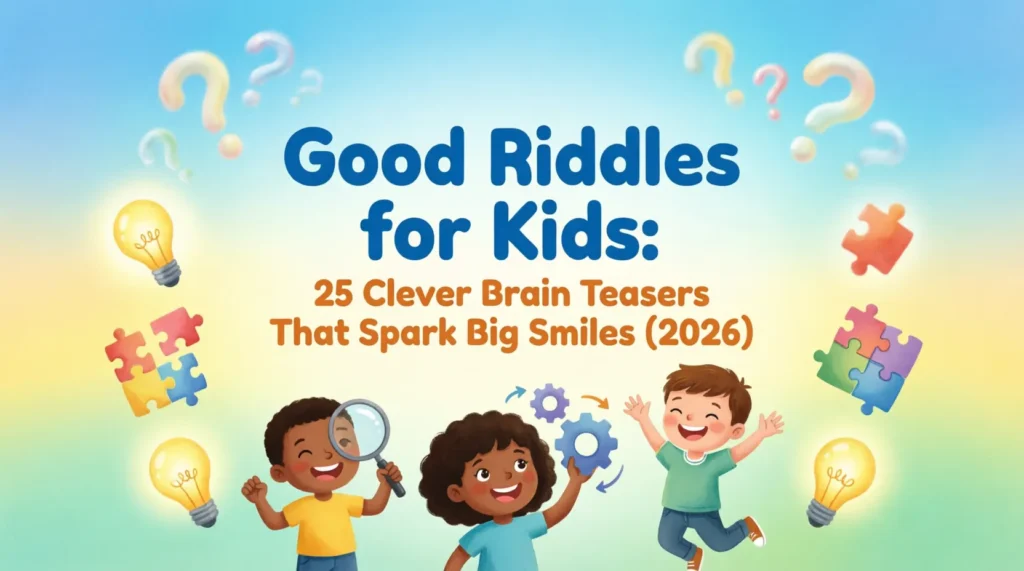
In short, good riddles for kids are playful brain teasers that mix laughter, curiosity, and simple problem-solving into one fun activity. They’re perfect for classrooms, family game nights, road trips, parties, and quiet afternoons when you want kids to think creatively while having fun. Scroll down and see how many your kids can solve before they burst out laughing.
Why Good Riddles for Kids Are More Powerful Than You Think
Kids love surprises, and riddles are built entirely around surprise. A child hears a question, starts guessing, gets tricked a little, and then suddenly lands on the answer with a giant grin. That tiny “aha!” moment feels exciting because it rewards curiosity and creative thinking at the same time.
Educators and child development researchers often point to riddles as a simple way to strengthen language skills, memory, and flexible thinking. When kids work through a clever puzzle, they practice connecting ideas instead of memorizing facts. That makes learning feel more like play than homework.
Studies show that playful problem-solving activities can improve attention span and verbal reasoning in elementary-age children. That’s one reason teachers, parents, and youth leaders keep turning to good riddles for kids during lessons, transitions, and group activities.
Riddles also create connection. Whether you’re sitting at the dinner table, waiting in the car line, or trying to calm a noisy classroom, a funny riddle instantly gives everyone something to focus on together. Across cultures around the world, riddles have long been used to teach wisdom, humor, and quick thinking in a way kids naturally enjoy.
What Makes a Great Good Riddles for Kids
A great kids’ riddle should challenge children just enough without making them feel stuck. If the answer is too obvious, kids lose interest fast. If it’s too confusing, they stop trying. The sweet spot is a playful twist that makes them laugh once they finally understand it.
The best good riddles for kids usually rely on simple wordplay, funny observations, or unexpected meanings. Kids especially enjoy riddles about animals, food, school, weather, and everyday objects because they already understand those topics. Familiar ideas help them focus on the puzzle instead of struggling with vocabulary.
Another important ingredient is clean humor. Young readers respond best to silly surprises, harmless tricks, and imaginative thinking. A riddle about a banana wearing shoes or a sleepy dinosaur feels much more exciting to a child than a complicated logic puzzle designed for adults.
Psychologists who study learning through play often explain that children remember information better when emotion is involved. That’s why a funny answer sticks in a kid’s memory longer than a plain fact from a worksheet.
The final secret is the payoff. A satisfying riddle makes kids say, “Ohhhh, now I get it!” That reaction keeps them eager to hear the next one.
Good Riddles for Kids: 25 Riddles to Try Right Now
Funny Everyday Riddles
Riddle: What gets wetter every time it dries something?
Answer: A towel
Riddle: What kind of room has no doors, no windows, and no floor?
Answer: A mushroom
Riddle: What runs around a playground but never gets tired?
Answer: A fence
Riddle: What has hands but can never clap?
Answer: A clock
Riddle: What jumps higher when it’s colder?
Answer: Popcorn
Riddle: What can follow you everywhere but never passes you?
Answer: Your shadow
Riddle: What gets bigger the more you take away from it?
Answer: A hole
Riddle: What kind of tree can fit in your hand?
Answer: A palm tree
Riddle: Why did the pencil go to bed early?
Answer: It was feeling pointless
Animal Riddles for Kids
Riddle: What animal is the best at hiding in school?
Answer: A cheetah because it’s always spotted
Riddle: What kind of lion never roars?
Answer: A dandelion
Riddle: What animal loves fast food the most?
Answer: A cheetah
Riddle: Why are fish so smart?
Answer: Because they live in schools
Riddle: What bird can lift the heaviest things?
Answer: A crane
Riddle: What do you call a sleeping bull?
Answer: A bulldozer
School and Learning Riddles
Riddle: What subject is a snake best at in school?
Answer: Hiss-tory
Riddle: What kind of math do birds love?
Answer: Owl-gebra
Riddle: Why did the notebook look sad?
Answer: Because it had too many problems
Riddle: What has lots of words but never speaks?
Answer: A book
Riddle: What can you catch in class but never throw?
Answer: A yawn
Food and Kitchen Riddles
Riddle: Why did the cookie visit the nurse?
Answer: Because it felt crummy
Riddle: What kind of key opens a banana?
Answer: A monkey
Riddle: What food loves to tell jokes?
Answer: A funny bone soup
Riddle: Why did the orange stop halfway up the hill?
Answer: It ran out of juice
Nature and Outdoor Riddles
Riddle: What falls but never gets hurt?
Answer: Snow
Riddle: What kind of rain is afraid of the sun?
Answer: Light rain
Riddle: What has a face but never smiles?
Answer: The moon
🎯 More Good Riddles for Kids: 25 Clever Brain Teasers That Spark Big Smiles (2026): Easy, Medium, and Hard Challenges
Easy Riddles for Good Riddles for Kids: 25 Clever Brain Teasers That Spark Big Smiles (2026) (Grades 6–7)
These easy riddles are perfect for grades 6–7 and help build confidence through observation and clever wordplay.
Riddle: I have four corners, but I am not a square. I carry stories wherever I go. What am I? Answer: A book.
Riddle: The more classmates write on me, the cleaner I become. What am I? Answer: A whiteboard.
Riddle: I always travel with your shoes, but I never take a step. What am I? Answer: Your shadow.
Riddle: I can be opened without a key and closed without a lock. You use me every day to learn. What am I? Answer: A notebook.
Riddle: I have pages but never read. I can be full of numbers or drawings. What am I? Answer: A workbook.
Riddle: I get shorter every time you use me, but I help your ideas grow. What am I? Answer: A pencil.
Medium Riddles for Good Riddles for Kids: 25 Clever Brain Teasers That Spark Big Smiles (2026) (Grades 7–8)
These medium-level riddles are best for grades 7–8 and encourage students to think through clues one step at a time.
Riddle: Two friends start reading the same 200-page book at the same time. One reads 20 pages each day, and the other reads 10. When will they be reading the same page again? Answer: Never, unless one stops and waits for the other.
Riddle: I have no wheels, yet I can race across a classroom in seconds. I make everyone turn their heads when I arrive. What am I? Answer: A rumor or a surprising announcement.
Riddle: I can fill an entire room without taking up any space. What am I? Answer: Light.
Riddle: You use me before a test and after a mistake. I help you improve but cannot speak. What am I? Answer: Feedback.
Riddle: Three students share eight markers equally without breaking any marker. One marker remains in its box. How is this possible? Answer: Two students receive three markers each, one student receives two, totaling eight, with one set still inside its original box when handed over.
Riddle: I am something you can lose every time you learn something new. What am I? Answer: A misconception.
Riddle: The more carefully you listen to me, the less I say. What am I? Answer: Silence.
Hard Riddles for Good Riddles for Kids: 25 Clever Brain Teasers That Spark Big Smiles (2026) (Grade 8 and Up)
These harder riddles are designed for grade 8 and up and reward creative thinking and clever reasoning.
Riddle: I am borrowed by everyone but owned by no one. People use me every day without asking. What am I? Answer: Time.
Riddle: I grow whenever you divide me and disappear when you stop sharing me. What am I? Answer: Knowledge.
Riddle: I can change my meaning simply by changing where I stand in a sentence. What am I? Answer: A word.
Riddle: I am always ahead of you, yet you can never catch me. If I arrive, I become something else. What am I? Answer: Tomorrow.
Riddle: You can carry me for years without feeling my weight, but one sentence can make me disappear. What am I? Answer: A misunderstanding.
Riddle: I become larger every time someone removes something from me. What am I? Answer: A gap in a line or a growing opening.
Riddle: I can be measured, wasted, saved, and spent, but no one has ever held me in their hand. What am I? Answer: Time.
Using different difficulty levels makes it easy to match riddles to students’ confidence and abilities. Try beginning with easy challenges and gradually introducing harder ones to encourage collaboration and creative problem-solving.
📚 Subject-Specific Good Riddles for Kids: 25 Clever Brain Teasers That Spark Big Smiles (2026): Math, Science, and More
Math Riddles for Good Riddles for Kids: 25 Clever Brain Teasers That Spark Big Smiles (2026)
These math riddles make numbers, shapes, and patterns feel like fun puzzles to solve.
Riddle: I am an odd number. Remove one letter from my name, and I become even. What number am I? Answer: Seven.
Riddle: I have three sides and three corners, but I can look very different each time you draw me. What am I? Answer: A triangle.
Riddle: Double me once and I become twelve. What number am I? Answer: Six.
Riddle: I always follow 9 when counting by tens but never when counting by ones. What am I? Answer: Zero.
Riddle: I can be whole, cut into pieces, or written with a line between two numbers. What am I? Answer: A fraction.
Science Riddles for Good Riddles for Kids: 25 Clever Brain Teasers That Spark Big Smiles (2026)
These science-themed riddles connect everyday observations with exciting scientific ideas.
Riddle: I help plants make food, but I am 93 million miles away. What am I? Answer: The Sun.
Riddle: I have no shape of my own, yet I can become ice, rain, or steam. What am I? Answer: Water.
Riddle: I am the largest organ of your body and work every day to protect you. What am I? Answer: Your skin.
Riddle: I cannot be seen, but I can move leaves, fly kites, and power turbines. What am I? Answer: Wind.
Riddle: I live in every breath you take and help your body release energy from food. What am I? Answer: Oxygen.
Language Riddles for Good Riddles for Kids: 25 Clever Brain Teasers That Spark Big Smiles (2026)
These language riddles play with letters, words, and meanings to build vocabulary and curiosity.
Riddle: Remove my first letter and I still sound the same. Remove my last letter and I still sound the same. Remove both, and I still sound the same. What word am I? Answer: Empty.
Riddle: I am a word that becomes shorter when you add two letters to me. What am I? Answer: Short.
Riddle: What five-letter word becomes longer when you add two letters? Answer: Longer.
Riddle: I begin every sentence but appear only once in every alphabet. What am I? Answer: The letter S.
Riddle: I can ask a question without saying a word. What am I? Answer: A question mark.
Use subject-specific riddles as five-minute warm-up activities before beginning a lesson.
Turn them into exit tickets that encourage students to explain how they reached their answers.
Divide students into small groups and challenge them to write their own subject-themed riddles to share with the class.
🎯 More Good Riddles for Kids: Easy, Medium, and Hard Challenges
Easy Riddles for Good Riddles for Kids (Grades 6–7)
These easy riddles are great for younger middle schoolers who enjoy simple wordplay and careful observation.
Riddle: I have a face that changes every day, but I never smile or frown. What am I? Answer: A calendar
Riddle: The more classmates join me, the bigger I become, but I never gain weight. What am I? Answer: A group photo
Riddle: I follow you around school all day, but I disappear when the lights go out. What am I? Answer: Your shadow
Riddle: I can be cracked, told, played, or shared, but I am not a game. What am I? Answer: A joke
Riddle: I have corners and pages, but I’m not a building. What am I? Answer: A book
Riddle: You can erase me, write on me, and fill me with ideas, but I’m not alive. What am I? Answer: A notebook
Medium Riddles for Good Riddles for Kids (Grades 7–8)
These medium-level riddles require a bit more reasoning and are perfect for students ready to think through clues step by step.
Riddle: Mia has three brothers. Each brother has one sister. How many sisters are there in the family? Answer: One sister
Riddle: A classroom clock strikes once at 1:00, twice at 2:00, and so on. How many times does it strike by 6:00? Answer: 21 times (1+2+3+4+5+6)
Riddle: I grow shorter every time someone uses me, but I still help people see. What am I? Answer: A candle
Riddle: Two students start reading the same book at the same time. One reads 20 pages a day and the other reads 30 pages a day. The book has 300 pages. Who finishes first? Answer: The student reading 30 pages a day
Riddle: I have many stories but no characters, many levels but no video game. What am I? Answer: A building
Riddle: If three pencils can write for three hours, how long can one pencil write? Answer: Three hours
Riddle: I become larger when you remove one of my letters. What am I? Answer: The word “large” (remove the “l” to get “arge,” which sounds like “larger” in the riddle’s wordplay context)
Hard Riddles for Good Riddles for Kids (Grade 8 and Up)
These challenging riddles use clever misdirection and abstract thinking for older students.
Riddle: You enter a room with one match, a candle, a lamp, and a fireplace. What do you light first? Answer: The match
Riddle: I can be broken before I am ever used. What am I? Answer: A promise
Riddle: A student looks at a photograph and says, “I have no brothers or sisters, but this person’s father is my father’s son.” Who is in the photograph? Answer: The student’s son
Riddle: The more accurately you describe me, the less likely I am to remain the same. What am I? Answer: The future
Riddle: I am always somewhere between where you were and where you are going. What am I? Answer: The present moment
Riddle: Three friends share a secret. The first tells nobody. The second tells one person. The third tells two people. Who helped keep the secret best? Answer: The first friend
Riddle: What can make a correct answer become wrong without changing the answer itself? Answer: A different question
Tip for teachers and parents: Start with easy riddles to build confidence, then gradually increase the challenge level as students become more comfortable explaining their reasoning. Mixing difficulty levels also encourages collaboration, since different students may excel at different types of puzzles.
📚 Subject-Specific Good Riddles for Kids: Math, Science, and More
Math Riddles for Good Riddles for Kids
These math-themed riddles make numbers, patterns, and shapes feel like fun puzzles.
Riddle: I am an odd number. Remove one letter and I become even. What number am I? Answer: Seven
Riddle: I have four equal sides and four right angles. Who am I? Answer: A square
Riddle: What comes next in this pattern: 2, 4, 8, 16, __? Answer: 32
Riddle: Two digits together make me. Reverse my digits and my value decreases by 27. I am 63. What happens when reversed? Answer: It becomes 36
Riddle: I can be measured but not touched. Every circle has me around its edge. What am I? Answer: Circumference
Science Riddles for Good Riddles for Kids
These science riddles connect everyday observations with important scientific ideas.
Riddle: I travel from the Sun to Earth in about eight minutes, helping you see everything around you. What am I? Answer: Sunlight
Riddle: I am a force that keeps your feet on the ground and planets in orbit. What am I? Answer: Gravity
Riddle: Plants use me to make food, and animals breathe me out. What am I? Answer: Carbon dioxide
Riddle: I can be solid, liquid, or gas depending on temperature. What am I? Answer: Water
Riddle: I rumble in the sky after a flash of light during a storm. What am I? Answer: Thunder
Language Riddles for Good Riddles for Kids
These wordplay riddles encourage students to think about letters, vocabulary, and language in creative ways.
Riddle: What five-letter word becomes shorter when you add two letters to it? Answer: Short
Riddle: Which English word still sounds the same even if you remove four of its five letters? Answer: Queue
Riddle: I begin with “e,” end with “e,” and usually contain only one letter. What am I? Answer: An envelope
Riddle: What word becomes a different word each time you remove a letter: start, star, tar, ar, a? Answer: Start
Riddle: I am a word that means “not moving,” but when you add one letter, I mean “still happening.” What am I? Answer: Still → Stillness is not correct; the intended answer is “still” becoming “ongoing” with added context, illustrating vocabulary change
Ideas for Teachers
Use one subject-specific riddle as a daily warm-up to spark curiosity before a lesson.
Turn riddles into exit tickets and have students explain how they found the answer.
Create small-group challenge stations where students solve and discuss riddles related to the current unit of study.
How to Use Good Riddles for Kids for Maximum Fun
Use them during car rides to turn “Are we there yet?” into a guessing game.
Add one riddle to morning classroom routines to wake up kids’ brains.
Turn dinner time into “family riddle night” where everyone gets a chance to ask one.
Hide riddles inside treasure hunts or birthday party games.
Use riddles as reading warmups before homework or story time.
Let kids invent their own riddles after hearing a few examples.
One reason good riddles for kids work so well is that they fit almost anywhere. You don’t need screens, supplies, or a big setup. A single clever question can instantly shift the mood of a room from bored to excited.
Teachers often use riddles to encourage shy students to participate because there’s less pressure than answering a direct academic question. At home, you can use riddles to create tiny moments of connection throughout the day. Even one or two playful questions before bedtime can become a family tradition kids remember for years.
Tips for Sharing Good Riddles for Kids Without Spoiling the Fun
The best way to tell a riddle is slowly. Give kids time to think before jumping in with hints. If you rush to the answer too quickly, they miss the fun part of solving it themselves.
Watch your audience carefully. Younger children usually enjoy visual clues and silly themes, while older kids love clever twists and trick questions. If a riddle feels too difficult, you can guide them with small hints instead of revealing the answer right away.
You should also celebrate funny wrong answers. Sometimes the guesses become even more entertaining than the real solution. Keeping the mood light encourages kids to stay curious instead of worrying about being correct.
A little dramatic pause before the answer also makes the payoff stronger. That moment of suspense is half the fun.
Bonus: Good Riddles for Kids That Stump Everyone
These bonus riddles are a little trickier than the main list. They still stay kid-friendly, but the answers require sharper observation and more creative thinking. Even adults sometimes get caught by these clever twists.
Riddle: What has four wheels and flies?
Answer: A garbage truck
Riddle: What can travel all around the world while staying in one corner?
Answer: A stamp
Riddle: What begins with T, ends with T, and has tea inside?
Answer: A teapot
Riddle: What comes once in a minute, twice in a moment, and never in a year?
Answer: The letter M
Riddle: What has many teeth but never bites?
Answer: A zipper
Riddle: What kind of band never plays music?
Answer: A rubber band
Riddle: What can you break without touching it?
Answer: A promise
FAQs About Good Riddles for Kids
What age group are good riddles for kids best for?
Most kids between ages 6 and 12 enjoy riddles the most because they’re developing stronger reading and reasoning skills. Younger children usually prefer simple, silly riddles, while older kids enjoy trickier wordplay and logic twists.
How hard should good riddles for kids be?
A good kids’ riddle should feel challenging but still solvable after a little thinking. If children can eventually figure out the answer with a hint or two, you’ve probably found the perfect difficulty level.
Can good riddles for kids help with learning?
Yes, they absolutely can. Educators often use riddles to improve vocabulary, listening skills, memory, and creative thinking. Because riddles feel playful, kids stay engaged much longer than they might during traditional drills or worksheets.
Are good riddles for kids useful in classrooms?
Teachers frequently use riddles as warmups, transition activities, and group challenges. They help students focus attention quickly while creating a fun classroom atmosphere that encourages participation.
What makes good riddles for kids different from adult riddles?
Kids’ riddles focus more on imagination, simple logic, and clean humor. Adult riddles are often more abstract or complicated, while children’s riddles are designed to feel approachable, funny, and rewarding.
Final Thoughts: Keep the Fun Going with Good Riddles for Kids
There’s a reason riddles have stayed popular for generations. They turn ordinary moments into playful challenges that make kids think, laugh, and connect with the people around them.
The best part is how easy they are to use. You can pull out a riddle during a long drive, a rainy afternoon, a classroom break, or a family dinner and instantly create energy in the room.
Over time, these little brain teasers can help kids grow more confident with language, observation, and creative thinking. More importantly, they create shared moments of laughter that children genuinely remember.
So go ahead and test a few of these good riddles for kids today — because sometimes one clever question is all it takes to light up a child’s imagination.
Frequently Asked Questions
Why are riddles considered beneficial for kids' learning?▼
Riddles help strengthen language skills, memory, and flexible thinking by encouraging kids to connect ideas rather than just memorize facts. This playful problem-solving approach makes learning feel more engaging and fun.
What types of riddles do kids enjoy the most?▼
Kids particularly enjoy riddles that involve animals, food, school, weather, and everyday objects, as these topics are familiar to them. This familiarity allows them to focus on solving the puzzle without struggling with complex vocabulary.
How can riddles be used in educational settings?▼
Teachers and youth leaders often incorporate riddles into lessons, transitions, and group activities to foster engagement and connection among students. Riddles can serve as a fun way to capture attention and prompt creative thinking.
What makes a riddle effective for kids?▼
An effective riddle should strike a balance between being challenging and accessible, providing a playful twist that leads to a satisfying ‘aha!’ moment. Clean humor and simple wordplay are key elements that keep kids interested and laughing.
How do riddles contribute to emotional learning in children?▼
Riddles evoke emotion through humor and surprise, which helps kids remember information better. The excitement of solving a funny riddle creates a memorable learning experience that sticks with them longer than traditional facts.
Can riddles be used for family activities?▼
Absolutely! Riddles are perfect for family game nights, road trips, and quiet afternoons, providing a fun way for families to bond and engage in creative thinking together.
What are some examples of good riddles for kids?▼
Examples include ‘What gets wetter every time it dries something? A towel’ and ‘What has hands but can never clap? A clock.’ These riddles use simple wordplay and relatable concepts to elicit laughter and enjoy the challenge.
Samantha Nguyen has been a literary enthusiast for over 15 years, combining her love for language and pedagogy to craft engaging riddles and puzzles. With a background in Education and Linguistics, Samantha has dedicated her career to making learning fun and accessible to children of all ages. She specializes in seasonal riddles, often weaving in cultural and historical themes to enrich classroom experiences during holidays and special events. Samantha is passionate about crafting puzzles that challenge young minds while also entertaining the whole family. Her riddles are designed to stimulate critical thinking, ensuring they remain a hit during family gatherings and road trips. She joined FunRiddleZone to reach a wider audience and share her passion for creative educational content.