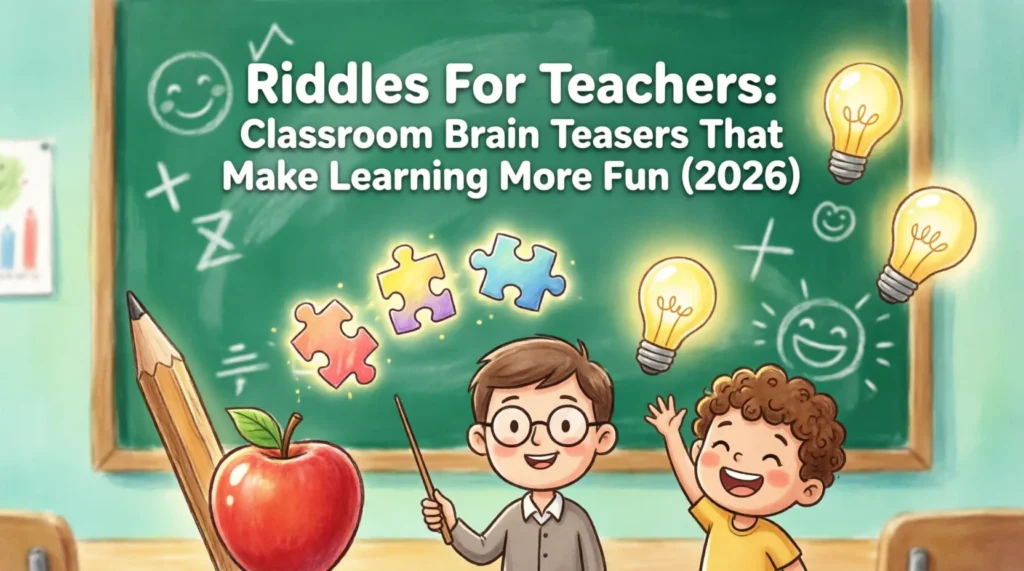
In short, riddles for teachers are clever, classroom-friendly puzzles designed to spark curiosity, boost critical thinking, and keep students engaged without feeling like extra work. Whether you teach elementary school, middle school, or high school, these riddles can turn quiet moments into memorable learning experiences that students actually look forward to solving.
Why Riddles For Teachers Are More Powerful Than You Think
A good riddle does more than fill a few spare minutes in class. It wakes students up, grabs attention fast, and encourages them to think beyond memorized answers. When you use riddles for teachers strategically, you create moments where students feel challenged and entertained at the same time.
Educators and cognitive scientists often point to puzzles and wordplay as powerful tools for improving memory, language processing, and flexible thinking. In classroom settings, riddles can also reduce stress and encourage participation from quieter students who may not normally raise their hands.
Studies show that playful problem-solving activities can improve student engagement and increase information retention during lessons. That matters when you are trying to hold attention during a long afternoon class or transition between subjects.
Riddles also help build classroom culture. When your students laugh together after finally solving a tricky clue, you create a shared moment that feels rewarding instead of academic. That balance is what makes riddles so effective for teachers in 2026 classrooms where attention spans are constantly competing with screens and distractions.
Across cultures, riddles have long been used to teach wisdom, sharpen thinking, and encourage storytelling. In schools today, they still serve the same purpose — just with a little more classroom energy and humor.
What Makes a Great Riddles For Teachers
The best riddles for teachers feel smart without becoming frustrating. Your students should pause, think, and maybe guess wrong once or twice before reaching that satisfying “aha!” moment. If the answer feels impossible, students disengage. If it feels too obvious, the challenge disappears.
Great classroom riddles usually include simple language paired with unexpected logic. A small twist in wording can completely change how students interpret the question. That surprise is what keeps students curious and eager for the next one.
For teachers, age-appropriate content matters too. Elementary students respond well to playful imagery and school-themed humor, while older students enjoy clever wordplay and logic-based traps. The strongest riddles avoid embarrassing students or relying on confusing cultural references that only part of the class understands.
Another important detail is pacing. A classroom riddle should be short enough to fit naturally into your lesson without slowing momentum. You want students thinking immediately, not waiting through a long setup.
Many experienced educators also use riddles to reinforce learning themes. A science teacher might use nature clues, while a language arts teacher might focus on puns or vocabulary twists. When riddles connect to your subject naturally, students absorb more than they realize.
Riddles For Teachers: 20 Riddles to Try Right Now
Classroom Riddles
Riddle: I travel from desk to desk but never move my legs. What am I?
Answer: Homework
Riddle: The more you erase me, the smaller I get. What am I?
Answer: A piece of chalk
Riddle: I open every class but never walk through the door. What am I?
Answer: A bell
Riddle: Students carry me everywhere, but I never take a single step. What am I?
Answer: A backpack
Riddle: I can be full of answers and still get every question wrong. What am I?
Answer: A test with incorrect answers
Riddle: I have many stories but no mouth to tell them. What am I?
Answer: A library
Riddle: I help students speak without making a sound. What am I?
Answer: A pencil
Teacher-Themed Brain Teasers
Riddle: I work hardest when everyone else is asleep. What am I?
Answer: A teacher grading papers
Riddle: I can silence a noisy room with just one look. What am I?
Answer: The teacher stare
Riddle: The more students ask me for help, the smarter they become. What am I?
Answer: A teacher
Riddle: I appear before every vacation and disappear right after exams. What am I?
Answer: Student focus
Riddle: I am always running but never leave the classroom. What am I?
Answer: The class clock
Riddle: You can sharpen me, click me, or lose me during class. What am I?
Answer: A pen
Subject-Based Riddles
Riddle: I have angles but never argue. What am I?
Answer: A triangle
Riddle: I contain worlds, oceans, and mountains but fit inside your hands. What am I?
Answer: A globe
Riddle: I tell stories from hundreds of years ago without speaking a word. What am I?
Answer: A history book
Riddle: I can divide people without making anyone angry. What am I?
Answer: Math
Riddle: I rise every morning in science class but never leave space. What am I?
Answer: The sun in a diagram
Funny School Riddles
Riddle: Why did the student eat his homework?
Answer: Because the teacher said it was a piece of cake
Riddle: What room has no walls, no floor, and no ceiling in school?
Answer: A classroom mushroom in a science lesson
Riddle: Why was the ruler always calm?
Answer: Because it knew how to keep things straight
Riddle: What gets sharper the more students use it?
Answer: Their minds
🎯 More dublin puns: Easy, Medium, and Hard Challenges
Easy Riddles for dublin puns (Grades 6–7)
These easy dublin puns riddles are perfect for younger middle schoolers who enjoy simple wordplay and quick laughs.
Riddle: What do you call a Dublin baker who always tells jokes? Answer: A pun-cake maker from Dublin.
Riddle: Why did the map of Dublin win an award? Answer: Because it always knew where it was going.
Riddle: What city likes to double the fun in its name? Answer: Dublin.
Riddle: What would you call a Dublin musician who can’t stop humming? Answer: A tune-lin’ Dub-lin performer.
Riddle: Why did the shamrock visit Dublin? Answer: To leaf a good impression.
Riddle: What do you get when Dublin tells a funny story twice? Answer: Double-in the laughs.
Medium Riddles for dublin puns (Grades 7–8)
These medium dublin puns riddles are great for students ready for multi-step thinking and playful language puzzles.
Riddle: I become a different word when you remove my first letter, but I’m still found in Ireland’s capital. What am I? Answer: Dublin (which becomes “ublin,” a playful place-name fragment often used in word games).
Riddle: If a city loved multiplication, which Irish city would it be? Answer: Dublin, because it sounds a bit like “doubling.”
Riddle: What travels around Dublin every day but never leaves its route? Answer: A city bus.
Riddle: A comedian opens two identical joke clubs in Dublin. What has he created? Answer: Double the Dublin puns.
Riddle: What has six letters, begins with D, and becomes part of dozens of playful jokes? Answer: Dublin.
Riddle: Why did the postcard from Dublin arrive smiling? Answer: Because it had plenty of stamp-approval.
Riddle: What do you call a clever joke that works in both geography and wordplay? Answer: A Dublin pun.
Hard Riddles for dublin puns (Grade 8 and Up)
These hard dublin puns riddles encourage abstract thinking, clever observations, and a little lateral problem-solving.
Riddle: I can describe a city and an action at the same time if you hear me differently. What am I? Answer: Dublin, because it playfully echoes “doubling.”
Riddle: Two students each write five Dublin jokes. Together they write ten, but their teacher says they also created one more thing. What is it? Answer: Double the dublin puns.
Riddle: The more people share me in class, the bigger I become without changing size. What am I? Answer: A good Dublin pun.
Riddle: I am found in maps, stories, songs, and jokes, yet I never move. What am I? Answer: The name Dublin.
Riddle: Remove every vowel from me and I still hint at my identity. What am I? Answer: Dublin (DBLN).
Riddle: I’m not arithmetic, but my nickname suggests multiplying fun. What am I? Answer: Dublin in a wordplay joke.
Riddle: What becomes more entertaining when students explain why it works instead of simply giving the answer? Answer: A clever Dublin pun.
Using difficulty levels lets teachers and parents match challenges to students’ confidence and reading levels. Try mixing easy and hard riddles during group activities so everyone has a chance to solve and explain their thinking.
📚 Subject-Specific dublin puns: Math, Science, and More
Math Riddles for dublin puns
These math-themed riddles combine numbers, patterns, and logic with playful thinking.
Riddle: I am an even number. Divide me by two and I become three. What number am I? Answer: Six.
Riddle: What shape has four equal sides and four right angles that loves being perfectly balanced? Answer: A square.
Riddle: If you double five Dublin postcards, how many do you have? Answer: Ten.
Riddle: I am greater than 20, less than 30, and my digits add up to 9. What number could I be? Answer: Twenty-seven.
Riddle: What number looks the same when turned upside down on a digital display? Answer: Eight.
Science Riddles for dublin puns
These science riddles explore everyday scientific ideas in a fun and approachable way.
Riddle: I help plants make their food, but I’m not something they can eat. What am I? Answer: Sunlight.
Riddle: I can be solid, liquid, or gas and cover most of our planet. What am I? Answer: Water.
Riddle: What force keeps your notebook from floating away during class? Answer: Gravity.
Riddle: I protect living cells and decide what enters or leaves. What am I? Answer: The cell membrane.
Riddle: I make thunder louder when I expand quickly after lightning flashes. What am I? Answer: Heated air.
Language Riddles for dublin puns
These language riddles celebrate letters, vocabulary, and wordplay that make learning enjoyable.
Riddle: What word becomes shorter when you add two letters to it? Answer: Short (when you add “er,” it becomes “shorter”).
Riddle: Which letter appears twice in the word “Dublin” and nowhere at all? Answer: None—the trick is noticing that no letter appears twice.
Riddle: What punctuation mark always asks questions? Answer: The question mark.
Riddle: What five-letter word becomes longer when you add two letters? Answer: Long (it becomes “longer”).
Riddle: What part of speech names a person, place, thing, or idea? Answer: A noun.
Teachers can bring subject-specific riddles into the classroom by:
Using them as five-minute warm-up activities before introducing a new topic.
Turning them into exit tickets that encourage students to explain their reasoning.
Organizing small-group challenges where students write their own math, science, or language riddles inspired by the lesson.
🎯 More Riddles for Teachers: Easy, Medium, and Hard Challenges
Easy Riddles for Riddles for Teachers (Grades 6–7)
These easy riddles use observation and simple wordplay, making them perfect for younger middle school students.
Riddle: I sit on every desk, but I never take a seat. What am I? Answer: A pencil
Riddle: The more pages I have, the thinner I become. What am I? Answer: A notebook
Riddle: I help students see mistakes, but I disappear as I work. What am I? Answer: An eraser
Riddle: I can be open or closed, but I am not a door. What am I? Answer: A book
Riddle: I travel from teacher to student and back again, carrying ideas but never speaking. What am I? Answer: A worksheet
Riddle: Students look at me all day, but I never look back. What am I? Answer: The classroom clock
Medium Riddles for Riddles for Teachers (Grades 7–8)
These medium-level riddles require a bit more reasoning and are great for students ready to connect clues together.
Riddle: A teacher gives three students one worksheet each. Every student finishes before the others, yet all finish at the same time. How is this possible? Answer: They all finished simultaneously.
Riddle: In a classroom, every student shakes hands with the teacher once. If there are 25 students, how many teacher-student handshakes happen? Answer: 25
Riddle: What classroom item becomes shorter every time it helps someone write? Answer: A pencil
Riddle: A teacher writes a word on the board. Students erase letters one at a time, but the word still remains a word after each change. What skill are they practicing? Answer: Vocabulary/word-building
Riddle: Two students study from the same book at the same time, but neither is waiting for the other to turn the page. How? Answer: They have separate copies.
Riddle: I can hold hundreds of answers but never ask a question. What am I? Answer: A gradebook
Riddle: A teacher gives a test on Friday and tells students the answers on Monday. What happened in between? Answer: The weekend
Hard Riddles for Riddles for Teachers (Grade 8 and Up)
These harder riddles use abstract thinking, careful interpretation, and clever reasoning.
Riddle: I grow larger the more knowledge I contain, yet I never gain weight. What am I? Answer: A library
Riddle: A teacher says, “The answer to this riddle is written nowhere in this classroom.” Yet a student solves it immediately. How? Answer: The answer is “nowhere.”
Riddle: I connect every student in a school, yet no one can touch me. What am I? Answer: Learning
Riddle: The more students share me, the more I expand. What am I? Answer: An idea
Riddle: A teacher asks a question that every student answers differently, yet all answers are correct. What question could it be? Answer: A personal-opinion question (such as “What’s your favorite book?”)
Riddle: I exist only after a mistake is made, but I help prevent future mistakes. What am I? Answer: Feedback
Riddle: Students try to avoid me, teachers spend time creating me, and everyone feels relieved when I’m finished. What am I? Answer: A test
Using difficulty tiers allows teachers and parents to keep everyone engaged, regardless of skill level. Start with easier riddles to build confidence, then gradually increase the challenge to encourage critical thinking and persistence.
📚 Subject-Specific Riddles for Teachers: Math, Science, and More
Math Riddles for Riddles for Teachers
These math-themed riddles encourage students to think about numbers, patterns, and shapes in fun ways.
Riddle: I am an odd number. Remove one letter and I become even. What number am I? Answer: Seven
Riddle: What shape has the most sides? Answer: A circle (it has one continuous side)
Riddle: I am a number that doubles when you look in a mirror. What am I? Answer: 8
Riddle: If two triangles each have three sides, how many sides do they have altogether? Answer: Six
Riddle: What number comes next: 2, 4, 8, 16, ___? Answer: 32
Science Riddles for Riddles for Teachers
These science riddles connect to everyday observations and basic scientific concepts.
Riddle: I fall from clouds but never get hurt when I hit the ground. What am I? Answer: Rain
Riddle: I am made of water, float in the sky, and sometimes block the Sun. What am I? Answer: A cloud
Riddle: I help plants make food, but I am not a chef. What am I? Answer: Sunlight
Riddle: I move around the Earth but never take a step. What am I? Answer: The Moon
Riddle: I can be solid, liquid, or gas, yet I am the same substance. What am I? Answer: Water
Language Riddles for Riddles for Teachers
These wordplay riddles help students think creatively about letters, vocabulary, and language.
Riddle: What word becomes shorter when you add two letters to it? Answer: Short
Riddle: What begins with T, ends with T, and has T inside it? Answer: Teapot
Riddle: Which letter of the alphabet contains the most water? Answer: C
Riddle: What five-letter word becomes shorter when you remove two letters? Answer: Short
Riddle: What word can be read the same forward and backward? Answer: Level
Teachers can incorporate subject riddles into lessons by:
Using them as bell-ringers or warm-up activities at the start of class.
Turning them into exit tickets that review key concepts before students leave.
Creating small-group challenges where students explain both the answer and the reasoning behind it.
How to Use Riddles For Teachers for Maximum Fun
Start your lesson with a quick riddle to grab attention immediately.
Use riddles during transitions when students are getting restless or distracted.
Turn riddles into small group competitions for team-building and collaboration.
Add subject-themed riddles to review sessions before quizzes or tests.
Post a “Riddle of the Day” on your classroom board or learning platform.
Let students create their own riddles as a creativity and writing exercise.
When you use riddles consistently, students begin associating your classroom with curiosity instead of pressure. That shift can completely change classroom energy over time. Even students who struggle academically often enjoy the playful challenge of solving a clever puzzle.
You can also adapt riddles to fit your teaching style. Some teachers use them as warm-ups, while others save them for brain breaks or end-of-week fun. The key is keeping the experience light, interactive, and welcoming for everyone in the room.
If you teach older students, try giving them a few extra seconds before allowing guesses. Teenagers especially enjoy the satisfaction of solving a riddle independently before someone blurts out the answer.
Tips for Sharing Riddles For Teachers Without Spoiling the Fun
Timing matters more than you think. After asking a riddle, give your students enough silence to process the clue before jumping in with hints. You will often see the best reactions right before someone figures it out.
If your class gets stuck, avoid revealing the answer too quickly. Instead, guide them with smaller clues that keep the challenge alive. That way, students still feel ownership over solving it.
You should also adapt the difficulty to the room. Younger students may need more literal clues, while older students enjoy misdirection and layered wordplay. Watching how your students respond helps you choose better riddles over time.
Most importantly, celebrate funny wrong answers. Sometimes the creative guesses are even better than the solution, and that playful atmosphere keeps students willing to participate again later.
Bonus: Riddles For Teachers That Stump Everyone
These bonus riddles are slightly trickier and designed to make even confident students pause for a moment. They work especially well during middle school and high school classes where students enjoy competitive thinking challenges.
Riddle: I can fill an entire classroom without taking up any space. What am I?
Answer: Light
Riddle: A teacher writes on me, students look at me, but I never learn anything. What am I?
Answer: A whiteboard
Riddle: I get passed around the classroom but never get dizzy. What am I?
Answer: A note
Riddle: I grow shorter every time I help students. What am I?
Answer: A pencil
Riddle: Students want me to end quickly, but teachers always need more of me. What am I?
Answer: Class time
Riddle: The more questions I answer, the more questions students ask. What am I?
Answer: Learning
Riddle: I am full of numbers but cannot count by myself. What am I?
Answer: A calculator
FAQs About Riddles For Teachers
What age group are riddles for teachers best for?
Riddles work for nearly every age group when you match the difficulty level correctly. Younger students enjoy playful and visual clues, while older students prefer logic twists and clever wording. You can easily adjust classroom riddles depending on your grade level and subject.
Can riddles for teachers improve classroom participation?
Yes, they often encourage participation from students who might stay quiet during regular lessons. Because riddles feel low-pressure and fun, students are more willing to share guesses and ideas without worrying about being wrong.
How often should teachers use riddles in class?
Many educators use them a few times per week as warm-ups, transitions, or brain breaks. You do not need to overdo it. Even one short riddle can reset classroom focus and boost energy during a difficult lesson.
What makes riddles for teachers different from regular riddles?
The best classroom riddles are designed specifically for school settings. They stay clean, age-appropriate, and easy to deliver quickly during lessons. Many also connect naturally to subjects like math, reading, science, or classroom life.
Can students create their own classroom riddles?
Absolutely. Creating riddles helps students practice writing, logic, and creative thinking all at once. Many teachers turn this into a collaborative activity where students challenge classmates with original ideas.
Final Thoughts: Keep the Fun Going with Riddles For Teachers
A clever riddle can completely change the mood of your classroom in under a minute. That is why so many teachers keep a few ready for transitions, warm-ups, and those moments when student energy starts to fade.
The beauty of riddles for teachers is how flexible they are. You can use them to encourage participation, reinforce learning, build classroom culture, or simply make students smile during a busy day.
When riddles become part of your regular teaching rhythm, students begin looking forward to the challenge. Over time, you may notice stronger critical thinking, more collaboration, and a classroom atmosphere that feels lighter and more connected.
Sometimes the smallest classroom moments create the biggest memories — and a great riddle is often one of them.
Frequently Asked Questions
How do riddles help improve student engagement in the classroom?▼
Riddles stimulate curiosity and challenge students to think critically, making learning more interactive. By incorporating playful problem-solving, educators can capture students’ attention and enhance information retention during lessons.
What characteristics make a riddle effective for teachers?▼
Effective riddles should feature simple language, unexpected logic, and age-appropriate content. They should also encourage students to pause and think, leading to a satisfying ‘aha!’ moment without causing frustration.
Can riddles be used in different grade levels, and if so, how?▼
Yes, riddles can be tailored for various age groups. Elementary students respond well to playful imagery and humor, while older students may enjoy clever wordplay and logic-based challenges.
What role do riddles play in building classroom culture?▼
Riddles create shared moments of laughter and collaboration, which can strengthen classroom relationships. These experiences foster a positive learning environment where students feel comfortable participating.
How can teachers integrate riddles into their lesson plans effectively?▼
Teachers should choose riddles that connect naturally to their subject matter, reinforcing key concepts. Additionally, riddles should be brief enough to maintain lesson momentum without overwhelming students.
What are some examples of classroom-friendly riddles mentioned in the article?▼
The article includes several riddles such as, ‘I travel from desk to desk but never move my legs. What am I?’ with the answer being ‘Homework.’ These examples illustrate how riddles can be both fun and educational.
How do riddles contribute to cognitive development in students?▼
Riddles encourage flexible thinking and improve language processing, which are crucial for cognitive development. Engaging with puzzles helps students develop problem-solving skills that extend beyond the classroom.
How can teachers use riddles for a quick classroom transition?▼
Post one riddle on the board while students settle in or line up — it gives early finishers something to think about without needing supervision.
10 More Classroom Riddles for Teachers
What has one head, one foot, and four legs?
Answer: A bed.
What subject do snakes love in school?
Answer: Hiss-tory.
Why did the pencil get sent to the principal’s office?
Answer: It kept making a point.
What has many pages but is not a book, and lines but is not a road?
Answer: A notebook.
Why was the math book sad?
Answer: It had too many problems.
What do you call a teacher who never farts in public?
Answer: A private tudor.
What did the calculator say to the student?
Answer: You can count on me.
Why did the student eat his homework?
Answer: The teacher said it was a piece of cake.
What gets bigger the more you take away from it?
Answer: A hole — great for a science-class discussion starter.
What has to be broken before you can use it?
Answer: An egg.
FAQ
What’s the answer to the classic classroom riddle “what has to be broken before you can use it”?
The answer is an egg — it’s one of the most popular opening riddles teachers use because nearly every student can solve it, which builds early confidence before harder puzzles.
How many riddles should a teacher use in one class period?
Most teachers find 3-5 riddles is the sweet spot for a warm-up or transition activity — enough to build momentum without eating into lesson time. Save the harder ones for early finishers or brain-break moments.
Are these riddles appropriate for all grade levels?
Yes. The riddles on this page are written to be safe and understandable for elementary through middle-school classrooms, with a mix of easy warm-ups and slightly trickier logic puzzles for older students.
Ethan is a puzzle enthusiast and lead writer at FunRiddlezone.com, where he focuses on creating and breaking down riddles that challenge the mind while keeping things fun and engaging. He specializes in turning tricky questions, wordplay, and logic puzzles into clear, satisfying explanations that actually make sense — not confusing or overcomplicated answers.
Drawing from logic, pattern recognition, and creative thinking, Ethan approaches riddles as mental exercises designed to sharpen thinking skills and spark curiosity. Instead of treating riddles as random tricks, he explains the reasoning behind each one, helping readers understand how to think through problems step by step.
He pays close attention to wording, hidden clues, and subtle misdirection — the key elements that make riddles both challenging and enjoyable. From classic brain teasers to tricky modern riddles, Ethan ensures that every puzzle is not just solved, but fully understood.
At FunRiddlezone.com, his mission is simple: make riddles more than just questions — turn them into a fun way to train your brain. He doesn’t just give answers — he helps readers think sharper, spot patterns faster, and enjoy the process of solving.