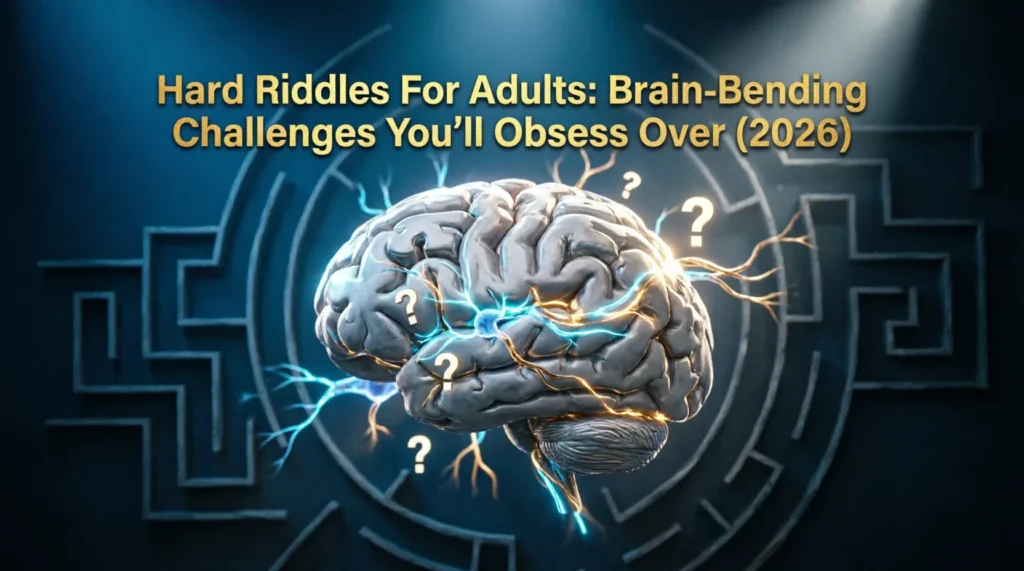
In short, hard riddles for adults are clever, layered brain teasers designed to challenge your logic, creativity, and lateral thinking skills. They’re perfect for game nights, trivia groups, date nights, office icebreakers, or anyone who loves that satisfying “aha!” moment. Get ready to test how sharp your mind really is.
Why Hard Riddles For Adults Are More Powerful Than You Think
Hard riddles for adults do more than fill awkward silence at parties. They force your brain to slow down, rethink assumptions, and spot patterns you would normally miss. That mental stretch is exactly why so many people become addicted to solving them.
Cognitive scientists often point to lateral-thinking exercises as powerful tools for improving mental flexibility and problem-solving speed. Unlike simple trivia questions, difficult riddles make you examine language, logic, and hidden meanings all at once.
Studies show that adults who regularly engage in puzzle-solving activities can improve memory retention, concentration, and creative thinking over time. That’s one reason hard riddles for adults continue to thrive everywhere from pub quizzes to escape rooms.
There’s also a social side to it. Few things create instant laughter faster than watching a confident friend completely miss an obvious answer. The challenge pulls people together because everyone wants to crack the puzzle first.
Riddles are also part of a much older global tradition. Across cultures, people have long used riddles to teach wisdom, sharpen wit, and entertain groups around the fire, dinner table, or classroom. Today’s adult brain teasers are simply a modern version of that timeless game.
What Makes a Great Hard Riddle For Adults
A great hard riddle for adults feels impossible for about thirty seconds. Then suddenly the answer clicks, and you wonder how you missed it. That shift from confusion to clarity is the entire magic.
The best riddles rely on misdirection rather than impossible logic. They lead your brain toward the obvious interpretation while quietly hiding the real one in plain sight. Adults especially enjoy this style because it rewards patience and flexible thinking instead of random guessing.
Strong wordplay also matters. A single double meaning can completely change how you interpret a clue. That’s why the most memorable riddles often sound deceptively simple at first.
Difficulty balance is important too. If a riddle is too easy, you lose interest immediately. If it’s impossibly vague, it becomes frustrating instead of satisfying. The strongest hard riddles for adults sit right in the sweet spot where you feel challenged but still capable of solving them.
Tone matters as well. Adult riddles can be witty, ironic, or psychologically clever without becoming offensive or crude. Clean but sharp humor tends to work best because it keeps everyone engaged, whether you’re using riddles at a dinner party, team event, or casual gathering.
Most importantly, every great riddle creates a genuine “aha moment.” You should feel rewarded, not tricked. That emotional payoff is what keeps people asking for one more puzzle long after the first round ends.
Hard Riddles For Adults: 20 Riddles to Try Right Now
Logic and Lateral Thinking Riddles
Riddle: A woman arrives at a hotel and hands the clerk a credit card. Five minutes later, she leaves smiling without paying for a room. Why?
Answer: She was there to return a lost credit card.
Riddle: A man builds a square house where every wall faces south. A bear walks by the house. What color is the bear?
Answer: White, because the house is at the North Pole.
Riddle: The more carefully you remove me, the bigger I become. What am I?
Answer: A hole.
Riddle: Two people are born at the exact same moment, from the same mother, on the same day and year, but they are not twins. How?
Answer: They are two of a set of triplets.
Riddle: A detective finds a cabin with no doors or windows. Inside is a dead man and a puddle of water. What happened?
Answer: The man was a fish in a broken bowl.
Riddle: You walk into a room containing a match, a fireplace, a candle, and a gas lamp. What do you light first?
Answer: The match.
Riddle: A man pushes his car to a hotel and immediately loses his fortune. Why?
Answer: He’s playing Monopoly.
Wordplay and Misdirection Riddles
Riddle: I become shorter every time I add two letters to myself. What am I?
Answer: The word “short.”
Riddle: What can run forever but never gets tired, has a bed but never sleeps, and has a mouth but never eats?
Answer: A river.
Riddle: You can hold me in your left hand but never in your right. What am I?
Answer: Your right elbow.
Riddle: What word is pronounced the same if you take away four of its five letters?
Answer: Queue.
Riddle: I only exist when there is light, but direct light kills me instantly. What am I?
Answer: A shadow.
Riddle: What gets sharper the more you use it?
Answer: Your brain.
Observation and Pattern Riddles
Riddle: A clock chimes six times in five seconds. How long does it take to chime twelve times?
Answer: Eleven seconds. The spaces between chimes matter.
Riddle: You see a boat filled with people, yet there isn’t a single person on board. How?
Answer: Everyone on the boat is married.
Riddle: Which month has 28 days?
Answer: All of them.
Riddle: Three doctors say Robert is their brother, but Robert says he has no brothers. Who is lying?
Answer: Nobody. The doctors are Robert’s sisters.
Deep Thinking Riddles
Riddle: I can be stolen, mistaken, or changed, yet I never leave you your entire life. What am I?
Answer: Your identity.
Riddle: The more people share me, the less they have. What am I?
Answer: A secret.
Riddle: A prisoner’s only way out is through two doors. One leads to freedom, one to death. Two guards know which is which. One guard always lies, and one always tells the truth. The prisoner may ask one question to one guard. What should he ask?
Answer: “Which door would the other guard say leads to freedom?” Then choose the opposite door.
🎯 More Hard Riddles For Adults: Brain-Bending Challenges You’ll Obsess Over (2026): Easy, Medium, and Hard Challenges
Easy Riddles for Hard Riddles For Adults: Brain-Bending Challenges You’ll Obsess Over (2026) (Grades 6–7)
These easy riddles are perfect for building confidence and introducing younger learners to observation and wordplay.
Riddle: I have four corners, but I never leave my place on your desk. What am I? Answer: A sheet of paper.
Riddle: The more classmates I hold, the lighter I become. What am I? Answer: A balloon losing air when passed around.
Riddle: I follow every sentence but never say a word. What am I? Answer: A period.
Riddle: I can be opened many times during class, but I’m not a door. What am I? Answer: A book.
Riddle: I grow shorter each time you use me to write. What am I? Answer: A pencil.
Riddle: I show every number from 1 to 12 but never do any math. What am I? Answer: A clock.
Medium Riddles for Hard Riddles For Adults: Brain-Bending Challenges You’ll Obsess Over (2026) (Grades 7–8)
These medium-level riddles are ideal for students ready to practice logic and multi-step thinking.
Riddle: Two students walk into school carrying identical backpacks. One backpack is empty, and one isn’t. Without opening them, how can you tell which is heavier? Answer: Pick them up—the heavier one isn’t empty.
Riddle: A number becomes larger when you turn it upside down. Which number is it? Answer: Six becomes nine.
Riddle: I have one eye but can never see. I help fix what is torn. What am I? Answer: A needle.
Riddle: You read me from left to right every day, but if you reverse me, I still make sense. What am I? Answer: NOON.
Riddle: I can travel across an entire classroom without moving my feet. What am I? Answer: Your voice.
Riddle: Three friends shared twelve cookies equally. None were broken, and none remained. How many did each receive? Answer: Four cookies each.
Riddle: I always arrive tomorrow but never today. What am I? Answer: Tomorrow.
Hard Riddles for Hard Riddles For Adults: Brain-Bending Challenges You’ll Obsess Over (2026) (Grade 8 and Up)
These brain-bending challenges reward careful thinking, clever observation, and creative problem-solving.
Riddle: I become stronger every time I’m shared, but weaker every time I’m hidden. What am I? Answer: Knowledge.
Riddle: A classroom has thirty desks and thirty students. Every student sits at a desk, yet one desk remains empty. How is this possible? Answer: The teacher’s desk is empty.
Riddle: You take away one letter from me and I become shorter. Remove another letter, and I become even shorter. What word am I? Answer: Shorter.
Riddle: I can fill an entire room without taking up any space. What am I? Answer: Light.
Riddle: If five machines make five paper stars in five minutes, how long would one hundred machines take to make one hundred paper stars? Answer: Five minutes.
Riddle: I can only exist when someone notices me, yet I disappear the moment nobody looks. What am I? Answer: A shadow.
Riddle: The more carefully you use me, the faster I disappear. What am I? Answer: Time.
Teachers and parents can use these difficulty tiers to create collaborative challenges where students progress from easy to hard puzzles together. Mixing difficulty levels also encourages confidence-building while giving advanced thinkers an opportunity to stretch their reasoning skills.
📚 Subject-Specific Hard Riddles For Adults: Brain-Bending Challenges You’ll Obsess Over (2026): Math, Science, and More
Math Riddles for Hard Riddles For Adults: Brain-Bending Challenges You’ll Obsess Over (2026)
These math-inspired riddles make patterns, numbers, and shapes fun to explore.
Riddle: I am an odd number. Remove one letter, and I become even. What number am I? Answer: Seven.
Riddle: I have three sides and three corners, but no matter how much I grow, I never gain another side. What am I? Answer: A triangle.
Riddle: If you count by twos from two to twenty, how many numbers will you say? Answer: Ten.
Riddle: I am half of eight, but if you draw me differently, I become zero. What am I? Answer: The number four (split horizontally resembles two zeros).
Riddle: What number doubles when reflected in a mirror placed beside it? Answer: Eleven (it appears as two ones side by side).
Science Riddles for Hard Riddles For Adults: Brain-Bending Challenges You’ll Obsess Over (2026)
These science riddles connect everyday observations to exciting scientific ideas.
Riddle: I help plants make their own food, but I’m not something they can eat. What am I? Answer: Sunlight.
Riddle: I am everywhere around you, but you cannot usually see me unless I move leaves or fill a balloon. What am I? Answer: Air.
Riddle: I change from solid to liquid and back again every day in many homes. What am I? Answer: Water.
Riddle: I make thunder possible, light the sky during storms, and carry electricity. What am I? Answer: Lightning.
Riddle: I live beneath your feet, hold water for plants, and help seeds grow. What am I? Answer: Soil.
Language Riddles for Hard Riddles For Adults: Brain-Bending Challenges You’ll Obsess Over (2026)
These wordplay riddles encourage students to think creatively about letters, vocabulary, and language.
Riddle: Remove my first letter, and I still sound the same. Remove my last letter, and I still sound the same. Remove both, and I still sound the same. What word am I? Answer: Empty.
Riddle: I begin every alphabet song but never finish it. What am I? Answer: The letter A.
Riddle: Which word becomes shorter when you add two letters to it? Answer: Short (adding “er” makes “shorter”).
Riddle: What has five letters, loses two, and still sounds exactly the same? Answer: Empty (remove “m” and “t” to make “epy,” which is pronounced differently—so instead: Queue loses four letters and still sounds the same.) Queue.
Riddle: I am found once in every minute, twice in every moment, and never in an hour. What am I? Answer: The letter M.
Teachers can incorporate subject riddles into lessons by:
Using them as five-minute warm-up activities at the start of class.
Turning them into exit tickets that encourage students to explain their reasoning.
Creating small-group challenges where students write and share their own subject-themed riddles.
🎯 More Hard Riddles for Adults: Easy, Medium, and Hard Challenges
Easy Riddles for Hard Riddles for Adults (Grades 6–7)
These easy challenges are great for warming up your brain with simple observation and clever wordplay.
Riddle: What can travel from one side of a room to the other without moving its own feet? Answer: A shadow
Riddle: I have many stories but no characters, many pages but no paper. What am I? Answer: A website
Riddle: What becomes larger every time you remove a piece of it? Answer: A hole
Riddle: What can be broken many times but still never leave the ground? Answer: A record
Riddle: I am full of holes, but I can still hold hundreds of names. What am I? Answer: A contact list
Riddle: What gets shorter every time you use it, yet that’s exactly what it’s made for? Answer: A pencil
Medium Riddles for Hard Riddles for Adults (Grades 7–8)
These medium-level riddles require a little more reasoning and are perfect for puzzlers who enjoy connecting clues.
Riddle: A man leaves home, makes three left turns, and arrives back home. Waiting there is someone wearing a mask. Who is it? Answer: The catcher in a baseball game
Riddle: Two parents and two children go to a restaurant. They order only three meals, yet everyone gets a full meal. How? Answer: They are a grandparent, a parent, and a child
Riddle: You enter a room with one match, a candle, a fireplace, and a lantern. What do you light first? Answer: The match
Riddle: A number is multiplied by itself and then increased by itself. The result is 20. What number is it? Answer: 4 (4 × 4 + 4 = 20)
Riddle: A train leaves City A at noon traveling east. Another leaves City B at noon traveling west on the same track. When they meet, which train is closer to City A? Answer: Neither; they are the same distance from City A
Riddle: Three friends share a hotel room costing $30. After a correction, the clerk refunds $5. They each receive $1 back, and $2 is kept as a tip. The guests paid $27 total, plus the $2 tip equals $29. Where is the missing dollar? Answer: There is no missing dollar; the $27 already includes the $2 tip
Riddle: A clock shows the same time in a mirror as it does in real life. What time is it? Answer: 6:00
Hard Riddles for Hard Riddles for Adults (Grade 8 and Up)
These tougher riddles use misdirection, abstract thinking, and lateral reasoning to challenge experienced problem-solvers.
Riddle: A woman has two coins that equal 30 cents. One is not a nickel. What are the coins? Answer: A quarter and a nickel (the quarter is not a nickel)
Riddle: You see a boat filled with people. It hasn’t sunk, but when you look again, you can’t see a single person on board. Why? Answer: Everyone on board is married, so there are no single people
Riddle: A room contains four corners. In each corner sits a cat. Each cat faces three cats. How many cats are there? Answer: Four
Riddle: The more accurate I become, the less useful I am. What am I? Answer: A weather forecast about the past
Riddle: A man gives one of his daughters 10 cents and the other 15 cents. Why does the one with 10 cents feel richer? Answer: She already had more money before receiving the coins
Riddle: You throw me away when you need me and bring me back when you’re done. What am I? Answer: An anchor
Riddle: A person walks into a room carrying a photograph. Someone asks, “Who is that?” The person replies, “I have no brothers or sisters, but that person’s father is my father’s son.” Who is in the photograph? Answer: Their child
Tip for teachers and parents: Start with easy riddles to build confidence, then gradually move up in difficulty as students explain their thinking. Mixed-difficulty challenges also work well for group discussions because different learners can contribute in different ways.
📚 Subject-Specific Hard Riddles for Adults: Math, Science, and More
Math Riddles for Hard Riddles for Adults
These math-themed riddles make numbers, patterns, and shapes feel like puzzles instead of homework.
Riddle: I am an odd number. Remove one letter and I become even. What number am I? Answer: Seven
Riddle: What shape has the most sides? Answer: A circle (it has two sides: inside and outside)
Riddle: I am a number. Double me and add 10, and the result is 30. What number am I? Answer: 10
Riddle: Two digits multiplied together equal 36. Added together, they equal 13. What are they? Answer: 4 and 9
Riddle: What comes next in the pattern: 1, 4, 9, 16, 25, ? Answer: 36
Science Riddles for Hard Riddles for Adults
These science riddles connect everyday observations to ideas from biology, chemistry, physics, and Earth science.
Riddle: I can be solid, liquid, or gas, yet I am still the same substance. What am I? Answer: Water
Riddle: I pull everything toward Earth, but nobody can see me. What am I? Answer: Gravity
Riddle: Plants use me to make food, and animals breathe me out. What am I? Answer: Carbon dioxide
Riddle: I travel faster than sound, help you see, and arrive from the Sun in minutes. What am I? Answer: Light
Riddle: I am made of tiny particles and make up everything around you. What am I? Answer: Matter
Language Riddles for Hard Riddles for Adults
These wordplay riddles challenge vocabulary, spelling, grammar, and creative thinking.
Riddle: What English word keeps the same pronunciation even after you remove four of its five letters? Answer: Queue
Riddle: Which letter appears once in a minute, twice in a moment, and never in an hour? Answer: The letter M
Riddle: What five-letter word becomes shorter when you add two letters to it? Answer: Short
Riddle: What word begins and ends with E but contains only one letter? Answer: Envelope
Riddle: What word can mean both a type of tree and part of your body? Answer: Palm
Ideas for teachers:
Use subject riddles as bell-ringer activities to spark curiosity at the beginning of class.
Turn them into exit tickets where students explain how they found the answer.
Create small-group challenge stations and let teams solve different subject categories together.
How to Use Hard Riddles For Adults for Maximum Fun
Use them as icebreakers during dinner parties or game nights.
Add one difficult riddle to your team meetings or office chats each week.
Turn them into friendly competitions with timed rounds and scorekeeping.
Text riddles to friends or partners during the day for ongoing fun.
Use them during long road trips to keep everyone mentally engaged.
Create themed puzzle nights with logic riddles, mystery riddles, and wordplay rounds.
The best experience happens when you resist rushing to the answer. Give people enough time to think, debate, and defend wild theories. That tension is where the fun lives.
You can also scale difficulty depending on your group. If everyone solves a riddle instantly, increase the complexity. If the room gets completely stuck, offer tiny hints instead of revealing the answer immediately. Hard riddles for adults work best when the challenge feels achievable.
Psychologists who study group interaction often note that collaborative problem-solving creates stronger social engagement than passive entertainment. In simple terms, people remember the conversations and laughter around riddles long after the answers fade.
Tips for Sharing Hard Riddles For Adults Without Spoiling the Fun
When you tell a riddle, pacing matters. Read it slowly enough that people catch every clue, but don’t over-explain or emphasize the trick too early.
Try giving your group at least thirty seconds before offering hints. Adults often solve riddles right after the moment they want to give up. That tiny extra pause can lead to the breakthrough.
If someone guesses incorrectly, keep the energy playful. Wrong answers are often the funniest part of the game. You can even encourage ridiculous theories before steering people back toward the real solution.
Pay attention to your audience too. Some groups love pure logic puzzles, while others prefer language tricks or observational riddles. The more you adapt to your crowd, the more addictive the experience becomes.
Most importantly, never make people feel bad for missing the answer. Great riddles should challenge your brain, not your confidence.
Bonus: Hard Riddles For Adults That Stump Everyone
These bonus riddles are trickier because they rely on layered assumptions and hidden perspectives. Even experienced puzzle fans often overthink them the first time around.
Riddle: Before Mount Everest was discovered, what was the tallest mountain in the world?
Answer: Mount Everest. It just hadn’t been discovered yet.
Riddle: A man describes his daughters, saying, “They are all blonde except two, all brunette except two, and all redheaded except two.” How many daughters does he have?
Answer: Three. One blonde, one brunette, and one redhead.
Riddle: What disappears the moment you say its name?
Answer: Silence.
Riddle: You enter a dark room with one candle and one oil lamp. You only have one match. What do you light first?
Answer: The match.
Riddle: A man shaves several times a day but still has a beard. Why?
Answer: He’s a barber.
Riddle: What can fill an entire room without taking up any physical space?
Answer: Light.
Riddle: The person who makes me doesn’t need me. The person who buys me doesn’t use me. The person who uses me doesn’t know it. What am I?
Answer: A coffin.
FAQs About Hard Riddles For Adults
Are hard riddles for adults good for brain training?
Yes. Many cognitive scientists and educators believe riddles strengthen problem-solving, memory, and flexible thinking. Because they force you to question assumptions, they activate parts of your brain that ordinary conversation often doesn’t.
What makes hard riddles for adults different from regular riddles?
Adult riddles usually rely on deeper misdirection, layered wordplay, and more abstract logic. Instead of simple punchline answers, they often require you to rethink the entire setup before the solution becomes clear.
Can hard riddles for adults work for parties or team events?
Absolutely. They’re excellent for breaking awkward silence and creating group interaction quickly. Many workplace psychologists recommend puzzle-based activities because they encourage collaboration and creative thinking without feeling forced.
How difficult should hard riddles for adults actually be?
The best riddles feel challenging but fair. If nobody can solve them even after hints, people lose interest. A strong riddle creates tension first, then rewards you with a satisfying realization.
Are hard riddles for adults appropriate for date nights?
They can be surprisingly perfect for date nights. Solving puzzles together creates playful competition, conversation, and shared laughter. You also learn how each person thinks under pressure, which makes the interaction even more entertaining.
Final Thoughts: Keep the Fun Going with Hard Riddles For Adults
Hard riddles for adults are more than quick entertainment. They sharpen your thinking, spark conversation, and create unforgettable moments where entire groups suddenly yell the answer at once.
The best part is how easy they are to use. You don’t need expensive games, complicated rules, or special equipment. All you need is one clever question and a room full of curious minds.
If you start using riddles regularly, you may notice something interesting. People become more engaged, more creative, and more willing to think outside the obvious answer. That mindset carries far beyond puzzle night.
So the next time conversation slows down, drop a riddle into the room and watch everyone’s brain wake up at once.
Frequently Asked Questions
What benefits do hard riddles for adults provide beyond entertainment?▼
Hard riddles for adults improve mental flexibility and problem-solving speed by challenging your logic and creativity. Engaging in these puzzles can enhance memory retention and concentration over time, making them more than just a fun activity.
How do hard riddles differ from simple trivia questions?▼
Unlike simple trivia questions, hard riddles require you to examine language, logic, and hidden meanings all at once. This layered approach promotes deeper thinking and often leads to a more rewarding ‘aha!’ moment.
What characteristics make a riddle truly great for adults?▼
A great hard riddle feels impossible at first but rewards you with clarity once solved. It should rely on misdirection, strong wordplay, and maintain a difficulty balance that keeps you engaged without causing frustration.
Why do riddles tend to be social activities?▼
Riddles create instant laughter and camaraderie, especially when one person confidently misses an obvious answer. This social aspect encourages group participation and friendly competition, making them ideal for gatherings.
Can you provide an example of a hard riddle for adults?▼
One example is: ‘A woman arrives at a hotel and hands the clerk a credit card. Five minutes later, she leaves smiling without paying for a room. Why?’ The answer is that she was there to return a lost credit card.
How do tone and humor play a role in adult riddles?▼
Tone matters significantly in adult riddles; they can be witty, ironic, or clever without being offensive. Clean humor tends to keep everyone engaged, making the riddles suitable for various social settings.
What is the significance of the 'aha moment' in solving riddles?▼
The ‘aha moment’ is crucial because it provides a sense of reward and satisfaction upon solving a riddle. This emotional payoff encourages people to seek out more puzzles and keeps the challenge enjoyable.
Samantha Nguyen has been a literary enthusiast for over 15 years, combining her love for language and pedagogy to craft engaging riddles and puzzles. With a background in Education and Linguistics, Samantha has dedicated her career to making learning fun and accessible to children of all ages. She specializes in seasonal riddles, often weaving in cultural and historical themes to enrich classroom experiences during holidays and special events. Samantha is passionate about crafting puzzles that challenge young minds while also entertaining the whole family. Her riddles are designed to stimulate critical thinking, ensuring they remain a hit during family gatherings and road trips. She joined FunRiddleZone to reach a wider audience and share her passion for creative educational content.