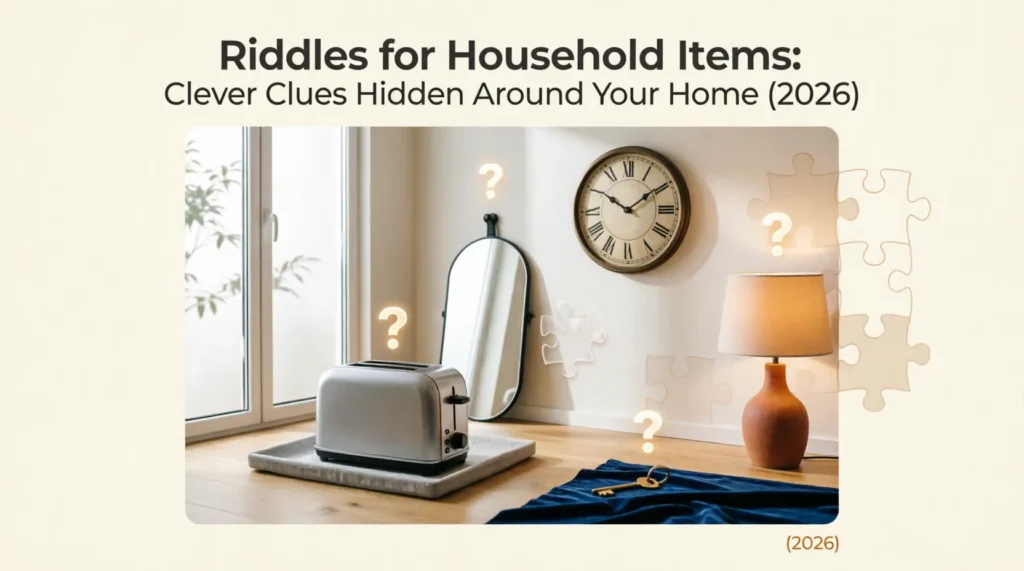
Riddles for Household Items: Clever Clues Hidden Around Your Home (2026)
In short, riddles for household items turn everyday objects into clever little brain teasers that anyone can enjoy. They’re perfect for family game nights, classrooms, road trips, icebreakers, or simply making ordinary moments more fun. Once you start guessing these household riddles, you may never look at your kitchen, bathroom, or living room the same way again.
Why Riddles for Household Items Are More Powerful Than You Think
There’s something surprisingly exciting about turning common objects into puzzles. A lamp, a broom, or even a sponge suddenly becomes mysterious when wrapped in clever wordplay. That’s why riddles for household items work so well for both kids and adults — they make familiar things feel fresh again.
Educators and cognitive scientists often point out that object-based riddles strengthen observation skills, memory, and flexible thinking. Because you already know the objects being described, your brain has to connect clues in creative ways instead of simply memorizing answers.
Studies show that playful problem-solving activities can improve attention span and language development, especially when families or groups solve riddles together. Even a quick five-minute riddle session can spark laughter, conversation, and sharper thinking.
Household riddles also have a universal appeal. No matter where you live, people recognize everyday items like mirrors, clocks, chairs, and refrigerators. That shared familiarity makes these riddles easy to enjoy across ages and cultures.
What Makes a Great Riddle for Household Items
The best household riddles balance simplicity with surprise. You should feel like the answer was right in front of you the whole time, yet somehow hidden by clever wording. That little “aha!” moment is what makes people smile after solving one.
A strong household riddle usually focuses on what an item does instead of what it looks like. A vacuum “eats dust,” a candle “shrinks while giving light,” and a refrigerator “works hardest when closed.” These twists make ordinary objects suddenly sound mysterious.
Good riddles for household items also use clean, relatable humor. Since these riddles are often shared with families, students, or mixed-age groups, the language should stay light and inclusive. The challenge comes from observation and misdirection, not confusion.
Another key ingredient is familiarity. If the answer is something you use every day, the riddle instantly becomes more satisfying. You enjoy the realization that the object was sitting nearby the entire time.
The strongest riddles also vary in style. Some rely on wordplay, some use logic, and others describe an object from an unusual angle. That variety keeps you engaged and makes guessing more exciting.
Riddles for Household Items: 20 Riddles to Try Right Now
Kitchen Household Riddles
Riddle: I get hotter the more I work, yet I help cool your hunger. What am I?
Answer: An oven
Riddle: I have shelves but hold no books. I keep things cold around the clock. What am I?
Answer: A refrigerator
Riddle: I spin and splash but never swim. Dirty dishes fear me. What am I?
Answer: A dishwasher
Riddle: I whistle when angry and calm down when served. What am I?
Answer: A kettle
Riddle: You fill me up to empty me every morning. What am I?
Answer: A coffee maker
Riddle: I’m full of holes but still help clean your messes. What am I?
Answer: A sponge
Riddle: I can crack under pressure, but breakfast depends on me. What am I?
Answer: An egg
Living Room and Bedroom Riddles
Riddle: I hold you up when you’re tired, but I never stand on my own feet. What am I?
Answer: A chair
Riddle: The more you relax on me, the more comfortable I become. What am I?
Answer: A couch
Riddle: I brighten your room but disappear when you sleep. What am I?
Answer: A lamp
Riddle: I tell stories without speaking and change channels without walking. What am I?
Answer: A television
Riddle: I have hands but cannot clap. I work all day without breaks. What am I?
Answer: A clock
Riddle: I reflect everything but keep nothing. What am I?
Answer: A mirror
Cleaning and Utility Riddles
Riddle: I eat dirt loudly but never get full. What am I?
Answer: A vacuum cleaner
Riddle: I sweep across the floor yet never leave footprints. What am I?
Answer: A broom
Riddle: I get wetter while making things dry. What am I?
Answer: A towel
Riddle: You step on me before entering, yet I welcome you home. What am I?
Answer: A doormat
Bathroom Household Riddles
Riddle: I run all day but never leave my place. What am I?
Answer: A faucet
Riddle: I disappear little by little every time you use me to get clean. What am I?
Answer: A bar of soap
Riddle: I protect your teeth by getting squeezed every morning and night. What am I?
Answer: Toothpaste
🎯 More riddles for household items: Easy, Medium, and Hard Challenges
Easy Riddles for riddles for household items (Grades 6–7)
These easy riddles are perfect for younger middle schoolers who enjoy spotting clues based on everyday observations.
Riddle: I stand by the door and collect muddy stories from shoes before they enter the house. Answer: Doormat
Riddle: I hold your food cold all day, but I never take a bite. Answer: Refrigerator
Riddle: I sit on a wall, yet I never climb. I tell you when to leave and when to arrive. Answer: Clock
Riddle: You pull me out when guests come over, then fold me away when they leave. Answer: Folding chair
Riddle: I swallow dirty dishes but return them clean. Answer: Dishwasher
Riddle: I brighten a room with the flip of a finger, but I am not the light itself. Answer: Light switch
Medium Riddles for riddles for household items (Grades 7–8)
These medium-level riddles require a little more reasoning and are great for students ready to connect multiple clues.
Riddle: The more family members use me, the shorter I become, even though nobody cuts me. Answer: Roll of toilet paper
Riddle: I travel from room to room, chasing crumbs, but I never get hungry. Answer: Vacuum cleaner
Riddle: I can be full in the morning and empty at night, yet nobody eats what I hold. Answer: Laundry basket
Riddle: I spend most of my time closed, but my job becomes important when things get hot. Answer: Oven mitt
Riddle: I help you reach things above your head, but I never grow taller myself. Answer: Step stool
Riddle: I often live beside a sink. When I’m dry, I wait. When I’m wet, I’m working. Answer: Sponge
Riddle: I guard your leftovers and disappear into cabinets when my job is done. Answer: Food storage container
Hard Riddles for riddles for household items (Grade 8 and Up)
These challenging riddles use clever thinking, subtle clues, and a bit of misdirection for older students.
Riddle: I spend my life carrying weight, but nobody notices me until I break. Answer: Shelf
Riddle: I create order by separating things, yet I am strongest when I stay hidden. Answer: Drawer divider
Riddle: I am opened to solve a problem and closed once the problem is gone. Most people forget about me between emergencies. Answer: First-aid kit
Riddle: I help you see yourself, but I never learn what you look like. Answer: Mirror
Riddle: I can make a room feel larger without moving a single wall. Answer: Mirror
Riddle: I am filled before I am useful, emptied when I am successful, and replaced when I can no longer help. Answer: Trash bag
Riddle: I hide in plain sight, connecting many devices, but if I disappear, the room becomes surprisingly quiet. Answer: Power strip
Using different difficulty levels helps every student experience success while still providing a challenge. Teachers and parents can start with easy riddles to build confidence, then gradually move to harder ones for deeper critical thinking.
📚 Subject-Specific riddles for household items: Math, Science, and More
Math Riddles for riddles for household items
These math-themed riddles encourage students to think about numbers, patterns, and shapes in everyday objects.
Riddle: I have four equal sides and four right angles. You might eat dinner on top of me every night. Answer: Square table
Riddle: My face is covered with numbers, and my hands move in circles all day. Answer: Clock
Riddle: The more times you divide what I hold, the more shelves appear to organize things. What am I? Answer: Bookcase
Riddle: I help measure ingredients. Some of my labels are fractions. Answer: Measuring cup
Riddle: I am round like a circle and often spin, helping clothes dry faster. Answer: Dryer drum
Science Riddles for riddles for household items
These science-inspired riddles connect household objects to concepts students encounter in biology, chemistry, physics, and earth science.
Riddle: I use electricity to create light, helping you see after sunset. Answer: Lamp
Riddle: I change electrical energy into heat energy so your clothes look neat. Answer: Iron
Riddle: Water changes from liquid to vapor around me every day as I help clean dishes. Answer: Dishwasher
Riddle: I use moving air to help cool a room, even though I don’t make cold air myself. Answer: Fan
Riddle: I keep food cold by moving heat away from it. Answer: Refrigerator
Language Riddles for riddles for household items
These wordplay riddles encourage students to think about letters, vocabulary, and language patterns.
Riddle: Remove the first letter from my name, and I become something you can write on. I help hold papers together. What am I? Answer: Clipboard
Riddle: My name starts with the same letter as “kitchen,” and you use me to cut food. Answer: Knife
Riddle: I contain the word “case,” and I help organize books. Answer: Bookcase
Riddle: My name ends with the same sound as “light,” and I help you sleep at night. Answer: Nightstand
Riddle: Rearrange the letters in “pots” and you’ll get a word connected to me. What household item am I? Answer: Pots
Use subject-themed riddles as bell-ringer activities to start class with curiosity and discussion.
Turn them into exit tickets by asking students to explain how the clues connect to the subject concept.
Create small-group challenge stations where teams solve riddles and write their own subject-based clues.
How to Use Riddles for Household Items for Maximum Fun
Turn cleaning time into a guessing game by asking riddles about nearby objects.
Use them during family dinners to start conversations without phones or screens.
Add them to classroom warmups so students practice critical thinking in a fun way.
Challenge friends during game night by timing how quickly they can solve each riddle.
Use them on road trips when you need quick entertainment without extra supplies.
Hide household objects during scavenger hunts and reveal clues through riddles.
Because these riddles are based on everyday items, you can easily adapt them to your surroundings. If you’re in the kitchen, use kitchen riddles. If you’re cleaning the house, turn chores into playful challenges. The familiarity makes participation feel natural and low-pressure.
You can also encourage people to create their own riddles. Child development researchers often note that writing riddles strengthens creativity and descriptive thinking. When you invent clues for common objects, you start noticing details you usually ignore.
Tips for Sharing Riddles for Household Items Without Spoiling the Fun
Timing matters more than you think. After asking a riddle, give people a few seconds to picture the object before offering hints. The pause creates suspense and makes the answer more satisfying.
If someone struggles, don’t rush to reveal the solution. Instead, guide them toward the answer with smaller clues. You could mention where the object is usually found or what it does every day.
You should also match the difficulty to your audience. Younger kids enjoy shorter clues with obvious connections, while adults usually prefer trickier wording and unexpected angles.
Keep the energy playful. Wrong guesses often become the funniest part of the game, especially when someone confidently names the wrong household item. A little laughter makes people want to keep playing.
Bonus: Riddles for Household Items That Stump Everyone
These bonus riddles are a little sneakier than the earlier ones. They rely more on misdirection, unusual descriptions, and everyday habits you rarely notice until someone turns them into a puzzle.
Riddle: I grow shorter every time I help you see better. What am I?
Answer: A candle
Riddle: I open wide when hungry but stay shut when full. What am I?
Answer: A mailbox
Riddle: I travel around the house but never leave your hand. What am I?
Answer: A remote control
Riddle: The harder you push me down, the higher I rise. What am I?
Answer: A toaster lever
Riddle: I guard your food but get blamed whenever something smells bad. What am I?
Answer: A refrigerator
Riddle: I can be folded, stacked, or forgotten, yet everyone looks for me at bedtime. What am I?
Answer: A blanket
Riddle: I’m pulled all day but rarely go anywhere. What am I?
Answer: Curtains
FAQs About Riddles for Household Items
What age group are riddles for household items best for?
These riddles work for almost every age because the objects are familiar to everyone. Younger kids enjoy the simple guessing aspect, while teens and adults appreciate the clever wording and surprise endings. You can easily adjust the difficulty depending on your audience.
Are riddles for household items good for classrooms?
Yes, they’re excellent for classrooms because they encourage observation, vocabulary growth, and critical thinking. Many educators use object-based riddles as warmup activities or quick brain breaks. Since the answers involve common items, students usually feel confident participating.
How do you make household riddles harder?
You can make them harder by describing what the object does instead of naming obvious features. Adding misdirection also increases the challenge. For example, instead of saying an object is “cold,” you might describe how it “guards leftovers day and night.”
Can adults enjoy riddles for household items too?
Absolutely. Adults often enjoy the wit and clever perspective behind these riddles. They work especially well during game nights, office icebreakers, dinner parties, or casual conversations where you want quick entertainment without complicated rules.
What makes riddles for household items different from regular riddles?
The biggest difference is familiarity. These riddles focus on objects you use every day, which makes solving them feel personal and satisfying. Instead of relying on obscure trivia, they reward observation and creative thinking about ordinary life.
Final Thoughts: Keep the Fun Going with Riddles for Household Items
Everyday objects may seem ordinary, but riddles reveal how strange and funny they can become when viewed from a different angle. That’s the magic of riddles for household items — they transform simple things into tiny adventures for your brain.
You don’t need special equipment, a big group, or hours of preparation to enjoy them. You can start with a single riddle at dinner, during a car ride, or while folding laundry, and suddenly the whole room is guessing and laughing together.
Over time, these little puzzles do more than entertain. They sharpen observation skills, encourage creativity, and help people connect through shared problem-solving. Researchers in learning and communication consistently highlight how playful thinking strengthens both memory and social bonding.
So the next time you walk through your home, look closely — your next favorite riddle might already be sitting on the kitchen counter.In short, riddles for household items turn everyday objects into clever little brain teasers that anyone can enjoy. They’re perfect for family game nights, classrooms, road trips, icebreakers, or simply making ordinary moments more fun. Once you start guessing these household riddles, you may never look at your kitchen, bathroom, or living room the same way again.
Why Riddles for Household Items Are More Powerful Than You Think
There’s something surprisingly exciting about turning common objects into puzzles. A lamp, a broom, or even a sponge suddenly becomes mysterious when wrapped in clever wordplay. That’s why riddles for household items work so well for both kids and adults — they make familiar things feel fresh again.
Educators and cognitive scientists often point out that object-based riddles strengthen observation skills, memory, and flexible thinking. Because you already know the objects being described, your brain has to connect clues in creative ways instead of simply memorizing answers.
Studies show that playful problem-solving activities can improve attention span and language development, especially when families or groups solve riddles together. Even a quick five-minute riddle session can spark laughter, conversation, and sharper thinking.
Household riddles also have a universal appeal. No matter where you live, people recognize everyday items like mirrors, clocks, chairs, and refrigerators. That shared familiarity makes these riddles easy to enjoy across ages and cultures.
What Makes a Great Riddle for Household Items
The best household riddles balance simplicity with surprise. You should feel like the answer was right in front of you the whole time, yet somehow hidden by clever wording. That little “aha!” moment is what makes people smile after solving one.
A strong household riddle usually focuses on what an item does instead of what it looks like. A vacuum “eats dust,” a candle “shrinks while giving light,” and a refrigerator “works hardest when closed.” These twists make ordinary objects suddenly sound mysterious.
Good riddles for household items also use clean, relatable humor. Since these riddles are often shared with families, students, or mixed-age groups, the language should stay light and inclusive. The challenge comes from observation and misdirection, not confusion.
Another key ingredient is familiarity. If the answer is something you use every day, the riddle instantly becomes more satisfying. You enjoy the realization that the object was sitting nearby the entire time.
The strongest riddles also vary in style. Some rely on wordplay, some use logic, and others describe an object from an unusual angle. That variety keeps you engaged and makes guessing more exciting.
Riddles for Household Items: 20 Riddles to Try Right Now
Kitchen Household Riddles
Riddle: I get hotter the more I work, yet I help cool your hunger. What am I?
Answer: An oven
Riddle: I have shelves but hold no books. I keep things cold around the clock. What am I?
Answer: A refrigerator
Riddle: I spin and splash but never swim. Dirty dishes fear me. What am I?
Answer: A dishwasher
Riddle: I whistle when angry and calm down when served. What am I?
Answer: A kettle
Riddle: You fill me up to empty me every morning. What am I?
Answer: A coffee maker
Riddle: I’m full of holes but still help clean your messes. What am I?
Answer: A sponge
Riddle: I can crack under pressure, but breakfast depends on me. What am I?
Answer: An egg
Living Room and Bedroom Riddles
Riddle: I hold you up when you’re tired, but I never stand on my own feet. What am I?
Answer: A chair
Riddle: The more you relax on me, the more comfortable I become. What am I?
Answer: A couch
Riddle: I brighten your room but disappear when you sleep. What am I?
Answer: A lamp
Riddle: I tell stories without speaking and change channels without walking. What am I?
Answer: A television
Riddle: I have hands but cannot clap. I work all day without breaks. What am I?
Answer: A clock
Riddle: I reflect everything but keep nothing. What am I?
Answer: A mirror
Cleaning and Utility Riddles
Riddle: I eat dirt loudly but never get full. What am I?
Answer: A vacuum cleaner
Riddle: I sweep across the floor yet never leave footprints. What am I?
Answer: A broom
Riddle: I get wetter while making things dry. What am I?
Answer: A towel
Riddle: You step on me before entering, yet I welcome you home. What am I?
Answer: A doormat
Bathroom Household Riddles
Riddle: I run all day but never leave my place. What am I?
Answer: A faucet
Riddle: I disappear little by little every time you use me to get clean. What am I?
Answer: A bar of soap
Riddle: I protect your teeth by getting squeezed every morning and night. What am I?
Answer: Toothpaste
How to Use Riddles for Household Items for Maximum Fun
Turn cleaning time into a guessing game by asking riddles about nearby objects.
Use them during family dinners to start conversations without phones or screens.
Add them to classroom warmups so students practice critical thinking in a fun way.
Challenge friends during game night by timing how quickly they can solve each riddle.
Use them on road trips when you need quick entertainment without extra supplies.
Hide household objects during scavenger hunts and reveal clues through riddles.
Because these riddles are based on everyday items, you can easily adapt them to your surroundings. If you’re in the kitchen, use kitchen riddles. If you’re cleaning the house, turn chores into playful challenges. The familiarity makes participation feel natural and low-pressure.
You can also encourage people to create their own riddles. Child development researchers often note that writing riddles strengthens creativity and descriptive thinking. When you invent clues for common objects, you start noticing details you usually ignore.
Tips for Sharing Riddles for Household Items Without Spoiling the Fun
Timing matters more than you think. After asking a riddle, give people a few seconds to picture the object before offering hints. The pause creates suspense and makes the answer more satisfying.
If someone struggles, don’t rush to reveal the solution. Instead, guide them toward the answer with smaller clues. You could mention where the object is usually found or what it does every day.
You should also match the difficulty to your audience. Younger kids enjoy shorter clues with obvious connections, while adults usually prefer trickier wording and unexpected angles.
Keep the energy playful. Wrong guesses often become the funniest part of the game, especially when someone confidently names the wrong household item. A little laughter makes people want to keep playing.
Bonus: Riddles for Household Items That Stump Everyone
These bonus riddles are a little sneakier than the earlier ones. They rely more on misdirection, unusual descriptions, and everyday habits you rarely notice until someone turns them into a puzzle.
Riddle: I grow shorter every time I help you see better. What am I?
Answer: A candle
Riddle: I open wide when hungry but stay shut when full. What am I?
Answer: A mailbox
Riddle: I travel around the house but never leave your hand. What am I?
Answer: A remote control
Riddle: The harder you push me down, the higher I rise. What am I?
Answer: A toaster lever
Riddle: I guard your food but get blamed whenever something smells bad. What am I?
Answer: A refrigerator
Riddle: I can be folded, stacked, or forgotten, yet everyone looks for me at bedtime. What am I?
Answer: A blanket
Riddle: I’m pulled all day but rarely go anywhere. What am I?
Answer: Curtains
FAQs About Riddles for Household Items
What age group are riddles for household items best for?
These riddles work for almost every age because the objects are familiar to everyone. Younger kids enjoy the simple guessing aspect, while teens and adults appreciate the clever wording and surprise endings. You can easily adjust the difficulty depending on your audience.
Are riddles for household items good for classrooms?
Yes, they’re excellent for classrooms because they encourage observation, vocabulary growth, and critical thinking. Many educators use object-based riddles as warmup activities or quick brain breaks. Since the answers involve common items, students usually feel confident participating.
How do you make household riddles harder?
You can make them harder by describing what the object does instead of naming obvious features. Adding misdirection also increases the challenge. For example, instead of saying an object is “cold,” you might describe how it “guards leftovers day and night.”
Can adults enjoy riddles for household items too?
Absolutely. Adults often enjoy the wit and clever perspective behind these riddles. They work especially well during game nights, office icebreakers, dinner parties, or casual conversations where you want quick entertainment without complicated rules.
What makes riddles for household items different from regular riddles?
The biggest difference is familiarity. These riddles focus on objects you use every day, which makes solving them feel personal and satisfying. Instead of relying on obscure trivia, they reward observation and creative thinking about ordinary life.
Final Thoughts: Keep the Fun Going with Riddles for Household Items
Everyday objects may seem ordinary, but riddles reveal how strange and funny they can become when viewed from a different angle. That’s the magic of riddles for household items — they transform simple things into tiny adventures for your brain.
You don’t need special equipment, a big group, or hours of preparation to enjoy them. You can start with a single riddle at dinner, during a car ride, or while folding laundry, and suddenly the whole room is guessing and laughing together.
Over time, these little puzzles do more than entertain. They sharpen observation skills, encourage creativity, and help people connect through shared problem-solving. Researchers in learning and communication consistently highlight how playful thinking strengthens both memory and social bonding.
So the next time you walk through your home, look closely — your next favorite riddle might already be sitting on the kitchen counter.
Frequently Asked Questions
What are some examples of household items riddles mentioned in the article?▼
The article provides several examples, including riddles about an oven, a refrigerator, and a coffee maker. These riddles creatively describe the functions of these items, turning them into fun brain teasers.
How do riddles for household items benefit cognitive skills?▼
Riddles enhance observation skills, memory, and flexible thinking by encouraging creative connections between clues and familiar objects. Engaging in these playful problem-solving activities can also improve attention span and language development, especially when done in groups.
What makes a great riddle for household items according to the article?▼
A great household riddle balances simplicity with surprise, often focusing on what the item does rather than its appearance. The best riddles evoke an ‘aha!’ moment and use relatable humor to engage audiences of all ages.
Why are household riddles appealing across different ages and cultures?▼
Household riddles feature everyday items that people universally recognize, such as mirrors and clocks, making them easily relatable. This shared familiarity allows people from various backgrounds to enjoy and participate in solving these riddles together.
Can you give an example of a riddle that uses wordplay?▼
The riddle about a kettle, which ‘whistles when angry and calms down when served,’ is a good example of wordplay. It uses clever descriptions to create a playful and engaging challenge.
How can I use these riddles in family settings?▼
You can incorporate these riddles into family game nights, classroom activities, or as icebreakers during gatherings. They are designed to spark laughter and conversation, making ordinary moments more enjoyable.
What is a unique feature of the riddles shared in this article?▼
The riddles often describe household items from unusual angles, adding an element of surprise and keeping the guessing process exciting. This variety in style ensures that the riddles remain engaging for everyone.
What household items make the best riddle subjects?▼
Everyday objects with an unusual second function — like a key, a mirror, or a clock — make the best riddles, since the misdirection comes from an item’s less-obvious use.
Can I turn these into a scavenger hunt?▼
Yes — hide the actual object near where each riddle is read aloud. For a ready-made version, see our riddles for escape rooms page for clue-and-lock pairing ideas.
More Household Object Riddles to Try
What has teeth but cannot bite?
Answer: A comb.
What has a head and a tail but no body?
Answer: A coin.
What has legs but doesn’t walk?
Answer: A table or chair.
What can be cracked, made, told, and played?
Answer: A joke.
What has a spine but no bones, and pages but no wings?
Answer: A book.
Related Riddle Collections
If you enjoyed matching everyday objects to clever clues, keep the streak going with our riddles for teachers (great for a classroom “guess the object” warm-up), our riddles for work meetings for icebreakers with everyday-item clues, and our full riddles for adults hub for 60+ more puzzles across every style.
Samantha Nguyen has been a literary enthusiast for over 15 years, combining her love for language and pedagogy to craft engaging riddles and puzzles. With a background in Education and Linguistics, Samantha has dedicated her career to making learning fun and accessible to children of all ages. She specializes in seasonal riddles, often weaving in cultural and historical themes to enrich classroom experiences during holidays and special events. Samantha is passionate about crafting puzzles that challenge young minds while also entertaining the whole family. Her riddles are designed to stimulate critical thinking, ensuring they remain a hit during family gatherings and road trips. She joined FunRiddleZone to reach a wider audience and share her passion for creative educational content.