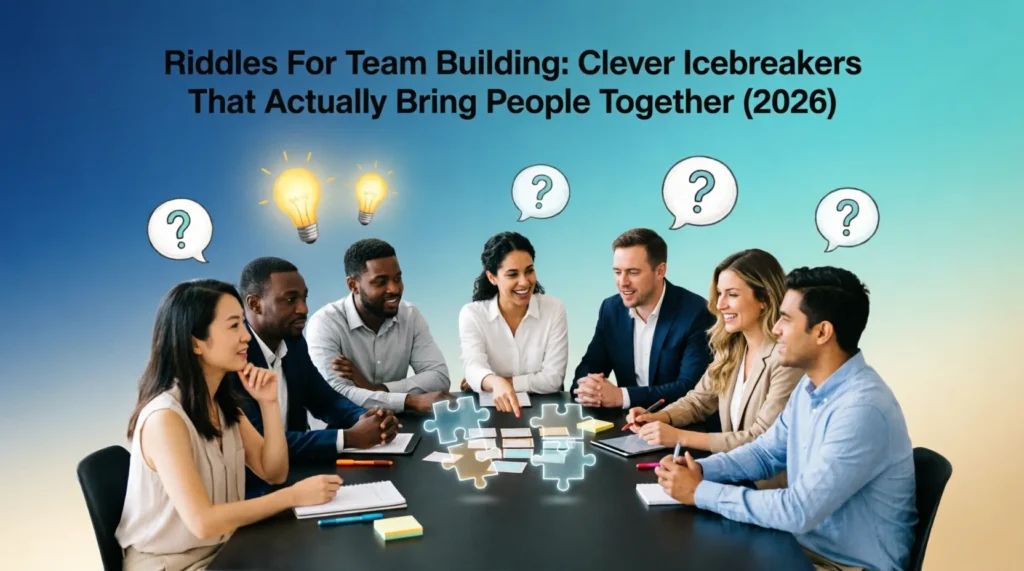
In short, riddles for team building are fun, low-pressure challenges that help coworkers connect, communicate, and think creatively together. They’re perfect for meetings, onboarding sessions, remote teams, and workplace icebreakers that need more energy and less awkward silence. Scroll down and see which riddles your team can solve first.
Team Building Riddles vs. Our Other Workplace Lists
This page is built specifically for group activities — retreats, structured icebreaker sessions, and moments where the whole team solves a riddle together as an exercise, not just a quick laugh. If you’re looking for something a little different, these related guides are worth a look:
Riddles for the Office — casual, everyday riddles for Slack messages and break-room chatter, no group activity required.
Riddles for Work Meetings — fast, single-riddle openers designed to reset a meeting in under two minutes.
Riddles for the Workplace — a broader HR-flavored list for onboarding and company-wide culture moments.
Why Riddles For Team Building Are More Powerful Than You Think
A good team riddle does more than fill a few minutes before a meeting. It creates shared moments where people collaborate, laugh, and think differently together. That matters more than most workplaces realize.
Workplace psychologists often point out that playful problem-solving activities help reduce social tension and encourage participation from quieter team members. When you use riddles for team building, you give everyone a chance to contribute without needing expert knowledge or job-specific skills.
Studies show that short collaborative brain challenges can improve group communication and increase engagement during meetings. Even a five-minute riddle session can shift the mood of a room from passive to energized.
Riddles also level the playing field. Your newest hire and your senior manager can both get stuck on the same puzzle — and that shared experience builds connection fast. Across cultures and industries, riddles have long been used as social tools because they reward curiosity, listening, and creative thinking.
If your team meetings feel repetitive or stiff, adding the right riddle can instantly change the atmosphere.
What Makes a Great Riddles For Team Building
The best riddles for team building are challenging enough to spark discussion but not so hard that people feel frustrated. You want your group talking, guessing, debating, and laughing — not sitting in silence waiting for one genius to solve everything.
A strong workplace riddle usually includes clever wordplay, a surprising twist, or a simple observation people overlook at first. The “aha moment” matters because it creates a shared burst of excitement when the answer finally clicks.
For office settings, the tone also matters a lot. Great team-building riddles stay workplace-safe, inclusive, and easy for different personality types to enjoy. You should avoid humor that feels embarrassing, overly personal, or too competitive.
The strongest riddles encourage collaboration naturally. Instead of rewarding one fast thinker, they invite multiple perspectives. One coworker notices a wording trick, another catches a detail everyone missed, and suddenly the whole team solves it together.
Educators and cognitive scientists often describe riddles as “social thinking exercises” because they activate memory, language, logic, and communication all at once. That combination makes them surprisingly effective for workplace bonding.
And unlike forced icebreakers, riddles feel playful instead of performative. Your team gets to focus on solving something together rather than awkwardly talking about themselves.
Riddles For Team Building: 20 Riddles to Try Right Now
Office Icebreaker Riddles
Riddle: I travel through every department all day long, but I never leave my desk. What am I?
Answer: An email
Riddle: The more coworkers use me, the shorter I become. What am I?
Answer: A pencil
Riddle: I help teams move forward, but I never take a single step. What am I?
Answer: A deadline
Riddle: Everyone waits for me every week, but once I arrive, I disappear quickly. What am I?
Answer: Friday afternoon
Riddle: I can unite a whole office in seconds, especially when I stop working unexpectedly. What am I?
Answer: The Wi-Fi
Riddle: I’m shared in meetings, stolen during breaks, and needed every Monday morning. What am I?
Answer: Coffee
Riddle: I have many windows, but no fresh air comes through me. What am I?
Answer: A computer
Collaboration and Communication Riddles
Riddle: The more people add to me, the clearer I become. What am I?
Answer: A brainstorm
Riddle: I grow stronger when shared, but weaker when ignored. What am I?
Answer: Team trust
Riddle: I can solve problems faster when many people carry me, but I’m not heavy. What am I?
Answer: Responsibility
Riddle: You hear me in every meeting, yet nobody can hold me. What am I?
Answer: An idea
Riddle: I connect teammates across cities and time zones, but I’m not a road. What am I?
Answer: A video call
Riddle: The less you listen to me, the bigger workplace problems become. What am I?
Answer: Feedback
Creative Thinking Team Riddles
Riddle: Two coworkers look at the same chart. One sees a problem, the other sees an opportunity. What changed?
Answer: Their perspective
Riddle: I’m often broken during successful team building sessions, but nobody gets in trouble. What am I?
Answer: The ice
Riddle: A manager gives everyone on the team the same challenge, but every answer is different and correct. What is the challenge?
Answer: A creative idea session
Riddle: I can fill an entire meeting room without taking up any space. What am I?
Answer: Conversation
Riddle: The more mistakes your team admits, the smarter the team becomes. Why?
Answer: Because they learn from them
Riddle: What gets bigger every time a team shares it?
Answer: Knowledge
Riddle: I start with one voice but become much stronger with many. What am I?
Answer: Collaboration
🎯 More riddles for team building: Easy, Medium, and Hard Challenges
Easy Riddles for riddles for team building (Grades 6–7)
These easy challenges are perfect for younger middle school students who enjoy observation, simple logic, and playful thinking.
Riddle: I belong to everyone on a team, but no one can carry me in their backpack. What am I? Answer: Team spirit
Riddle: The more teammates use me, the stronger I become. What am I? Answer: Trust
Riddle: I can travel across a classroom without moving my feet. What am I? Answer: A message
Riddle: I have many voices but only one goal. What am I? Answer: A team
Riddle: I grow when people share me, but shrink when people keep me to themselves. What am I? Answer: An idea
Riddle: Everyone can stand in me during a game, but I am not a room. What am I? Answer: A circle
Medium Riddles for riddles for team building (Grades 7–8)
These medium-level riddles encourage teamwork, reasoning, and connecting multiple clues.
Riddle: Five students build a tower. Each student adds one block. The tower has five blocks, but one student never touched a block. How is that possible? Answer: One student gave directions while the others placed the blocks.
Riddle: A group has four puzzles to solve. Every puzzle requires two students working together. What is the smallest number of students needed to solve all four puzzles at the same time? Answer: Eight students
Riddle: A team captain is always ahead of the team but never leaves it. How? Answer: The captain leads from the front of the group.
Riddle: Three teammates each bring a different snack: apples, crackers, and popcorn. Mia did not bring apples. Jordan did not bring popcorn. Sam did not bring crackers. Who brought apples? Answer: Sam
Riddle: Everyone on a team receives the same instructions, yet they all contribute something different. Why? Answer: Each person has a different role or perspective.
Riddle: A group challenge requires one recorder, one speaker, and one timekeeper. Three students volunteer. How many roles can be filled? Answer: Three
Riddle: The more people who listen to me carefully, the fewer mistakes are made. What am I? Answer: Instructions
Hard Riddles for riddles for team building (Grade 8 and Up)
These harder riddles use clever reasoning, abstract thinking, and a bit of misdirection.
Riddle: A team of six solved a mystery. Every member discovered a clue, but only one clue revealed the answer. Without the other five clues, the answer could never have been found. Why? Answer: The clues worked together to provide the full picture.
Riddle: I cannot be seen, measured, or touched, but losing me can break a team faster than losing any tool. What am I? Answer: Trust
Riddle: A group wins a challenge because one member made a mistake. How can that happen? Answer: The mistake revealed a better solution.
Riddle: The smartest person in the room solves fewer problems than the team. Why? Answer: A team combines multiple ideas and perspectives.
Riddle: I am created when people disagree respectfully and think carefully. What am I? Answer: A stronger solution
Riddle: Every team member owns me equally, but no one can divide me into pieces. What am I? Answer: Success
Riddle: The more different I become, the stronger I grow. What am I? Answer: A team with diverse ideas
Tip for teachers and parents: Start with easy riddles to build confidence and participation, then gradually increase the difficulty as students become more comfortable sharing ideas. Mixing difficulty levels helps every learner experience success while still encouraging critical thinking and collaboration.
📚 Subject-Specific riddles for team building: Math, Science, and More
Math Riddles for riddles for team building
These math-themed riddles encourage students to think about numbers, patterns, and problem-solving in a fun way.
Riddle: I am an odd number. Remove one letter from my name, and I become even. What number am I? Answer: Seven
Riddle: I have four equal sides and four corners. What shape am I? Answer: A square
Riddle: Two numbers add up to 10 and multiply to 24. What are they? Answer: 4 and 6
Riddle: What comes next in the pattern: 2, 4, 8, 16, ___? Answer: 32
Riddle: I am a number with three digits. My hundreds digit is 5, my tens digit is 2, and my ones digit is 7. What number am I? Answer: 527
Science Riddles for riddles for team building
These science-inspired riddles connect everyday observations to key scientific concepts.
Riddle: I help plants make food using sunlight, water, and air. What process am I? Answer: Photosynthesis
Riddle: I am all around you, but you cannot usually see me. I help you breathe every day. What am I? Answer: Air
Riddle: I can be solid, liquid, or gas and still be the same substance. What am I? Answer: Water
Riddle: I pull a dropped pencil toward the floor every time. What force am I? Answer: Gravity
Riddle: I am Earth’s natural satellite and reflect sunlight at night. What am I? Answer: The Moon
Language Riddles for riddles for team building
These wordplay riddles help students explore vocabulary, spelling, and language patterns.
Riddle: What five-letter word becomes shorter when you add two letters to it? Answer: Short
Riddle: Which English word contains all five vowels in order? Answer: Facetious
Riddle: I begin with the letter E, end with the letter E, and contain only one letter. What am I? Answer: An envelope
Riddle: Remove the first letter from me and I still sound the same. Remove another letter and I still sound the same. What word am I? Answer: Empty
Riddle: What word becomes a different word every time you remove a letter: start, tart, art, at? Answer: Start
Ideas for teachers:
Use subject riddles as daily warm-up activities to activate prior knowledge before a lesson.
Turn riddles into exit tickets where students explain not only the answer but also their reasoning.
Create small-group competitions where teams solve subject-specific riddles and discuss their strategies together.
How to Use Riddles For Team Building for Maximum Fun
Start meetings with one quick riddle to energize the room.
Divide your team into small groups and let them solve riddles together.
Use riddles in Slack or Microsoft Teams channels for daily engagement.
Add riddles to onboarding sessions to help new employees feel comfortable faster.
Turn riddles into friendly competitions during workshops or retreats.
Use themed riddles connected to your company culture, projects, or goals.
You don’t need a giant corporate event to make riddles work. In fact, short and casual often works better. A quick challenge before a weekly meeting can create more natural interaction than a long formal icebreaker exercise.
Timing matters too. If your team looks mentally drained, use lighter observational riddles instead of complex logic puzzles. If the group is energetic and competitive, harder challenges can create exciting discussions.
Remote teams especially benefit from riddles for team building because they create shared experiences without requiring personal oversharing. Even a simple five-minute guessing session can help distributed coworkers feel more connected.
The key is consistency. When your team expects small moments of fun and collaboration, meetings begin to feel more human and less transactional.
Tips for Sharing Riddles For Team Building Without Spoiling the Fun
When you present a riddle, give your team enough time to think before revealing the answer. Silence can feel awkward at first, but that pause is usually where the best ideas appear.
Encourage wild guesses instead of only rewarding correct answers. Sometimes the funniest wrong answer creates the biggest laugh and loosens up the entire room.
You should also adjust difficulty based on your group. If people look confused for too long, offer small hints instead of ending the game abruptly. A good hint keeps the energy alive without giving everything away.
Try rotating who reads the riddles aloud. That small change increases participation and helps quieter teammates feel included naturally.
Most importantly, keep the atmosphere light. Team-building riddles work best when people feel relaxed enough to think creatively without worrying about looking silly.
Bonus: Riddles For Team Building That Stump Everyone
These bonus riddles are trickier because they rely on lateral thinking, workplace observation, and unexpected twists. They’re great for experienced teams that already enjoy puzzle-style collaboration.
Riddle: Everyone in the office has it, but nobody can lose it. What is it?
Answer: Their role
Riddle: A team becomes more productive after removing something instead of adding something. What did they remove?
Answer: Confusion
Riddle: What can pass through an entire company without opening a single door?
Answer: Information
Riddle: The smartest person in the meeting says the fewest words. Why?
Answer: They’re listening carefully
Riddle: A remote team meets every day, yet nobody travels anywhere. What are they building?
Answer: Connection
Riddle: What increases when your team admits uncertainty?
Answer: Trust
Riddle: One employee can start it, but the entire workplace can feel it within minutes. What is it?
Answer: Positive energy
Riddles for Retreats, Offsites, and Team Events
While our team building brain teasers collection is built for quick daily warm-ups, these riddles for team building are designed for bigger moments — company retreats, offsites, and dedicated team-building days where you have more time to let a group really work through a challenge together.
5 Extra Team-Building Riddles
We are stronger together but useless alone — think of us like puzzle pieces. What are we?Answer: A team.
I am built slowly through small actions but can be broken in a single moment. What am I?Answer: Trust.
I have no single owner, yet everyone in the room contributes to me. What am I?Answer: A shared goal.
I grow louder when everyone agrees and quieter when no one speaks up. What am I?Answer: Consensus.
I am the space where ideas are shared freely without judgment. What am I?Answer: A brainstorm.
FAQs About Riddles For Team Building
Are riddles for team building good for remote teams?
Yes, they work extremely well for remote teams because they create quick shared experiences without needing physical activities. You can use them in video calls, chat channels, or virtual happy hours to encourage interaction and teamwork naturally.
How long should a team-building riddle activity last?
Most teams respond best to short sessions between 5 and 15 minutes. The goal is to energize people, not overwhelm them. A few well-chosen riddles often work better than a long puzzle marathon.
Can riddles for team building improve communication?
They absolutely can. Many riddles encourage active listening, collaborative thinking, and group discussion. Workplace psychologists often recommend short problem-solving exercises because they help teams practice communication in a low-pressure setting.
What types of riddles work best in professional offices?
Clean, inclusive riddles with clever twists usually perform best. Workplace-safe humor, observational puzzles, and collaborative logic riddles help people engage without making anyone uncomfortable or singled out.
Are riddles better than traditional icebreakers?
For many teams, yes. Traditional icebreakers can feel forced because they focus heavily on personal sharing. Riddles shift the attention toward solving something together, which often feels more natural and enjoyable for employees.
The more you take, the more you leave behind. What am I? Answer: Footsteps.
Final Thoughts: Keep the Fun Going with Riddles For Team Building
The best riddles for team building do something surprisingly simple: they help people feel comfortable thinking together. That matters whether you’re running a small startup, managing a remote department, or leading a giant office meeting.
You don’t need expensive retreats or complicated workshops to create stronger team connections. Sometimes all it takes is one clever question that gets everyone talking, laughing, and collaborating for a few minutes.
As your team gets used to solving riddles together, you may notice bigger changes too. Conversations become easier, brainstorming becomes more open, and meetings feel more energized instead of routine.
A shared laugh over a tricky riddle today can become the spark for better teamwork tomorrow.
Frequently Asked Questions
How do riddles help improve team communication?▼
Riddles encourage playful problem-solving, which can reduce social tension and promote participation from quieter team members. This collaborative approach fosters communication and engagement, making it easier for teams to share ideas and connect with one another.
What qualities make a riddle suitable for team building?▼
A great team-building riddle should be challenging enough to spark discussion but not overly difficult, ensuring everyone can participate. It often includes clever wordplay or surprising twists that lead to an ‘aha moment,’ creating excitement and shared experiences among team members.
Can riddles benefit remote teams?▼
Yes, riddles can be particularly effective for remote teams as they provide a fun, low-pressure way to connect and engage during virtual meetings. Incorporating riddles can energize the atmosphere and help team members bond despite geographical distances.
What types of riddles should be avoided in a workplace setting?▼
It’s best to avoid riddles that feature humor that may be embarrassing, overly personal, or competitive. Riddles should remain inclusive and accessible to all personality types to ensure a positive experience for everyone involved.
How can riddles shift the mood of a meeting?▼
Even a brief riddle session can change the dynamic of a meeting from passive to energized by encouraging laughter and collaboration. This shift can make meetings feel less repetitive and more engaging, breaking the ice and fostering a more open environment.
What are some examples of effective office icebreaker riddles?▼
Effective office icebreaker riddles include: ‘I travel through every department all day long, but I never leave my desk. What am I?’ (Answer: An email) and ‘The more coworkers use me, the shorter I become. What am I?’ (Answer: A pencil). These riddles foster discussion and laughter among team members.
Why are riddles considered 'social thinking exercises'?▼
Riddles are termed ‘social thinking exercises’ because they engage multiple cognitive processes such as memory, language, logic, and communication. This holistic activation helps facilitate team bonding and collaboration, making them a powerful tool for enhancing workplace relationships.
Ethan is a puzzle enthusiast and lead writer at FunRiddlezone.com, where he focuses on creating and breaking down riddles that challenge the mind while keeping things fun and engaging. He specializes in turning tricky questions, wordplay, and logic puzzles into clear, satisfying explanations that actually make sense — not confusing or overcomplicated answers.
Drawing from logic, pattern recognition, and creative thinking, Ethan approaches riddles as mental exercises designed to sharpen thinking skills and spark curiosity. Instead of treating riddles as random tricks, he explains the reasoning behind each one, helping readers understand how to think through problems step by step.
He pays close attention to wording, hidden clues, and subtle misdirection — the key elements that make riddles both challenging and enjoyable. From classic brain teasers to tricky modern riddles, Ethan ensures that every puzzle is not just solved, but fully understood.
At FunRiddlezone.com, his mission is simple: make riddles more than just questions — turn them into a fun way to train your brain. He doesn’t just give answers — he helps readers think sharper, spot patterns faster, and enjoy the process of solving.