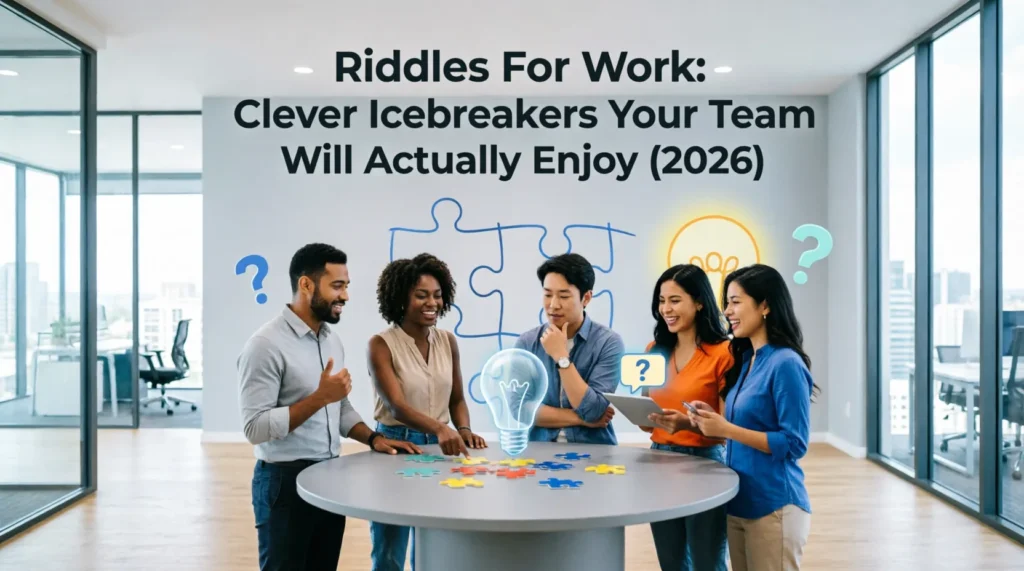
In short, riddles for work are fun, professional brain teasers designed to spark conversation, boost team energy, and make meetings feel less robotic. They’re perfect for team huddles, onboarding sessions, Slack channels, and Friday fun breaks—and some of these riddles might become your office’s favorite tradition.
These riddles are built for the workday specifically — short enough for a coffee-break Slack message or a two-minute meeting opener, with no setup required.
Why Riddles For Work Are More Powerful Than You Think
A good workplace riddle does more than fill awkward silence. It gives your team a quick mental reset, encourages creative thinking, and helps people connect without forced small talk.
Workplace psychologists often point out that short collaborative challenges can improve team communication and lower stress during busy workdays. That matters whether you work in a fast-moving office, a remote team, or a hybrid setup where people rarely get casual moments together.
Studies show that light workplace activities tied to humor and problem-solving can improve employee engagement and participation during meetings. That’s one reason riddles for work have become popular in Slack channels, virtual meetings, and team-building sessions.
The best part? You don’t need to be “the funny coworker” to use them. A simple riddle can instantly make your next meeting feel more human, relaxed, and memorable.
What Makes a Great Riddle For Work
The best workplace riddles hit a very specific balance. They should be clever enough to make people think, but easy enough that nobody feels embarrassed for missing the answer.
A great work riddle usually includes clean humor, a little misdirection, and a satisfying “aha” moment. You want your coworkers to laugh, groan, or immediately share the riddle with someone else. That reaction is what keeps people engaged.
Tone matters, too. Unlike party riddles or edgy adult jokes, riddles for work should stay professional and inclusive. That means avoiding anything offensive, overly personal, or divisive. The goal is to create connection—not awkwardness.
The strongest workplace riddles also feel relatable. They often involve meetings, emails, coffee, deadlines, office supplies, remote work, or common team experiences. When people recognize themselves in the setup, the punchline lands harder.
Educators and cognitive scientists often describe riddles as “low-pressure mental workouts.” In workplace settings, that makes them especially useful because they challenge your brain without feeling like another task on your to-do list.
Riddles For Work: 20 Riddles to Try Right Now
Office Life Riddles
Riddle: I travel through every department all day long, but I never leave my desk. What am I?
Answer: An email
Riddle: The more meetings I attend, the less work I seem to finish. What am I?
Answer: A calendar
Riddle: I’m full of numbers, but nobody wants to open me on Monday morning. What am I?
Answer: A spreadsheet
Riddle: I’m always running out, even though nobody can physically see me disappearing. What am I?
Answer: Time
Riddle: Everyone waits for me on Friday, but I disappear by Monday morning. What am I?
Answer: The weekend
Riddle: I help people stay awake during meetings, but I’m never invited to speak. What am I?
Answer: Coffee
Riddle: The more you click me, the less organized your desktop becomes. What am I?
Answer: The “Save As” button
Teamwork and Communication Riddles
Riddle: I become stronger when everyone shares me, but weaker when one person keeps me. What am I?
Answer: Team knowledge
Riddle: I can build trust in seconds or destroy it with one reply-all mistake. What am I?
Answer: Communication
Riddle: I start every project, survive every deadline, and somehow still get blamed at the end. What am I?
Answer: The group chat
Riddle: Everyone contributes to me, but nobody wants ownership when I go wrong. What am I?
Answer: A team project
Riddle: I’m easiest to ignore when things are busy, but hardest to fix when forgotten. What am I?
Answer: Feedback
Riddle: I can make a five-minute task last an hour if too many people join me. What am I?
Answer: A meeting
Remote Work Riddles
Riddle: I freeze during important presentations and magically recover after the meeting ends. What am I?
Answer: The internet connection
Riddle: I’m technically “working from home,” but I spend half the day looking for quiet. What am I?
Answer: A remote worker
Riddle: I let people speak without unmuting themselves. What am I?
Answer: The chat box
Riddle: I’m the tiny square where everyone pretends to look attentive. What am I?
Answer: A video call window
Workplace Humor Riddles
Riddle: What gets longer the closer it gets to 5 p.m.?
Answer: The last hour of the workday
Riddle: Why did the sticky note get promoted?
Answer: Because it always stuck to the plan
Riddle: What’s the quietest part of most meetings?
Answer: The moment after “Any questions?”
Riddle: Why was the office chair so confident?
Answer: Because it always had support
🎯 More riddles for work: Easy, Medium, and Hard Challenges
Easy Riddles for riddles for work (Grades 6–7)
These easy riddles are perfect for grades 6–7 and help build confidence through simple observations and playful thinking.
Riddle: I have four corners, but I am not a square. You can open me and fill me with ideas. What am I? Answer: A notebook.
Riddle: I get shorter every time you use me, but I help you make things longer. What am I? Answer: A pencil.
Riddle: I travel around a classroom many times but never take a step. What am I? Answer: A paper worksheet.
Riddle: I have pages but never tell a lie unless someone writes one in me. What am I? Answer: A journal.
Riddle: The more classmates I hold, the lighter I become. What am I? Answer: A balloon.
Riddle: I can be full of numbers or stories, but I never speak aloud. What am I? Answer: A book.
Medium Riddles for riddles for work (Grades 7–8)
These medium-level riddles are great for grades 7–8 and encourage logical thinking and careful reading.
Riddle: Mia has three brothers. Each brother has one sister. How many sisters does Mia have? Answer: One—Mia is the only sister.
Riddle: You write my name with five letters. Remove two letters and I still sound the same. What word am I? Answer: Empty (remove “m” and “t” to get “epy,” which sounds like “empty” when spoken quickly is unfair—better answer: Stone → tone? No. “Queue” becomes “que”? Let’s use “Empty” isn’t fair.) Queue. Remove four letters and it is still pronounced “Q.”
Riddle: Three students shared 24 stickers equally. Later, each gave away 2 stickers. How many stickers do they have altogether? Answer: 18.
Riddle: I always arrive tomorrow, but I never become today. What am I? Answer: The word “tomorrow.”
Riddle: If two clocks ring every 15 minutes and 20 minutes, after how many minutes will they ring together again? Answer: 60 minutes.
Riddle: I grow when you organize me and shrink when you ignore me. Teachers love when I am complete. What am I? Answer: Your homework checklist.
Riddle: I can divide a room without building a wall. What am I? Answer: A curtain or partition.
Hard Riddles for riddles for work (Grade 8 and Up)
These challenging riddles are best for grade 8 and up and reward abstract thinking, pattern spotting, and clever reasoning.
Riddle: Two students look at the same number. One says it’s six, and the other says it’s nine. They’re both correct. How? Answer: They are standing on opposite sides of the number.
Riddle: I disappear whenever everyone notices me. What am I? Answer: Silence.
Riddle: I can be broken without ever being touched, and once broken, people may speak more carefully. What am I? Answer: A promise.
Riddle: A teacher writes all the numbers from 1 to 100. Which digit appears most often? Answer: The digit 1.
Riddle: I become more useful when I am shared, but less useful when I am copied without understanding. What am I? Answer: Knowledge.
Riddle: Four friends each shake hands once with every other friend. How many handshakes happen altogether? Answer: Six.
Riddle: I am something you can keep after giving me away. What am I? Answer: Your word.
Using difficulty tiers helps every learner find an appropriate challenge while building confidence. Try mixing levels during classroom games or family activities so students can stretch their thinking at their own pace.
📚 Subject-Specific riddles for work: Math, Science, and More
Math Riddles for riddles for work
These math riddles turn patterns, numbers, and problem-solving into a fun classroom challenge.
Riddle: I have three sides and three corners. Who am I? Answer: A triangle.
Riddle: What number becomes larger when you turn it upside down? Answer: Six (it becomes nine).
Riddle: I am an odd number. Remove one letter and I become even. What number am I? Answer: Seven.
Riddle: What comes next in the pattern: 2, 4, 8, 16, ___? Answer: 32.
Riddle: If a dozen pencils are shared equally among four students, how many pencils does each student get? Answer: Three.
Science Riddles for riddles for work
These science riddles introduce familiar concepts from biology, chemistry, physics, and earth science in a playful way.
Riddle: I help plants make their food, but I never eat lunch myself. What am I? Answer: Sunlight.
Riddle: I fall from clouds, fill rivers, and return to the sky without climbing. What am I? Answer: Water.
Riddle: I pull everything toward Earth, though you cannot see me. What am I? Answer: Gravity.
Riddle: I am the gas people breathe in to stay alive, but I am invisible. What am I? Answer: Oxygen.
Riddle: I am made of molten rock deep underground before becoming lava at the surface. What am I? Answer: Magma.
Language Riddles for riddles for work
These language riddles encourage students to explore letters, vocabulary, and clever wordplay.
Riddle: What word becomes shorter when you add two letters to it? Answer: Short (it becomes shorter).
Riddle: Which English word has all five vowels in order? Answer: Abstemious.
Riddle: Remove the first letter from me and I still sound the same. Remove another and I still sound the same. What word am I? Answer: Empty (empty → mpty → pty all sound like their spoken forms of the remaining letters).
Riddle: I begin every sentence but am never the first word. What am I? Answer: A capital letter.
Riddle: What punctuation mark asks for answers without speaking? Answer: A question mark.
Teachers can use subject-specific riddles to:
Start lessons with a five-minute warm-up challenge.
Use them as exit tickets to review key concepts in a fun way.
Divide students into small groups and award points for teamwork and explanations.
🎯 More Riddles for Work: Easy, Medium, and Hard Challenges
Easy Riddles for Riddles for Work (Grades 6–7)
These easy riddles are perfect for beginners and anyone who enjoys quick workplace-themed brain teasers.
Riddle: I help everyone get organized, but I’m not a person. I’m filled with dates and reminders. What am I? Answer: A calendar
Riddle: The more people add to me during a meeting, the longer I become. What am I? Answer: An agenda
Riddle: I travel from desk to desk without moving my feet. What am I? Answer: An email
Riddle: I can hold hundreds of ideas, but I’m thinner than a sandwich. What am I? Answer: A notebook
Riddle: You can click me, drag me, and drop me, but I’m not a toy. What am I? Answer: A computer file
Riddle: I have a face and hands, but I never type a report. What am I? Answer: A clock
Medium Riddles for Riddles for Work (Grades 7–8)
These medium-level riddles require a little more logic and are great for students ready for an extra challenge.
Riddle: Three coworkers enter a meeting room. One brings a laptop, one brings notes, and one brings neither. The meeting requires only one laptop and one set of notes. How many people are fully prepared? Answer: Two people
Riddle: A manager schedules a meeting every Friday. This week, Friday becomes a holiday. The meeting is moved one day earlier. What day is the meeting? Answer: Thursday
Riddle: I’m shared by a team, but nobody owns me alone. Everyone can add to me, and everyone can benefit from me. What am I? Answer: A shared document
Riddle: If every employee shakes hands with every other employee exactly once, and there are four employees, how many handshakes occur? Answer: Six
Riddle: A printer can print 20 pages in 2 minutes. At the same speed, how many pages can it print in 5 minutes? Answer: 50 pages
Riddle: The more tasks you finish, the shorter I become. What am I? Answer: A to-do list
Riddle: I’m often opened before work begins and checked before work ends. I contain messages but I’m not a mailbox outside. What am I? Answer: An email inbox
Hard Riddles for Riddles for Work (Grade 8 and Up)
These harder riddles use clever thinking, misdirection, and workplace logic for experienced puzzle solvers.
Riddle: A team of five people sits around a circular table. Everyone sits between two coworkers. How many neighbors does each person have? Answer: Two
Riddle: I can increase productivity when I disappear. What am I? Answer: A distraction
Riddle: A worker completes one-third of a project on Monday, one-third on Tuesday, and the rest on Wednesday. What fraction was completed on Wednesday? Answer: One-third
Riddle: Two coworkers start the same task at the same time. One works twice as fast as the other. By the time the slower worker finishes half the task, how much has the faster worker completed? Answer: The entire task
Riddle: I’m often measured, discussed, and improved, but I cannot be seen or touched. What am I? Answer: Productivity
Riddle: A report is copied from one folder to another. How many reports exist afterward if the original remains? Answer: Two reports
Riddle: Everyone at work wants more of me, but if you manage me poorly, I seem to disappear. What am I? Answer: Time
Tip for teachers and parents: Start with easy riddles to build confidence and encourage participation from everyone. Then gradually introduce medium and hard challenges to develop reasoning skills and spark deeper discussions.
How to Use Riddles For Work for Maximum Fun
Start team meetings with one quick riddle to energize the room.
Post a daily or weekly riddle in your Slack or Teams channel.
Use riddles during onboarding to help new employees feel included faster.
Turn riddles into mini team competitions with small prizes or bragging rights.
Add workplace riddles to training sessions to break up long presentations.
Use them during virtual happy hours or remote team-building events.
You don’t need a giant event to make riddles work. Even one clever question can shift the energy of a meeting and help people loosen up before serious discussions begin.
Timing also matters. Short riddles work best at transitions—before brainstorming sessions, after lunch, or during moments when attention naturally dips. You’ll often notice people becoming more talkative and collaborative after a quick challenge.
If your team is remote, riddles can create a shared moment that feels surprisingly personal. In many virtual workplaces, those small moments are what build stronger culture over time.
Tips for Sharing Riddles For Work Without Spoiling the Fun
Don’t rush the answer. Give your coworkers a few moments to think, guess, and debate before revealing it. Half the fun comes from hearing the creative wrong answers people invent.
Keep your tone light and playful. If someone doesn’t solve the riddle, move on quickly and celebrate funny guesses instead of focusing on who got it right.
You should also adjust the difficulty based on your audience. A fast-paced sales team might enjoy sharper wordplay, while a mixed department meeting may respond better to simple observational humor.
If you’re using riddles regularly, vary the style. Mix office humor with logic riddles, communication puzzles, and teamwork themes so the experience stays fresh.
Most importantly, keep riddles short. In work settings, quick wins are better than long, complicated puzzles that derail the meeting.
Bonus: Riddles For Work That Stump Everyone
These bonus riddles are a little trickier and more unexpected. They’re perfect when your team already loves workplace brain teasers and wants a bigger challenge.
Riddle: I’m copied constantly at work, yet people get nervous when they see too many of me. What am I?
Answer: People CC’d on an email
Riddle: I can shrink a project timeline without changing a single deadline. What am I?
Answer: Better prioritization
Riddle: Everyone says they want fewer of me, but they keep scheduling more. What am I?
Answer: Meetings
Riddle: I help teams move faster, but too much of me creates confusion. What am I?
Answer: Multitasking
Riddle: I’m invisible in a healthy workplace but obvious the second I disappear. What am I?
Answer: Trust
Riddle: The more experienced you become at work, the shorter I seem. What am I?
Answer: The workweek
Riddle: I’m often called “open,” but people still hesitate to walk through me. What am I?
Answer: An open-door policy
Riddles for Work Outside of Meetings
Not every workplace riddle needs a conference room. These riddles for work are just as at home in a Slack channel, a lunch break, or a quick water-cooler chat between tasks. Save the meeting-specific icebreakers for our riddles for work meetings page, and use this list any time you want to add a little fun to the regular workday — no agenda required.
5 Extra Water-Cooler Riddles
I get passed around the office but never wear out. What am I?Answer: An idea.
I fill up fast on Monday and empty out by Friday. What am I?Answer: An inbox.
I have a deadline but no clock hands. What am I?Answer: A due date.
I keep the coffee hot and the gossip hotter. Where am I?Answer: The break room.
I am typed all day but never spoken aloud. What am I?Answer: An email.
FAQs About Riddles For Work
Are riddles for work good for team building?
Yes, especially when they’re short, inclusive, and easy to participate in. Workplace psychologists often recommend low-pressure group activities because they encourage communication without making employees feel forced into uncomfortable bonding exercises.
How long should workplace riddles take?
Most work riddles should take under two minutes. You want quick engagement and energy, not a 20-minute distraction that throws off the meeting schedule.
Can riddles for work be used in virtual meetings?
Absolutely. In fact, riddles work especially well in remote settings because they create instant interaction. A quick riddle in Zoom, Teams, or Slack can help remote employees feel more connected and involved.
What makes riddles for work different from regular riddles?
Workplace riddles focus on professional, relatable situations like meetings, teamwork, communication, deadlines, and office culture. They’re designed to stay clean, inclusive, and comfortable for mixed groups.
Are riddles for work appropriate for managers and leadership teams?
Definitely. Managers often use riddles as icebreakers, morale boosters, and creative thinking exercises. They can help leaders create a more approachable atmosphere without forcing artificial fun.
Final Thoughts: Keep the Fun Going with Riddles For Work
Workdays can become repetitive fast. That’s why small moments of humor and curiosity matter more than people realize.
Riddles for work give your team a chance to pause, laugh, think creatively, and connect in a natural way. They turn ordinary meetings into conversations people actually remember.
You don’t need a giant company event or expensive team-building program to create better workplace energy. Sometimes one clever question is enough to shift the mood of the entire room.
The more your team shares moments like these, the easier collaboration becomes—and the more enjoyable work starts to feel.
A great workplace riddle doesn’t just challenge your brain; it reminds people that work can still be fun.
Frequently Asked Questions
What are the benefits of using riddles in a workplace setting?▼
Riddles can spark conversation, boost team energy, and make meetings feel less robotic. They serve as quick mental resets that encourage creative thinking and help team members connect without forced small talk.
How should a workplace riddle be structured?▼
A great workplace riddle should strike a balance between cleverness and accessibility, making it easy enough that no one feels embarrassed for missing the answer. It often includes clean humor, a bit of misdirection, and should feel relatable to common workplace experiences.
Are there specific types of riddles that work best for teams?▼
Yes, the strongest workplace riddles often revolve around themes like meetings, emails, coffee, and deadlines. These relatable topics resonate with employees and enhance the engagement during team activities.
What tone should workplace riddles maintain?▼
Workplace riddles should remain professional and inclusive, avoiding anything offensive or divisive. The goal is to foster connection and enjoyment among team members, rather than awkwardness.
Can riddles improve employee engagement during meetings?▼
Absolutely! Light workplace activities like riddles tied to humor and problem-solving can significantly improve employee participation and engagement during meetings, making them more enjoyable and memorable.
How can I introduce riddles into my team's routine?▼
You can incorporate riddles into team huddles, onboarding sessions, or even Slack channels to lighten the mood and encourage interaction. Consider dedicating time during meetings or Friday fun breaks to share a riddle and foster team bonding.
What makes a riddle memorable for coworkers?▼
A memorable riddle often elicits laughter or an ‘aha’ moment when the punchline lands. When coworkers recognize themselves in the setup and feel the humor, they are more likely to share the riddle with others.
Ethan is a puzzle enthusiast and lead writer at FunRiddlezone.com, where he focuses on creating and breaking down riddles that challenge the mind while keeping things fun and engaging. He specializes in turning tricky questions, wordplay, and logic puzzles into clear, satisfying explanations that actually make sense — not confusing or overcomplicated answers.
Drawing from logic, pattern recognition, and creative thinking, Ethan approaches riddles as mental exercises designed to sharpen thinking skills and spark curiosity. Instead of treating riddles as random tricks, he explains the reasoning behind each one, helping readers understand how to think through problems step by step.
He pays close attention to wording, hidden clues, and subtle misdirection — the key elements that make riddles both challenging and enjoyable. From classic brain teasers to tricky modern riddles, Ethan ensures that every puzzle is not just solved, but fully understood.
At FunRiddlezone.com, his mission is simple: make riddles more than just questions — turn them into a fun way to train your brain. He doesn’t just give answers — he helps readers think sharper, spot patterns faster, and enjoy the process of solving.