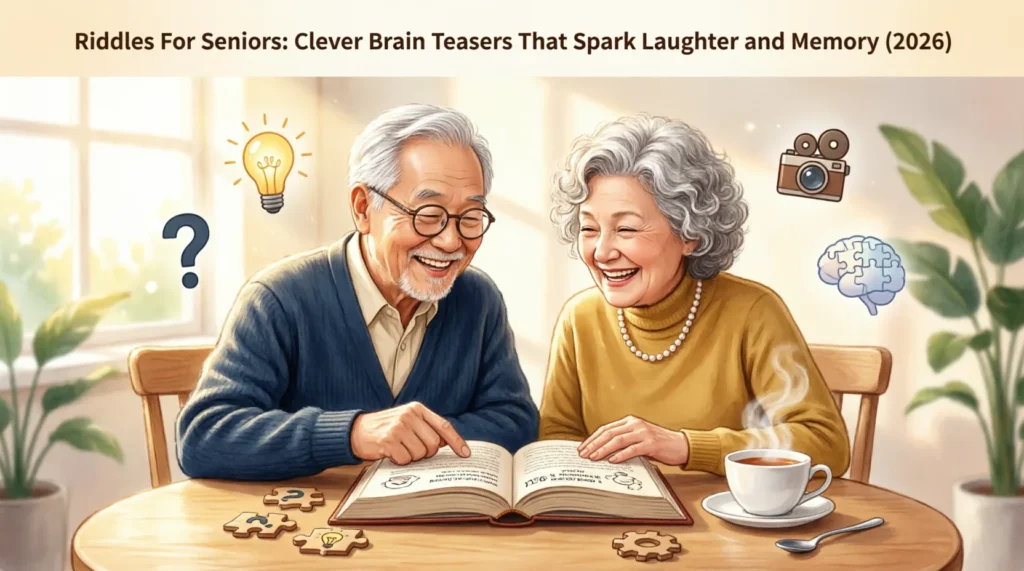
In short, riddles for seniors are fun, low-pressure brain teasers designed to encourage laughter, conversation, memory recall, and mental sharpness. They’re perfect for retirement communities, family gatherings, game nights, or simply enjoying a clever challenge with friends. Scroll down and see how many of these senior-friendly riddles you can solve before peeking at the answers.
Why Riddles For Seniors Are More Powerful Than You Think
A good riddle does more than pass the time. For many older adults, riddles create moments of connection, curiosity, and genuine laughter. They encourage you to think creatively, recall memories, and stay mentally active without feeling like “work.”
Cognitive scientists and aging researchers often point to puzzles, wordplay, and problem-solving games as simple ways to keep the mind engaged. Unlike fast-paced trivia games that can feel stressful, riddles for seniors usually reward patience, life experience, and observation.
Studies show that mentally stimulating activities may help older adults maintain stronger memory skills and sharper reasoning over time. Even better, riddles naturally create conversation. One clever question can turn a quiet afternoon into a lively group discussion full of stories, guesses, and friendly debate.
Riddles also work beautifully across generations. You can enjoy them with grandchildren, neighbors, caregivers, or longtime friends. That shared “aha!” moment never really gets old.
What Makes a Great Riddles For Seniors
The best riddles for seniors strike a balance between challenge and fun. They shouldn’t feel impossible, but they also shouldn’t be so easy that the answer appears instantly. A satisfying riddle gives you just enough clues to make your brain work before the answer suddenly clicks into place.
Wordplay is especially effective for older audiences because it rewards life experience and language skills. Many seniors enjoy riddles built around common routines, classic sayings, household objects, seasons, hobbies, or memories from earlier decades. These familiar themes make the riddles feel welcoming rather than confusing.
A great senior-friendly riddle also respects pacing. Long, complicated setups can become frustrating, while short and clever riddles keep energy high in group settings. Educators who work with older adults often note that short-form brain games encourage participation from everyone, even people who usually stay quiet during activities.
Clean humor matters too. The strongest riddles rely on wit, surprise, and observation instead of embarrassing jokes or offensive punchlines. You want the kind of riddle that makes people grin, groan, and immediately ask for another one.
Most importantly, a good riddle creates an “aha moment.” That instant where the answer suddenly feels obvious is what keeps people engaged and eager for the next challenge.
Riddles For Seniors: 20 Riddles to Try Right Now
Everyday Life Riddles
Riddle: I get shorter every time I’m used, but I’m meant to help you see. What am I?
Answer: A candle.
Riddle: The more birthdays I have, the less hair I usually keep. What am I?
Answer: A person.
Riddle: I travel around the world while sitting in the corner of a room. What am I?
Answer: A postage stamp.
Riddle: You use me more after retirement than before, yet I never get tired. What am I?
Answer: A rocking chair.
Riddle: I have numbers, but I never count. I keep moving, but I never walk. What am I?
Answer: A clock.
Riddle: I’m filled with stories from long ago, but I never speak out loud. What am I?
Answer: A photo album.
Riddle: The older I get, the more valuable I may become. But if you break me, people groan. What am I?
Answer: An antique.
Wordplay and Humor Riddles
Riddle: Why did the retired gardener become such a good comedian?
Answer: Because he always knew how to plant a joke.
Riddle: What gets bigger every time you take something away from it?
Answer: A hole.
Riddle: Why don’t calendars ever get lonely?
Answer: Because their days are always full.
Riddle: I can be cracked, played, told, and shared, but I’m not a code. What am I?
Answer: A joke.
Riddle: Why was the old suitcase so relaxed?
Answer: Because it had already been through everything.
Riddle: What kind of room has no doors, no windows, and no furniture?
Answer: A mushroom.
Memory and Observation Riddles
Riddle: I follow you all day long, but disappear when the lights come on. What am I?
Answer: A shadow.
Riddle: The more you dry, the wetter I become. What am I?
Answer: A towel.
Riddle: What belongs to you but gets used by other people more than you use it?
Answer: Your name.
Riddle: I have keys but no locks, space but no rooms, and you can enter but not go inside. What am I?
Answer: A keyboard.
Riddle: I’m easy to lift, but hard to throw. What am I?
Answer: A feather.
Classic Thinking Riddles
Riddle: Two fathers and two sons went fishing, but only three people were there. How?
Answer: They were a grandfather, father, and son.
Riddle: What can run but never walks, has a bed but never sleeps, and has a mouth but never talks?
Answer: A river.
🎯 More riddles for seniors: Easy, Medium, and Hard Challenges
Easy Riddles for riddles for seniors (Grades 6–7)
These easy challenges are perfect for building confidence with simple observation and playful thinking.
Riddle: I have four corners but never leave the ground. What am I? Answer: A room.
Riddle: I follow every page in a book but never read a single word. What am I? Answer: The page number.
Riddle: I become shorter every time someone uses me, but I still do my job. What am I? Answer: A pencil.
Riddle: You can see me before a race, during a game, or after school, but you can never hold me. What am I? Answer: Time.
Riddle: I can be opened without a key and closed without a lock. What am I? Answer: A book.
Riddle: I grow when everyone shares ideas, but I take up no space. What am I? Answer: Knowledge.
Medium Riddles for riddles for seniors (Grades 7–8)
These medium-level riddles are great for students ready to combine clues and think through each answer carefully.
Riddle: Mia is taller than Ben, and Ben is taller than Ava. Who is the shortest? Answer: Ava.
Riddle: Three friends each bring one sandwich. They cut every sandwich in half and share equally. How many half-sandwich pieces are there? Answer: Six.
Riddle: A classroom clock shows 2:30. The minute hand moves to the 6. How many minutes have passed? Answer: Thirty minutes.
Riddle: Every student in a club shakes hands once with every other student. If there are four students, how many handshakes happen? Answer: Six.
Riddle: You write me once, erase me twice, and write me again. Which action happened the most? Answer: Erasing.
Riddle: A word has six letters. Remove the first letter, and five remain. Remove another first letter, and it still makes a word. Keep doing this until one letter is left. What kind of word is it? Answer: A word with valid shorter forms after each first-letter removal.
Riddle: Two classmates finish the same puzzle together. One places more pieces than the other, but both finish at the same time. How is that possible? Answer: They worked on the same puzzle together.
Hard Riddles for riddles for seniors (Grade 8 and Up)
These harder riddles reward careful reasoning, flexible thinking, and spotting clever patterns.
Riddle: I always arrive after today but become today when you meet me. What am I? Answer: Tomorrow.
Riddle: The more carefully you organize me, the easier I become to lose. What am I? Answer: Free time.
Riddle: Everyone owns one of me, but no one can lend it to someone else. What am I? Answer: Your past.
Riddle: I become larger every time you divide me among friends. What am I? Answer: An idea.
Riddle: I can connect two people without touching either of them. What am I? Answer: A conversation.
Riddle: The first step toward solving me is realizing I may not be asking the obvious question. What am I? Answer: A puzzle.
Riddle: I disappear the moment everyone notices me. What am I? Answer: Silence.
Using difficulty levels lets every learner experience success before moving to bigger challenges. Try mixing easy, medium, and hard riddles so everyone has a chance to participate while stretching their thinking.
📚 Subject-Specific riddles for seniors: Math, Science, and More
Math Riddles for riddles for seniors
These math-themed riddles turn numbers, patterns, and shapes into fun brain teasers.
Riddle: I have three sides and three corners. Who am I? Answer: A triangle.
Riddle: Double me and then add four. The answer is twenty. What number am I? Answer: Eight.
Riddle: I come after every even number when you count by ones. What kind of number am I? Answer: An odd number.
Riddle: I stay the same no matter how you turn me upside down: 8 + 8 = 16 still works because the numbers haven’t changed. What mathematical idea does this show? Answer: Numbers keep their value regardless of orientation.
Riddle: I have four equal sides and four right angles. What shape am I? Answer: A square.
Science Riddles for riddles for seniors
These science riddles encourage curiosity about the natural world through everyday observations.
Riddle: Plants use me to make food, and I shine every day. What am I? Answer: Sunlight.
Riddle: I travel through your body carrying oxygen, but I’m not air. What am I? Answer: Blood.
Riddle: I can be solid, liquid, or gas without changing what I am. What am I? Answer: Water.
Riddle: I pull a dropped pencil toward the floor every single time. What force am I? Answer: Gravity.
Riddle: I am made of tiny pieces too small to see, and everything around you is built from me. What am I? Answer: Matter.
Language Riddles for riddles for seniors
These language riddles help students practice vocabulary, spelling, and wordplay while having fun.
Riddle: I make a sentence into a question with just one small mark. What am I? Answer: A question mark.
Riddle: Remove one letter from the word “smile,” and I become something you wear on your face. What am I? Answer: Smile without the “s” becomes “mile”—a reminder that changing one letter creates a new word.
Riddle: I am the beginning of every alphabet but only one letter long. What am I? Answer: The letter A.
Riddle: I connect two complete thoughts without making a new sentence. What punctuation mark am I? Answer: A semicolon.
Riddle: I sound the same as another word but have a different meaning and spelling. What am I called? Answer: A homophone.
Use one subject riddle as a quick warm-up to spark curiosity before introducing a new lesson.
Turn riddles into exit tickets by asking students to explain not just the answer, but how they figured it out.
Have small groups create their own subject-themed riddles and challenge classmates to solve them.
How to Use Riddles For Seniors for Maximum Fun
Use them during family dinners or holiday gatherings to spark conversation.
Bring a few riddles to retirement community activities or social clubs.
Start game nights with a short riddle round before cards or board games.
Share one daily riddle in group chats with friends or relatives.
Use riddles during long car rides to keep everyone engaged.
Turn them into friendly competitions where players earn points for correct answers.
You don’t need fancy equipment or complicated rules to make riddles enjoyable. Often, the funniest moments happen when someone gives a wildly creative wrong answer before the real solution is revealed. Those unexpected guesses become part of the fun.
If you’re using riddles with seniors who prefer a slower pace, allow extra thinking time before revealing the answer. Many older adults enjoy discussing clues out loud and working through possibilities together rather than rushing to finish first.
Riddles also work wonderfully as memory warmups. Activity coordinators, caregivers, and educators often use short brain teasers to help groups become more alert and engaged before starting larger activities.
Tips for Sharing Riddles For Seniors Without Spoiling the Fun
Timing matters when you tell a riddle. Read it slowly and clearly so everyone has a chance to picture the clues in their minds. If you rush through the wording, you can accidentally reveal the trick too early.
Give people enough time to think before offering hints. Seniors often enjoy discussing possibilities together, and that conversation is part of what makes the experience memorable. A quick answer can actually reduce the fun.
You can also adjust difficulty on the fly. If a riddle feels too tricky, offer one extra clue instead of revealing the answer immediately. On the other hand, if your group solves riddles quickly, challenge them to explain why the answer works.
Most importantly, keep the atmosphere light. The goal isn’t to stump people endlessly. It’s to create smiles, curiosity, and moments where everyone feels included.
Bonus: Riddles For Seniors That Stump Everyone
These bonus riddles are a little trickier and rely more on observation, logic, and misdirection. They’re especially fun for puzzle lovers who enjoy thinking one step beyond the obvious answer.
Riddle: A man reads a newspaper every day but never turns a page. Why?
Answer: He reads it on a tablet.
Riddle: What can fill a room without taking up any space?
Answer: Light.
Riddle: I’m taken from a mine, locked in wood, and used by nearly everyone. What am I?
Answer: Pencil lead.
Riddle: The more you relax me, the tighter I become. What am I?
Answer: A knot.
Riddle: What has four wheels and flies?
Answer: A garbage truck.
Riddle: I can be old, new, borrowed, or blue. What am I?
Answer: A song.
Riddle: What disappears as soon as you say its name?
Answer: Silence.
FAQs About Riddles For Seniors
Are riddles for seniors good for brain health?
Many educators and cognitive specialists believe that word games and riddles help encourage mental engagement, memory recall, and flexible thinking. While riddles aren’t magic brain boosters, they can absolutely help keep your mind active in an enjoyable way.
What kinds of riddles do seniors enjoy most?
Most seniors enjoy riddles with clever wordplay, everyday themes, and satisfying “aha” moments. Riddles connected to familiar experiences, humor, hobbies, or classic objects often work especially well because they feel relatable and easy to picture.
Can riddles for seniors be used in group activities?
Absolutely. Riddles are excellent for retirement communities, church groups, family events, and senior centers. They encourage conversation, teamwork, and laughter without requiring physical activity or expensive supplies.
How hard should riddles for seniors be?
The ideal difficulty depends on your group. Some people love quick and simple riddles, while others enjoy more challenging brain teasers. A good mix usually works best because it keeps everyone involved and gives different people a chance to shine.
Are riddles for seniors good for intergenerational fun?
Yes, and that’s one of their biggest strengths. Grandparents, grandchildren, parents, and friends can all enjoy riddles together. Because riddles rely on curiosity rather than age or athletic ability, they naturally bring generations into the same conversation.
Final Thoughts: Keep the Fun Going with Riddles For Seniors
Riddles for seniors offer something surprisingly powerful: laughter mixed with curiosity. They keep conversations moving, encourage creative thinking, and turn ordinary moments into memorable ones.
You don’t need to solve every riddle instantly to enjoy them. Half the fun comes from the guessing, the storytelling, and the playful debates that happen along the way. One clever question can brighten an afternoon more than you might expect.
The more you use riddles, the more naturally they become part of your routines. A quick brain teaser at breakfast, during a phone call, or at a family gathering can help keep minds active and relationships strong.
And sometimes, the best memories begin with someone smiling and saying, “Alright, here’s a good one for you.”
Frequently Asked Questions
What are the benefits of riddles for seniors?▼
Riddles for seniors encourage mental sharpness, memory recall, and laughter, making them a fun way to engage the mind. They also create opportunities for conversation and connection among peers and across generations.
How should riddles for seniors be structured?▼
Great riddles for seniors strike a balance between challenge and fun, avoiding overly complicated setups. Short and clever riddles are preferred as they maintain energy and encourage participation from everyone.
What themes are common in senior-friendly riddles?▼
Senior-friendly riddles often revolve around familiar themes such as common routines, classic sayings, household objects, and memories from earlier decades. These relatable topics help make the riddles feel welcoming and engaging.
Why is wordplay effective in riddles for older adults?▼
Wordplay is particularly effective for older audiences because it taps into their life experience and language skills. Clever wordplay can lead to those satisfying ‘aha moments’ that keep seniors engaged.
Can riddles help in maintaining cognitive skills in seniors?▼
Yes, mentally stimulating activities like riddles may help older adults maintain stronger memory skills and sharper reasoning over time. Cognitive scientists recommend puzzles and word games as enjoyable ways to keep the mind active.
What types of humor should be avoided in riddles for seniors?▼
Riddles for seniors should rely on clean humor, avoiding embarrassing jokes or offensive punchlines. The goal is to make people smile and enjoy the challenge without crossing any lines.
How can I use these riddles at family gatherings?▼
These riddles can be used to spark laughter and conversation during family gatherings, making them perfect icebreakers. They can turn quiet moments into lively discussions, encouraging everyone to share stories and guesses.
Samantha Nguyen has been a literary enthusiast for over 15 years, combining her love for language and pedagogy to craft engaging riddles and puzzles. With a background in Education and Linguistics, Samantha has dedicated her career to making learning fun and accessible to children of all ages. She specializes in seasonal riddles, often weaving in cultural and historical themes to enrich classroom experiences during holidays and special events. Samantha is passionate about crafting puzzles that challenge young minds while also entertaining the whole family. Her riddles are designed to stimulate critical thinking, ensuring they remain a hit during family gatherings and road trips. She joined FunRiddleZone to reach a wider audience and share her passion for creative educational content.