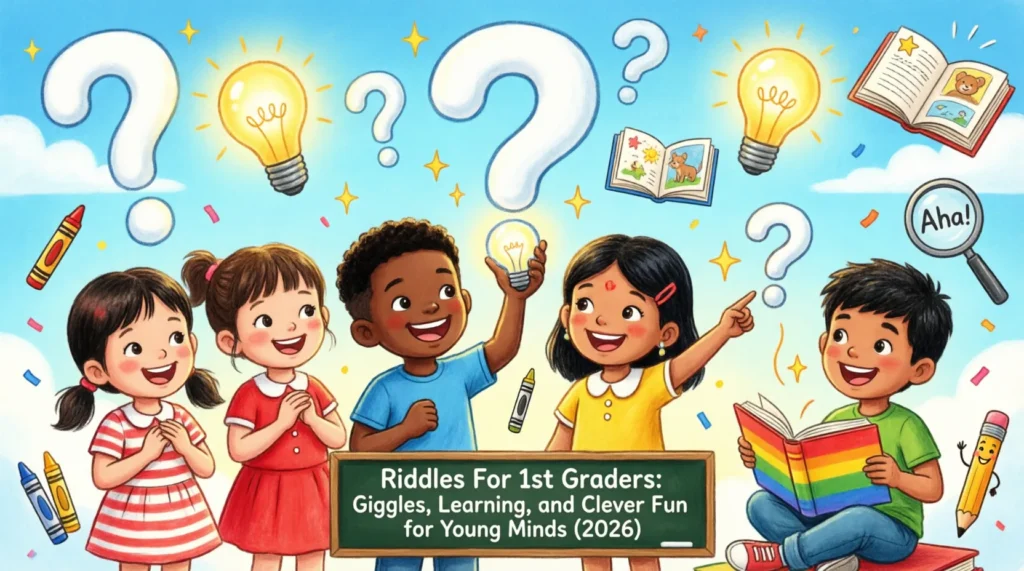
In short, riddles for 1st graders are simple, playful brain teasers designed to help young children think, laugh, and learn at the same time. They’re perfect for classrooms, family game nights, car rides, and anytime you want to spark curiosity. Scroll down and see how many of these kid-friendly riddles your first grader can solve!
Why Riddles For 1st Graders Are More Powerful Than You Think
First graders are naturally curious. They love asking questions, spotting patterns, and figuring things out on their own. That’s exactly why riddles are such a powerful learning tool at this age.
When children solve a riddle, they practice listening carefully, thinking creatively, and making connections between clues. Educators and child development researchers often point to activities like riddles as simple ways to strengthen language skills and critical thinking without making learning feel like work.
Studies show that playful problem-solving activities can help young learners improve memory, vocabulary, and reasoning skills. Even better, riddles create moments of laughter and accomplishment that help children stay engaged.
Riddles for 1st graders also encourage confidence. Every time a child figures out an answer, they experience a small but meaningful success that motivates them to keep learning.
Because riddles are a global tradition enjoyed across cultures, they also help children discover that learning can be fun no matter where they live or what language they speak.
What Makes a Great Riddle For 1st Graders
The best riddles for first graders are simple enough to understand but clever enough to create a satisfying surprise. Young children are still building vocabulary and reasoning skills, so the clues should be clear and age-appropriate.
A great first-grade riddle usually focuses on familiar topics. School supplies, animals, weather, food, numbers, and everyday objects all work well because children already have experience with them.
The magic comes from the “aha moment.” A child hears the clues, thinks through the possibilities, and suddenly realizes the answer. That small burst of discovery is what makes riddles so enjoyable.
Good riddles for this age group also use clean humor and positive themes. You want children to feel included and successful, not confused or frustrated. A little wordplay can be fun, but the answer should still feel fair once it’s revealed.
Most importantly, great riddles invite participation. They encourage children to guess, discuss, and think aloud, turning a simple question into an interactive learning experience.
Riddles For 1st Graders: 20 Riddles to Try Right Now
School and Learning Riddles
Riddle: I help you write your spelling words, but I get shorter every day. What am I?
Answer: A pencil
Riddle: I have many pages but I’m not a bird. I help you learn new things. What am I?
Answer: A book
Riddle: I hang on the wall and show numbers all day. What am I?
Answer: A clock
Riddle: You carry me to school. I hold your books and lunch. What am I?
Answer: A backpack
Riddle: I am white before you use me and colorful after you draw. What am I?
Answer: Paper
Riddle: I erase mistakes but I never write them. What am I?
Answer: An eraser
Riddle: I have keys but I don’t open doors. Students use me in computer class. What am I?
Answer: A keyboard
Animal Riddles
Riddle: I say “moo,” give milk, and live on a farm. What am I?
Answer: A cow
Riddle: I hop through gardens and wiggle my nose. What am I?
Answer: A rabbit
Riddle: I have feathers, wings, and I lay eggs. What am I?
Answer: A chicken
Riddle: I am called man’s best friend. I wag my tail when I’m happy. What am I?
Answer: A dog
Riddle: I am very tall and have a long neck for reaching leaves. What am I?
Answer: A giraffe
Riddle: I carry my house wherever I go. What am I?
Answer: A snail
Riddle: I swing through trees and love bananas. What am I?
Answer: A monkey
Nature and Everyday Fun Riddles
Riddle: I shine during the day and help keep Earth warm. What am I?
Answer: The sun
Riddle: I fall from clouds but I’m not a bird. What am I?
Answer: Rain
Riddle: I am cold, white, and fall in winter. What am I?
Answer: Snow
Riddle: You can blow me up, but I am not angry. I float at parties. What am I?
Answer: A balloon
Riddle: I have four wheels but I am not a bicycle. Families ride in me. What am I?
Answer: A car
Riddle: I come in many flavors and melt on hot days. What am I?
Answer: Ice cream
Riddle: I light up the night sky but disappear during most sunny days. What am I?
Answer: The moon
🎯 More riddles for 1st graders: Easy, Medium, and Hard Challenges
Easy Riddles for riddles for 1st graders (Grades 6–7)
These easy riddles are perfect for students who are building confidence with observation and simple wordplay.
Riddle: I become shorter every time you use me, but I help you write more. What am I? Answer: A pencil.
Riddle: I have four corners, but I can still travel from classroom to classroom inside a backpack. What am I? Answer: A notebook.
Riddle: The more classmates join me, the louder I become, even though I never speak first. What am I? Answer: Laughter.
Riddle: I always show today’s lesson, but I never raise my hand. What am I? Answer: The classroom board.
Riddle: I have pages but no story, and I help you solve problems instead of creating adventures. What am I? Answer: A workbook.
Riddle: You can open me every morning, but I am not a door. I tell you what you’ll learn today. What am I? Answer: A class schedule.
Medium Riddles for riddles for 1st graders (Grades 7–8)
These medium riddles encourage students to think through clues carefully and connect ideas step by step.
Riddle: Three students each borrow two books from the library. None of the books are shared. How many books leave the library? Answer: Six books.
Riddle: You read one chapter every day. After reading for five days, you still have two chapters left. How many chapters were in the book? Answer: Seven chapters.
Riddle: A clock in the classroom stops at 2:00, but students don’t notice until 5:00. How long has it been stopped? Answer: Three hours.
Riddle: Every desk has one chair. Four new desks are added, but only three chairs arrive. How many desks have no chair? Answer: One desk.
Riddle: You write the numbers from 1 through 20. Which digit appears the most? Answer: The digit 1.
Riddle: A science team has eight students. Half wear goggles, and half of those also wear gloves. How many students wear both goggles and gloves? Answer: Two students.
Riddle: Two friends start reading the same book. One reads 10 pages a day, and the other reads 15 pages a day. After two days, who has read more? Answer: The student reading 15 pages a day.
Hard Riddles for riddles for 1st graders (Grade 8 and Up)
These harder riddles reward creative thinking, careful reasoning, and looking beyond the obvious clue.
Riddle: I can divide a room without building a wall, and everyone can still see through me. What am I? Answer: A window.
Riddle: The more carefully you organize me, the easier it becomes to find something missing. What am I? Answer: A list.
Riddle: I grow every time someone learns something new, but I never become heavier. What am I? Answer: Knowledge.
Riddle: I can be full even when nothing can be held in your hands. What am I? Answer: A calendar full of events.
Riddle: I connect yesterday to tomorrow, but I only exist for a moment. What am I? Answer: Today.
Riddle: Everyone can stand in my shadow, but no one can catch me. What am I? Answer: Time.
Riddle: I become more valuable the more people share me, yet no one has less afterward. What am I? Answer: An idea.
Using different difficulty levels lets every student experience success while still providing an appropriate challenge. Try starting with easy riddles to build confidence, then gradually introduce medium and hard puzzles as critical thinking skills grow.
📚 Subject-Specific riddles for 1st graders: Math, Science, and More
Math Riddles for riddles for 1st graders
These math-themed riddles turn numbers, shapes, and patterns into fun brain teasers.
Riddle: I have three sides and three corners. No matter how big I become, I never gain another side. What am I? Answer: A triangle.
Riddle: Double me and you’ll have ten. What number am I? Answer: Five.
Riddle: I come after every even number and before the next even number. What am I? Answer: An odd number.
Riddle: I stay the same whether you turn me upside down or right side up. Which number am I? Answer: 8.
Riddle: I am a pattern that never skips me: 2, 4, 6, 8… What kind of numbers are these? Answer: Even numbers.
Science Riddles for riddles for 1st graders
These science riddles help students think about the natural world in creative ways.
Riddle: I help plants make food using sunlight, water, and air. What process am I? Answer: Photosynthesis.
Riddle: I pull everything toward Earth, even though you cannot see me. What am I? Answer: Gravity.
Riddle: I can be solid, liquid, or gas, but I am still the same substance. What am I? Answer: Water.
Riddle: I shine brightly during the day and give Earth light and warmth. What am I? Answer: The Sun.
Riddle: I protect your brain like a natural helmet made of bone. What am I? Answer: The skull.
Language Riddles for riddles for 1st graders
These language riddles encourage students to notice letters, words, and clever wordplay.
Riddle: Remove my first letter and I still sound exactly the same. What word am I? Answer: Honest.
Riddle: I begin every sentence when someone is talking, but I am not a word. What am I? Answer: A capital letter.
Riddle: I tell you the name of a person, place, or thing. What part of speech am I? Answer: A noun.
Riddle: I can change a statement into a question with just one small mark. What am I? Answer: A question mark.
Riddle: Rearrange the letters in “LISTEN” to make another real word that means the same letters in a different order. What is it? Answer: Silent.
Teachers can easily weave subject riddles into everyday learning by:
Using one riddle as a warm-up before starting a new lesson.
Turning riddles into exit tickets to review key concepts in a fun way.
Having small groups solve riddles together and explain their thinking to the class.
How to Use Riddles For 1st Graders for Maximum Fun
Start your morning class with a riddle challenge.
Use riddles during car rides to keep children engaged.
Add a riddle to the dinner table conversation.
Turn riddles into a classroom team game.
Use them as brain breaks between lessons.
Include them at birthday parties or family gatherings.
You don’t need special materials to make riddles exciting. Simply read one aloud and give children time to think before revealing the answer. The anticipation is often just as fun as solving the puzzle.
You can also encourage children to create their own riddles. When kids invent clues for familiar objects, they practice observation, vocabulary, and creativity all at once.
Many teachers use riddles as warm-up activities because they quickly capture attention. Parents often find that a few fun riddles can transform a quiet car ride into an energetic conversation.
Tips for Sharing Riddles For 1st Graders Without Spoiling the Fun
Give children enough time to think before revealing the answer. A few extra seconds can help them work through the clues and experience the satisfaction of solving the puzzle themselves.
If your child guesses incorrectly, encourage them to keep trying. You can offer small hints instead of giving away the answer immediately.
Pay attention to your audience. If a riddle seems too easy, ask children to explain why the answer fits. If a riddle seems too difficult, simplify the clues.
Most of all, keep the atmosphere positive and playful. The goal is to build curiosity and confidence while having fun together.
Bonus: Riddles For 1st Graders That Stump Everyone
These bonus riddles are a little trickier than the main set. They’re still age-appropriate, but they require children to think a bit more carefully about the clues.
Riddle: The more you take away from me, the bigger I become. What am I?
Answer: A hole
Riddle: I have a face and two hands but no arms or legs. What am I?
Answer: A clock
Riddle: I go up when rain comes down. What am I?
Answer: An umbrella
Riddle: I am full of holes but can still hold water. What am I?
Answer: A sponge
Riddle: You can catch me but you cannot throw me. What am I?
Answer: A cold
Riddle: I have a neck but no head. What am I?
Answer: A bottle
Riddle: The more you use me, the sharper I get. What am I?
Answer: Your brain
FAQs About Riddles For 1st Graders
What age group are riddles for 1st graders best for?
Most riddles for 1st graders work well for children between ages 6 and 8. Younger children may enjoy them with help, while older children can often solve them independently.
How hard should riddles for 1st graders be?
The ideal difficulty level allows children to think for a short time without becoming frustrated. The answer should feel surprising but still make sense once revealed.
Can riddles for 1st graders be used in the classroom?
Absolutely. Many teachers use riddles as warm-up activities, literacy exercises, brain breaks, and discussion starters. They help students practice listening and reasoning in a fun way.
What skills do riddles for 1st graders develop?
Riddles can strengthen vocabulary, memory, comprehension, logical thinking, and creative problem-solving. Child development researchers often highlight these types of playful challenges as valuable learning experiences.
Are riddles for 1st graders good for family activities?
Yes. They are easy to share during meals, road trips, family game nights, and bedtime routines. Because everyone can participate, riddles create opportunities for conversation and laughter.
Final Thoughts: Keep the Fun Going with Riddles For 1st Graders
Riddles for 1st graders do much more than entertain. They help children build thinking skills, practice language, and develop confidence while having fun.
Whether you’re a parent, teacher, grandparent, or caregiver, you can use these simple puzzles to turn ordinary moments into memorable learning experiences.
The more often children engage with riddles, the more comfortable they become with solving problems, exploring ideas, and thinking creatively. Those are skills that benefit them far beyond first grade.
Start with a few favorites today, share plenty of laughs, and watch curiosity grow one clever clue at a time.
When a child learns to love solving riddles, they’re also learning to love discovering new possibilities.
Frequently Asked Questions
Why are riddles beneficial for 1st graders?▼
Riddles help 1st graders enhance their language skills and critical thinking abilities in a playful manner. They encourage children to listen carefully, think creatively, and build connections between clues, all while having fun.
What qualities make a great riddle for young children?▼
A great riddle for 1st graders is simple enough for them to understand but clever enough to create an ‘aha moment’ when they discover the answer. It should focus on familiar topics like school supplies, animals, or everyday objects to ensure clarity and engagement.
How can riddles be incorporated into learning activities?▼
Riddles can be used in classrooms, during family game nights, or even on car rides to spark curiosity and learning. They turn simple questions into interactive experiences that invite participation and discussion among children.
What themes should riddles for 1st graders focus on?▼
Riddles for this age group should feature positive themes and clean humor to foster an inclusive and successful atmosphere. Familiar topics like food, animals, and school-related items make the riddles relatable and enjoyable for young minds.
How do riddles promote confidence in children?▼
Every time a child successfully solves a riddle, they experience a small but meaningful success that boosts their confidence and motivates them to keep learning. This sense of accomplishment is crucial for their overall development.
What is an example of a riddle that would appeal to 1st graders?▼
An example of a riddle appealing to 1st graders is: ‘I help you write your spelling words, but I get shorter every day. What am I?’ The answer is ‘a pencil,’ which is a familiar object they encounter regularly.
Can riddles improve memory and vocabulary skills in young learners?▼
Yes, studies indicate that playful problem-solving activities like riddles can significantly enhance memory, vocabulary, and reasoning skills in young learners. They provide a fun way for children to engage with language and concepts.
Samantha Nguyen has been a literary enthusiast for over 15 years, combining her love for language and pedagogy to craft engaging riddles and puzzles. With a background in Education and Linguistics, Samantha has dedicated her career to making learning fun and accessible to children of all ages. She specializes in seasonal riddles, often weaving in cultural and historical themes to enrich classroom experiences during holidays and special events. Samantha is passionate about crafting puzzles that challenge young minds while also entertaining the whole family. Her riddles are designed to stimulate critical thinking, ensuring they remain a hit during family gatherings and road trips. She joined FunRiddleZone to reach a wider audience and share her passion for creative educational content.