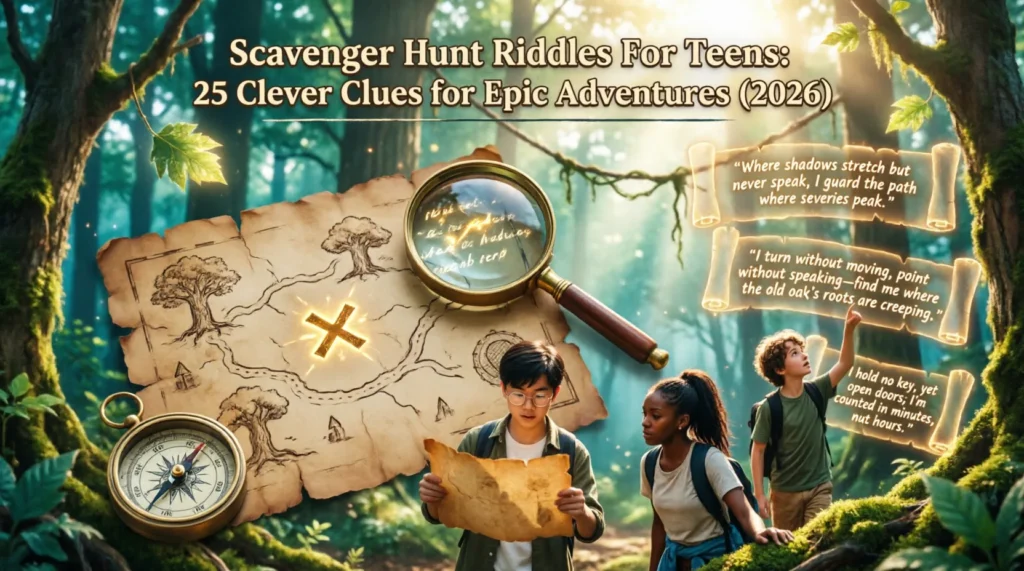
In short, scavenger hunt riddles for teens turn ordinary treasure hunts into exciting challenges filled with problem-solving, teamwork, and laughter. They’re perfect for birthday parties, youth groups, school events, family gatherings, and weekend adventures. Scroll down to discover original riddles that will keep teens engaged from the first clue to the final prize.
Looking for more? Check out our full Riddles For Teens hub for even more categories, difficulty levels, and a complete FAQ.
Why Scavenger Hunt Riddles For Teens Are More Powerful Than You Think
Teenagers crave challenges that feel rewarding rather than childish. That’s exactly why scavenger hunt riddles for teens work so well. They combine mystery, movement, competition, and creativity into a single activity that feels more like an adventure than a game.
Riddles encourage teens to think beyond obvious answers. Instead of simply following directions, they must interpret clues, make connections, and collaborate with friends to uncover hidden locations.
Educators and cognitive scientists often point to puzzles and riddles as excellent tools for strengthening critical thinking, memory, reasoning, and communication skills. When teens work together to solve clues, they also practice teamwork and social problem-solving.
Studies show that puzzle-based activities can increase engagement and attention compared to passive forms of entertainment. That’s one reason scavenger hunts remain popular at schools, camps, youth events, and teen parties around the world.
What Makes a Great Scavenger Hunt Riddle For Teens
A great teen scavenger hunt riddle sits right in the sweet spot between easy and impossible. If the answer is obvious, the hunt becomes boring. If the clue is too difficult, players get frustrated and lose momentum.
The best riddles use clever wordplay, light misdirection, and familiar locations. Teens enjoy clues that make them stop and think for a moment before the answer suddenly clicks into place. That satisfying “aha” moment is what makes a scavenger hunt memorable.
Good scavenger hunt riddles for teens also connect naturally to real-world hiding places. Instead of abstract answers, the solution should lead players toward a location they can physically find. A refrigerator, bookshelf, mailbox, basketball hoop, or school locker can all become part of the adventure.
Another important factor is variety. Some clues should rely on observation. Others should use logic, puns, patterns, or everyday knowledge. Mixing styles keeps everyone involved and prevents the hunt from feeling repetitive.
Because teens often play in groups, the strongest riddles encourage discussion and teamwork. A clue that sparks debate is usually more fun than one that can be solved instantly by a single person.
Scavenger Hunt Riddles For Teens: 25 Riddles to Try Right Now
Around the House
Riddle: I keep your food cold day and night. Open my door and you’ll find a bite.
Answer: Refrigerator
Riddle: You visit me before bed and after you wake. Water and mirrors are what I take.
Answer: Bathroom
Riddle: I have many stories but cannot speak. Readers visit me whenever knowledge they seek.
Answer: Bookshelf
Riddle: I go up and down but never leave the house.
Answer: Stairs
Riddle: I shine through the day but disappear at night. Look beside me for your next clue in sight.
Answer: Window
Riddle: I hold your clothes but never get dressed myself.
Answer: Closet
Riddle: I heat leftovers and popcorn too. Push a button and I’ll work for you.
Answer: Microwave
Riddle: People sit on me when they’re tired or chatting away. Cushions help make me comfortable every day.
Answer: Couch
School and Learning Clues
Riddle: Students carry me from class to class, but I never earn a grade.
Answer: Backpack
Riddle: I erase mistakes without saying a word.
Answer: Eraser
Riddle: My face has numbers but I never take a test.
Answer: Clock
Riddle: Teachers write on me while students look my way.
Answer: Whiteboard
Riddle: I contain hundreds of pages but tell many different stories.
Answer: Library
Riddle: I hold papers together without glue or tape.
Answer: Stapler
Outdoor Adventure Clues
Riddle: I have rings but no jewels. Children climb me for fun.
Answer: Playground bars
Riddle: I guard your home but never move from my spot. Letters visit me every day.
Answer: Mailbox
Riddle: You bounce a ball toward me if you’re aiming to score.
Answer: Basketball hoop
Riddle: I drink rain but never get thirsty. Leaves grow from my arms.
Answer: Tree
Riddle: Cars rest on me when their journey is done.
Answer: Driveway
Riddle: I open and close but never say hello or goodbye.
Answer: Gate
Trickier Teen Challenge Clues
Riddle: The more shoes I hold, the less walking I do.
Answer: Shoe rack
Riddle: I have keys but unlock nothing. Music comes alive through me.
Answer: Piano
Riddle: I tell you where to go, but I never take a step.
Answer: Map
Riddle: I can connect you to friends across the world, yet I fit inside your pocket.
Answer: Smartphone
Riddle: I light up when darkness falls, but I sleep during the day.
Answer: Lamp
🎯 More scavenger hunt riddles for teens: Easy, Medium, and Hard Challenges
Easy Riddles for scavenger hunt riddles for teens (Grades 6–7)
These easy riddles are perfect for younger middle school students who enjoy simple clues based on observation and everyday thinking.
Riddle: I wait by the classroom door and carry books without reading them. What am I? Answer: A backpack
Riddle: I have numbers, but I never count by myself until someone presses me. What am I? Answer: A calculator
Riddle: You can write on me, erase me, and write again without changing my shape. What am I? Answer: A whiteboard
Riddle: I grow shorter every time you use me, but I help your ideas grow longer. What am I? Answer: A pencil
Riddle: I sit on every desk during class, but I disappear into backpacks when the bell rings. What am I? Answer: A notebook
Riddle: I can point north, south, east, and west without taking a single step. What am I? Answer: A compass
Medium Riddles for scavenger hunt riddles for teens (Grades 7–8)
These medium riddles are great for students ready to combine clues and think through each answer one step at a time.
Riddle: I have four equal sides and four right angles. Turn me sideways, and I still keep my name. What am I? Answer: A square
Riddle: The more classmates who borrow me, the lighter I become. What am I? Answer: A stack of paper
Riddle: I always travel from question to answer, but I never leave the page. What am I? Answer: An arrow
Riddle: You can hear me at the beginning of every school day, but I never speak a word. What am I? Answer: The school bell
Riddle: I help you find a page without reading the whole book. What am I? Answer: The table of contents
Riddle: I can be opened without a key, closed without a lock, and filled without water. What am I? Answer: A notebook
Riddle: I become more useful the more carefully you organize me, yet I never change size. What am I? Answer: A folder
Hard Riddles for scavenger hunt riddles for teens (Grade 8 and Up)
These challenging riddles encourage older students to use abstract thinking, clever observation, and a bit of lateral reasoning.
Riddle: I am always one step behind your future and one step ahead of your memories. What am I? Answer: The present
Riddle: Every classroom has me, yet no one can hold me. The more students share me, the bigger I become. What am I? Answer: Knowledge
Riddle: I can connect two ideas without touching either one. What am I? Answer: A comparison
Riddle: I disappear whenever every question has been answered, but I return with the next lesson. What am I? Answer: Curiosity
Riddle: I can change the meaning of a sentence even though I am only one tiny mark. What am I? Answer: Punctuation
Riddle: You create me before you solve a problem, and you test me before you trust me. What am I? Answer: A hypothesis
Riddle: The more carefully you follow me, the less likely you are to notice me. What am I? Answer: Instructions
Using different difficulty levels helps every student experience success before moving on to bigger challenges. Try mixing easy, medium, and hard riddles so everyone has a chance to contribute while building confidence and critical-thinking skills.
📚 Subject-Specific scavenger hunt riddles for teens: Math, Science, and More
Math Riddles for scavenger hunt riddles for teens
These math-themed riddles encourage students to spot patterns, think logically, and have fun with numbers.
Riddle: I am a number that doubles when multiplied by one but disappears when multiplied by zero. What am I? Answer: Any number
Riddle: I have three sides and three angles, but no matter how you turn me, I never become a square. What am I? Answer: A triangle
Riddle: Add me to myself and you get ten. What number am I? Answer: Five
Riddle: I have no corners, no sides, and I roll instead of slide. What shape am I? Answer: A circle
Riddle: I always stand exactly between 20 and 22. What number am I? Answer: 21
Science Riddles for scavenger hunt riddles for teens
These science riddles introduce familiar concepts from biology, chemistry, physics, and earth science in a fun way.
Riddle: I carry water from the roots to the leaves without using a bucket. What am I? Answer: A plant stem
Riddle: I am invisible, fill every classroom, and become wind when I move. What am I? Answer: Air
Riddle: I am the force that keeps your feet on the ground even when you jump. What am I? Answer: Gravity
Riddle: I protect Earth from many harmful rays while floating high above us. What am I? Answer: The ozone layer
Riddle: I can be solid, liquid, or gas, yet I am still the same substance. What am I? Answer: Water
Language Riddles for scavenger hunt riddles for teens
These wordplay riddles help students think about letters, vocabulary, grammar, and the way language works.
Riddle: I begin every sentence but never stay capital forever. What am I? Answer: The first letter
Riddle: Remove my first letter and I still sound the same. I am used to tell stories. What am I? Answer: Write
Riddle: I separate ideas without ending the sentence. What am I? Answer: A comma
Riddle: I describe a noun but do not replace it. What part of speech am I? Answer: An adjective
Riddle: I can change a statement into a question with just one small mark. What am I? Answer: A question mark
Use one subject riddle as a quick warm-up at the start of class to activate prior knowledge.
Turn riddles into exit tickets by asking students to solve one before leaving the classroom.
Divide students into small groups and let each team solve or create subject-themed riddles as a collaborative challenge.
How to Use Scavenger Hunt Riddles For Teens for Maximum Fun
Create teams of three to five players for friendly competition.
Hide clues in locations that match each riddle answer.
Increase difficulty gradually as the hunt progresses.
Add bonus challenges between clues for extra points.
Include a meaningful final prize or surprise destination.
Use a time limit to create excitement and urgency.
You can adapt scavenger hunt riddles for teens to almost any event. Birthday parties, school celebrations, youth groups, family reunions, and neighborhood gatherings all become more memorable when riddles guide the experience.
For larger groups, consider creating multiple clue paths that eventually lead to the same final location. This keeps teams spread out and prevents everyone from crowding around the same clue.
If you want to make the hunt even more engaging, build a story around the riddles. Teens often enjoy solving a mystery, recovering a lost treasure, or completing a secret mission as they move from clue to clue.
Tips for Sharing Scavenger Hunt Riddles For Teens Without Spoiling the Fun
Start with clues that build confidence. Early success encourages players to stay engaged and excited for tougher challenges ahead.
Give participants enough time to think before offering hints. The satisfaction comes from solving the clue themselves, not receiving the answer immediately.
When someone guesses incorrectly, encourage creative thinking rather than saying they’re wrong outright. A simple hint can keep the momentum going while preserving the challenge.
Pay attention to your group. If everyone is stuck, make the next clue slightly easier. If players are racing through the hunt, increase the difficulty of future riddles.
Most importantly, focus on fun rather than perfection. The laughter, teamwork, and surprising discoveries are what people remember long after the hunt ends.
Bonus: Scavenger Hunt Riddles For Teens That Stump Everyone
These bonus clues require a little more observation and creative thinking. They’re perfect for older teens or experienced scavenger hunt players who enjoy a bigger challenge.
Riddle: I get wetter every time I help you dry.
Answer: Towel
Riddle: I travel around the world while staying in one corner.
Answer: Stamp
Riddle: The more you remove from me, the larger I become.
Answer: Hole
Riddle: I have a screen but never go to the movies.
Answer: Window screen
Riddle: I can run but have no legs. You hear me outside after rain.
Answer: Stream
Riddle: I carry knowledge in silence and open with a single cover.
Answer: Book
Riddle: I follow you during sunny days but disappear in darkness.
Answer: Shadow
FAQs About Scavenger Hunt Riddles For Teens
What age group are scavenger hunt riddles for teens best for?
Most are ideal for ages 13 to 18. You can easily adjust the difficulty depending on the group’s reading level, puzzle experience, and event setting.
How many riddles should a teen scavenger hunt include?
For most events, 10 to 20 clues create a balanced experience. Larger parties or special occasions can comfortably use 25 or more riddles for a longer adventure.
Can scavenger hunt riddles for teens be used indoors?
Absolutely. Many of the best scavenger hunts take place inside homes, schools, community centers, or youth facilities. Indoor hunts are especially useful during bad weather.
What makes scavenger hunt riddles for teens different from kids’ riddles?
Teen riddles usually involve more wordplay, deeper reasoning, and slightly more complex clues. They challenge players without becoming frustratingly difficult.
How do I make a scavenger hunt more exciting for teenagers?
Add competition, time limits, team challenges, mystery themes, or story-driven missions. Teens often enjoy activities that feel immersive and reward clever thinking.
Final Thoughts: Keep the Fun Going with Scavenger Hunt Riddles For Teens
Scavenger hunt riddles for teens do much more than fill time. They create memorable experiences that combine creativity, teamwork, movement, and problem-solving into one exciting activity.
Whether you’re planning a birthday party, youth event, school challenge, or family gathering, the right riddles can transform ordinary spaces into places filled with mystery and adventure.
The more often you use scavenger hunts, the more confident and creative your players become. You’ll quickly discover new ways to challenge them while keeping the experience fresh and entertaining.
Gather your clues, hide your prizes, and let the adventure begin—because every great memory starts with a question waiting to be solved.
Frequently Asked Questions
What types of events are scavenger hunt riddles suitable for?▼
Scavenger hunt riddles are ideal for a variety of events including birthday parties, youth group meetings, school activities, family gatherings, and even weekend adventures. They transform ordinary treasure hunts into exciting challenges that engage teens in problem-solving and teamwork.
How do scavenger hunt riddles benefit teenagers?▼
These riddles encourage teens to think critically and creatively as they interpret clues and collaborate with friends. This activity not only fosters problem-solving skills but also enhances communication and teamwork, making it a valuable tool for social interaction.
What characteristics make a great scavenger hunt riddle for teens?▼
A great riddle strikes a balance between being too easy and too difficult, creating that satisfying ‘aha’ moment when the answer is revealed. Using clever wordplay, familiar locations, and a variety of clue styles keeps the hunt engaging and fun for all participants.
Can you provide examples of riddle themes and locations?▼
Yes, riddles can be themed around everyday locations like a refrigerator, bookshelf, or bathroom. Each riddle is designed to lead participants to a physical location that they can find, adding a real-world connection to the adventure.
What skills do scavenger hunts help develop in teenagers?▼
Scavenger hunts help develop critical thinking, memory, reasoning, and communication skills. By working in groups to solve riddles, teens also enhance their teamwork and social problem-solving abilities.
Why are scavenger hunts more engaging than passive entertainment?▼
Studies show that puzzle-based activities like scavenger hunts increase engagement and attention levels compared to passive forms of entertainment. The active participation required to solve clues makes the experience more rewarding and memorable.
How can variety be incorporated into scavenger hunt riddles?▼
Incorporating variety can be achieved by mixing clue types, such as some that rely on observation, logic, or puns. This keeps all participants involved and prevents the hunt from becoming repetitive, ensuring a more dynamic experience.
How do I turn these riddles into a real scavenger hunt for teens?
Write each riddle’s answer as the next clue location, then hide the following riddle there. For example, if a riddle’s answer is ‘the refrigerator,’ tape the next clue to the fridge door. Chain 6-10 riddles together for a 30-45 minute hunt.
What is a good prize for a teen scavenger hunt riddle challenge?
Gift cards, movie tickets, gaming credit, or a shared prize like pizza money for the whole team tend to land better with teens than physical trinkets. Splitting one bigger prize among a team also encourages teamwork instead of rushing ahead alone.
How long should a scavenger hunt riddle be for a teenage audience?
One to three sentences is the sweet spot. Teens lose patience with overly wordy riddles, but a riddle that is too short can feel too easy. Aim for just enough misdirection to make the group pause and debate the answer for a minute.
Ethan is a puzzle enthusiast and lead writer at FunRiddlezone.com, where he focuses on creating and breaking down riddles that challenge the mind while keeping things fun and engaging. He specializes in turning tricky questions, wordplay, and logic puzzles into clear, satisfying explanations that actually make sense — not confusing or overcomplicated answers.
Drawing from logic, pattern recognition, and creative thinking, Ethan approaches riddles as mental exercises designed to sharpen thinking skills and spark curiosity. Instead of treating riddles as random tricks, he explains the reasoning behind each one, helping readers understand how to think through problems step by step.
He pays close attention to wording, hidden clues, and subtle misdirection — the key elements that make riddles both challenging and enjoyable. From classic brain teasers to tricky modern riddles, Ethan ensures that every puzzle is not just solved, but fully understood.
At FunRiddlezone.com, his mission is simple: make riddles more than just questions — turn them into a fun way to train your brain. He doesn’t just give answers — he helps readers think sharper, spot patterns faster, and enjoy the process of solving.