In short, riddles for 8th grader students are designed to be challenging, clever, and fun without feeling impossible. They help middle schoolers sharpen critical thinking, build confidence, and enjoy a few laughs along the way. Scroll down and see how many you can solve before checking the answers!
Why Riddles For 8th Grader Are More Powerful Than You Think
Eighth grade is a unique stage. Students are old enough to enjoy tricky wordplay and logic challenges, but they still love the excitement of discovering a surprising answer.
That is why riddles for 8th grader learners work so well. They encourage students to think beyond the obvious and explore different ways of solving problems.
Educators and cognitive scientists often point to puzzles and riddles as simple tools that support reasoning, memory, and language development. When students work through a riddle, they practice analyzing clues instead of jumping to conclusions.
Studies show that students who regularly engage with brain-teasing activities often strengthen critical-thinking skills and improve problem-solving confidence over time.
Riddles are also a global tradition. Across cultures and generations, people have used clever questions and puzzles to entertain, teach, and spark curiosity. For an eighth grader, that combination of challenge and fun is hard to beat.
What Makes a Great Riddles For 8th Grader
A great riddle for an eighth grader sits right in the sweet spot between easy and impossible. If the answer is obvious, the challenge disappears. If the answer feels completely random, the riddle becomes frustrating.
The best riddles for 8th grader students use smart misdirection. They encourage you to focus on one detail while the real clue hides somewhere else. That moment when everything suddenly makes sense is what creates the famous “aha moment.”
Good middle-school riddles also use familiar topics. School, technology, sports, books, science, numbers, and everyday experiences make the clues feel relatable while still providing a challenge.
Clean humor matters too. Students can enjoy clever twists, surprising answers, and playful language without needing inappropriate jokes or confusing references.
When you find yourself smiling after hearing the answer, you have probably discovered a great riddle.
Riddles For 8th Grader: 20 Riddles to Try Right Now
School and Learning Riddles
Riddle: I am full of answers but cannot ask a single question. What am I?
Answer: A textbook
Riddle: The more notes I hold, the less music I make. What am I?
Answer: A notebook
Riddle: I travel from teacher to student all day but never move my feet. What am I?
Answer: Knowledge
Riddle: I get shorter every time you use me in class. What am I?
Answer: A pencil
Riddle: I help you see mistakes but am not a teacher. What am I?
Answer: An eraser
Riddle: I can contain hundreds of stories but never tell one myself. What am I?
Answer: A library
Riddle: You use me to measure angles, yet I am never angry. What am I?
Answer: A protractor
Logic and Observation Riddles
Riddle: A room contains five candles. Three go out. How many candles remain?
Answer: Five remain; three are simply no longer burning.
Riddle: What gets bigger every time you take something away from it?
Answer: A hole
Riddle: What can run all day but never gets tired?
Answer: A river
Riddle: I have corners but never take up a corner of a room. What am I?
Answer: A stamp
Riddle: What belongs to you but is used more by other people?
Answer: Your name
Riddle: I am lighter than a feather, yet most people cannot hold me for a minute. What am I?
Answer: Your breath
Riddle: What question can you never honestly answer “yes” to?
Answer: “Are you asleep?”
Science, Numbers, and Everyday Life
Riddle: I am always in front of you but cannot be seen. What am I?
Answer: The future
Riddle: Two fathers and two sons go fishing and catch three fish. Each person gets one fish. How is that possible?
Answer: There are only three people: a grandfather, a father, and a son.
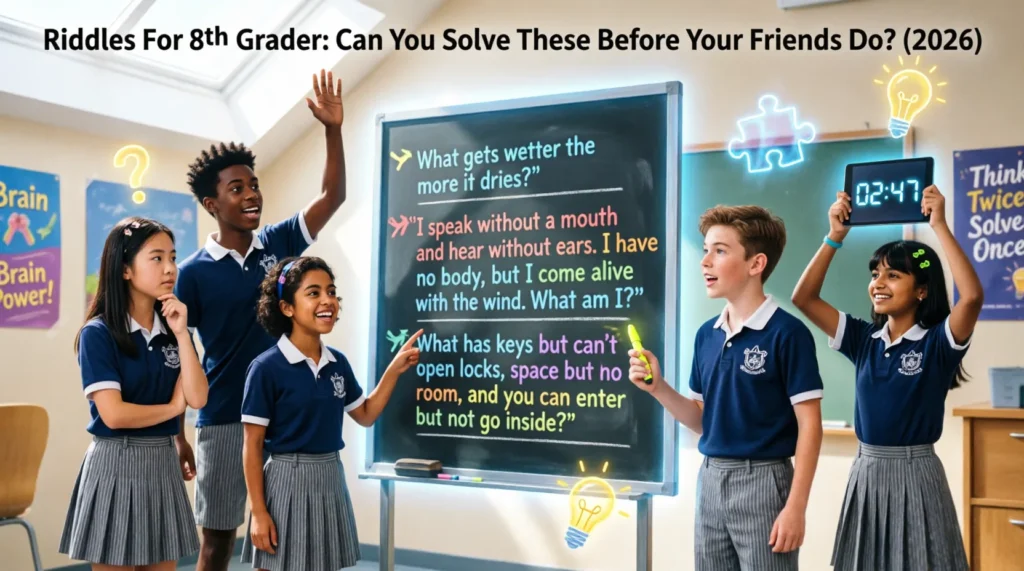
Riddle: What has dozens of keys but cannot open a single door?
Answer: A keyboard
Riddle: The more you share me, the less of me you have. What am I?
Answer: A secret
Riddle: What goes up when rain comes down?
Answer: An umbrella
Riddle: I can be cracked, made, told, and played. What am I?
Answer: A joke
Riddle: What has one eye but cannot see?
Answer: A needle
🎯 More riddles for 8th grader: Easy, Medium, and Hard Challenges
Easy Riddles for riddles for 8th grader (Grades 6–7)
These easy challenges are perfect for students building confidence with observation, simple logic, and playful thinking.
Riddle: I can be opened without a key, closed without a lock, and shared without leaving your hands. What am I? Answer: A book
Riddle: I become shorter every time someone adds more to me. What am I? Answer: A pencil
Riddle: You can fill me with words, but I never speak. What am I? Answer: A notebook
Riddle: I travel from one student to another every day, yet I never walk. What am I? Answer: Homework
Riddle: I have corners but never turn, and I hold stories instead of people. What am I? Answer: A page
Riddle: The more carefully you erase me, the cleaner I become. What am I? Answer: A mistake on paper
Medium Riddles for riddles for 8th grader (Grades 7–8)
These medium-level riddles are great for students ready to combine clues and think through more than one step.
Riddle: Two classmates each solve half of a puzzle. Together they finish it, but neither solved the whole puzzle alone. What did they each solve? Answer: Half of the puzzle
Riddle: I have twelve faces, but I never smile. I help you plan without speaking. What am I? Answer: A calendar
Riddle: If every answer creates one new question, and you answer three questions in a row, how many new questions are waiting? Answer: Three
Riddle: A classroom has four rows with six desks in each row. One desk is removed. How many desks remain? Answer: Twenty-three
Riddle: I always point in the same direction, but people use me to find many different places. What am I? Answer: A compass needle
Riddle: You read me from beginning to end, but I help you understand things that happened before. What am I? Answer: A history book
Riddle: I become more valuable after someone corrects me. What am I? Answer: A first draft
Hard Riddles for riddles for 8th grader (Grade 8 and Up)
These harder riddles encourage abstract thinking, careful reasoning, and creative problem-solving.
Riddle: I grow every time you divide me with someone, yet nothing is taken away. What am I? Answer: Knowledge
Riddle: I can connect two ideas without touching either one. What am I? Answer: A comparison
Riddle: Every answer I contain once began as a question. What am I? Answer: A textbook
Riddle: I disappear the moment everyone agrees about me, but I return with every new mystery. What am I? Answer: Uncertainty
Riddle: I can change the meaning of a sentence without changing a single word. What am I? Answer: Punctuation
Riddle: I always arrive after effort, but I can’t be borrowed from someone else. What am I? Answer: Experience
Riddle: I become easier to carry the more people help with me. What am I? Answer: A challenge
Using different difficulty levels helps every student experience success while still providing opportunities to stretch their thinking. Try letting students choose their own challenge level or work their way from easy to hard as their confidence grows.
📚 Subject-Specific riddles for 8th grader: Math, Science, and More
Math Riddles for riddles for 8th grader
These math-themed riddles build logical thinking with numbers, patterns, and shapes in a fun way.
Riddle: I am an odd number. Remove one letter from my name, and I become even. What number am I? Answer: Seven
Riddle: I have three sides and three angles, but no matter how you turn me, I stay the same shape. What am I? Answer: A triangle
Riddle: I double every time you multiply me by two, but I disappear when you multiply me by zero. What am I? Answer: A number
Riddle: I separate two equal halves of a circle but never leave it. What am I? Answer: The diameter
Riddle: What increases by one every time you count but never becomes tired? Answer: The next number
Science Riddles for riddles for 8th grader
These science riddles connect everyday observations to biology, chemistry, physics, and earth science concepts.
Riddle: I help plants make food, but I never eat any myself. What am I? Answer: Sunlight
Riddle: I am made of tiny pieces that are always moving, even when you can’t see them. What am I? Answer: Matter
Riddle: I pull everything toward Earth without using hands or ropes. What am I? Answer: Gravity
Riddle: I can be solid, liquid, or gas, but I am still the same substance. What am I? Answer: Water
Riddle: I protect Earth from many harmful rays, but you can’t see me in the sky. What am I? Answer: The ozone layer
Language Riddles for riddles for 8th grader
These language riddles encourage students to think about letters, words, grammar, and vocabulary in creative ways.
Riddle: I can make a sentence complete, but I am only one tiny mark. What am I? Answer: A period
Riddle: Remove the first letter from “plane,” and I still help words fly together. What remains? Answer: Lane
Riddle: I join two smaller words to create one larger word. What am I making? Answer: A compound word
Riddle: What kind of word describes a noun without changing what it is? Answer: An adjective
Riddle: The more carefully you choose me, the clearer your message becomes. What am I? Answer: A word
Use one subject riddle as a daily warm-up to spark curiosity before the lesson begins.
Turn a few riddles into exit tickets to check understanding in a fun, low-pressure way.
Divide students into small groups and let them solve, explain, or even create their own subject-themed riddles for classmates.
How to Use Riddles For 8th Grader for Maximum Fun
Use them as classroom warm-up activities.
Challenge friends during lunch breaks.
Turn family road trips into riddle competitions.
Add them to birthday party games.
Use them as brain breaks during homework sessions.
Create weekly riddle challenges with classmates.
You can make the experience even better by keeping score and rewarding creative thinking. Sometimes the funniest guesses are just as entertaining as the correct answers.
If you are a teacher, parent, or student leader, try mixing easy and difficult riddles together. This keeps everyone involved and gives each participant a chance to shine.
Tips for Sharing Riddles For 8th Grader Without Spoiling the Fun
Timing matters. After asking a riddle, give people enough time to think before revealing the answer.
Encourage creative guesses instead of rushing to correct mistakes. Many students learn more from discussing possibilities than from hearing the answer immediately.
If a riddle seems too difficult, offer a small hint rather than giving away the solution. This keeps the challenge alive while helping everyone stay engaged.
You can also adjust the difficulty based on your audience. If your group solves riddles quickly, increase the complexity. If they seem stuck, choose clues that are a little more straightforward.
Most importantly, keep the mood fun. The goal is to enjoy the challenge, not to turn it into a test.
Bonus: Riddles For 8th Grader That Stump Everyone
These bonus riddles require a little more patience and careful thinking. They are perfect when you want an extra challenge.
Riddle: A man leaves home, makes three left turns, and returns home to find two masked strangers waiting. Who are they?
Answer: A catcher and an umpire at a baseball game
Riddle: What can fill a room without taking up any space?
Answer: Light
Riddle: I become wetter as I dry. What am I?
Answer: A towel
Riddle: Which month has 28 days?
Answer: All of them
Riddle: The more you remove from me, the larger I become. What am I?
Answer: A hole
Riddle: What has many rings but no fingers?
Answer: A tree
Riddle: What comes once in a minute, twice in a moment, and never in a thousand years?
Answer: The letter M
FAQs About Riddles For 8th Grader
What age group are riddles for 8th grader best for?
These riddles are generally ideal for students around 13 to 14 years old. However, younger students who enjoy challenges and older students looking for quick brain teasers can enjoy them too.
How difficult should riddles for 8th grader be?
The best difficulty level makes students think for a minute or two without feeling stuck. A good riddle should be challenging enough to create curiosity but fair enough to solve with logic.
Can riddles for 8th grader be used in the classroom?
Absolutely. Many teachers use riddles as warm-up activities, discussion starters, or quick brain breaks. They help students practice reasoning while keeping the classroom atmosphere energetic.
What makes riddles for 8th grader different from elementary-school riddles?
Middle-school riddles often include stronger wordplay, deeper logic, and more subtle clues. They challenge students to analyze information instead of relying on simple observations.
Are riddles for 8th grader good for building critical-thinking skills?
Yes. Educators frequently use puzzles and riddles because they encourage students to examine evidence, consider multiple possibilities, and think creatively before reaching a conclusion.
Final Thoughts: Keep the Fun Going with Riddles For 8th Grader
Riddles for 8th grader students do much more than pass the time. They combine humor, logic, creativity, and problem-solving into one engaging activity.
Whether you are a student, teacher, or parent, you can use these riddles almost anywhere. A few clever questions can instantly spark conversation and curiosity.
As riddles become a regular habit, you may notice stronger reasoning skills, better confidence, and plenty of shared laughter. That combination makes them worth revisiting again and again.
So pick a riddle, challenge someone nearby, and see who discovers the answer first—the best puzzles always leave you wanting one more.
Frequently Asked Questions
Why are riddles beneficial for 8th graders?▼
Riddles help 8th graders sharpen their critical thinking skills, build confidence, and enjoy learning through fun challenges. Engaging with these puzzles promotes reasoning, memory, and language development, making them a valuable tool in education.
What characteristics make a riddle suitable for 8th graders?▼
A suitable riddle for 8th graders strikes a balance between being challenging and solvable. It should use clever misdirection and relatable topics, ensuring that students are engaged without feeling frustrated.
Can riddles improve problem-solving skills in students?▼
Yes, studies indicate that students who regularly engage with brain-teasing activities, like riddles, tend to strengthen their problem-solving skills and boost their confidence over time. This engagement encourages them to analyze clues and think critically.
What are some examples of school-related riddles mentioned in the article?▼
The article provides several school-related riddles such as, ‘I am full of answers but cannot ask a single question. What am I?’ with the answer being ‘A textbook.’ Another example is, ‘I get shorter every time you use me in class. What am I?’ answered by ‘A pencil.’
How do riddles encourage critical thinking among students?▼
Riddles prompt students to analyze clues and explore different ways of solving problems rather than jumping to conclusions. This process fosters critical thinking by challenging them to think creatively and logically.
What role does humor play in effective riddles for 8th graders?▼
Clean humor is essential in effective riddles for 8th graders as it allows them to enjoy clever twists and surprising answers without inappropriate content. When a riddle elicits a smile or laughter, it enhances the overall experience of solving it.
Why do riddles hold a global tradition across cultures?▼
Riddles are a longstanding tradition around the world, used to entertain, teach, and spark curiosity across generations. Their universal appeal lies in combining challenge and fun, making them an effective learning tool regardless of cultural background.
Ethan is a puzzle enthusiast and lead writer at FunRiddlezone.com, where he focuses on creating and breaking down riddles that challenge the mind while keeping things fun and engaging. He specializes in turning tricky questions, wordplay, and logic puzzles into clear, satisfying explanations that actually make sense — not confusing or overcomplicated answers.
Drawing from logic, pattern recognition, and creative thinking, Ethan approaches riddles as mental exercises designed to sharpen thinking skills and spark curiosity. Instead of treating riddles as random tricks, he explains the reasoning behind each one, helping readers understand how to think through problems step by step.
He pays close attention to wording, hidden clues, and subtle misdirection — the key elements that make riddles both challenging and enjoyable. From classic brain teasers to tricky modern riddles, Ethan ensures that every puzzle is not just solved, but fully understood.
At FunRiddlezone.com, his mission is simple: make riddles more than just questions — turn them into a fun way to train your brain. He doesn’t just give answers — he helps readers think sharper, spot patterns faster, and enjoy the process of solving.