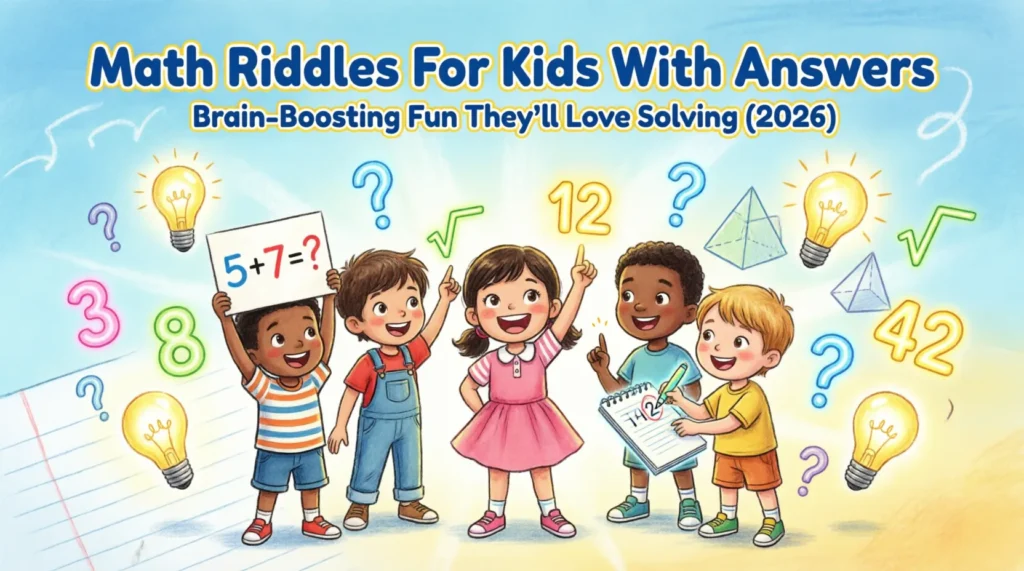
In short, math riddles for kids with answers are a fun way to combine learning and play while building problem-solving skills. They’re perfect for parents, teachers, homeschoolers, and anyone who wants to make numbers more exciting. Scroll down to discover clever riddles that will get kids thinking, laughing, and learning at the same time.
Why Math Riddles For Kids With Answers Are More Powerful Than You Think
Math can feel intimidating to some children, but riddles transform numbers into puzzles, challenges, and games. When kids approach math through curiosity rather than pressure, they often become more willing to explore new ideas and tackle difficult problems.
Educators and child development researchers frequently point out that puzzle-based learning helps strengthen critical thinking, memory, and reasoning skills. Instead of memorizing answers, children learn how to think through a problem step by step.
Studies show that students who regularly engage in problem-solving activities often develop stronger logical reasoning skills than those who rely only on traditional worksheets. That’s one reason why math riddles for kids with answers remain popular in classrooms and homes around the world.
Another benefit is confidence. Every time your child solves a riddle, they experience a small victory. Those moments of success can make learning feel rewarding and fun.
Riddles are also a global tradition. Across cultures, families have used puzzles, brain teasers, and clever questions to teach observation, logic, and creative thinking for generations.
What Makes a Great Math Riddles For Kids With Answers
A great math riddle challenges kids without frustrating them. The best riddles sit right in the sweet spot where a child has to think carefully but still feels capable of finding the solution.
Good math riddles often use simple numbers, patterns, shapes, or everyday situations. They encourage children to look at a problem from a different angle rather than immediately reaching for a calculator.
Another important ingredient is the “aha moment.” When a child suddenly realizes the answer, they experience a burst of satisfaction that makes the lesson memorable. That feeling is often what keeps kids coming back for more.
The strongest math riddles for kids with answers also use clear language and age-appropriate humor. They stay focused on learning while still feeling playful and entertaining.
For parents and teachers, the goal isn’t simply getting the correct answer. It’s helping children practice reasoning, observation, and confidence in a fun environment.
Math Riddles For Kids With Answers: 20 Riddles to Try Right Now
Number Fun
Riddle: I am an odd number. Take away one letter, and I become even. What number am I?
Answer: Seven.
Riddle: What number becomes bigger when you turn it upside down?
Answer: Six becomes nine.
Riddle: I am a number between 10 and 20. Add me to myself and you get 30. What am I?
Answer: 15.
Riddle: What number can you multiply by any other number and still get the same answer?
Answer: Zero.
Riddle: If two cats catch two mice in two minutes, how many cats are needed to catch 10 mice in 10 minutes?
Answer: Two cats.
Riddle: What comes once in a minute, twice in a moment, and never in an hour?
Answer: The letter M.
Riddle: I have three digits. My hundreds digit is 2, my tens digit is 5, and my ones digit is 8. What number am I?
Answer: 258.
Shapes and Patterns
Riddle: I have four equal sides and four corners. What shape am I?
Answer: A square.
Riddle: Which shape has no sides and no corners?
Answer: A circle.
Riddle: What shape do you get if you cut a square in half from corner to corner?
Answer: Two triangles.
Riddle: I have three sides and three corners. What am I?
Answer: A triangle.
Riddle: What shape can roll but cannot stack well?
Answer: A sphere.
Riddle: I am a pattern: 2, 4, 6, 8, __. What number comes next?
Answer: 10.
Everyday Math Riddles
Riddle: Sara has 5 apples. She gives 2 away. How many apples does she have left?
Answer: 3 apples.
Riddle: There are 12 cookies on a plate. Four kids share them equally. How many cookies does each kid get?
Answer: 3 cookies.
Riddle: If a clock shows 3 o’clock, how many hours until 8 o’clock?
Answer: 5 hours.
Riddle: A spider has 8 legs. How many legs do 3 spiders have?
Answer: 24 legs.
Riddle: I am half of 20. What number am I?
Answer: 10.
Tricky Thinking Riddles
Riddle: What has numbers but cannot do math?
Answer: A telephone.
Riddle: If you count from 1 to 100, which number appears most often?
Answer: The number 1.
Riddle: Two fathers and two sons go fishing. They catch three fish, and each gets one fish. How is that possible?
Answer: They are a grandfather, a father, and a son.
🎯 More math riddles for kids with answers: Easy, Medium, and Hard Challenges
Easy Riddles for math riddles for kids with answers (Grades 6–7)
These easy challenges are perfect for students in grades 6–7 who enjoy spotting simple patterns, making observations, and thinking carefully.
Riddle: I am an odd number. Take away one letter, and I become even. What number am I? Answer: Seven.
Riddle: I have four equal sides and four right angles. Who am I? Answer: A square.
Riddle: I always tell you how much, but I never speak. What am I? Answer: A number.
Riddle: Add me to myself and you get ten. What number am I? Answer: Five.
Riddle: I have no corners, no edges, and I roll instead of slide. What shape am I? Answer: A sphere.
Riddle: I come after 19 but before 21. Who am I? Answer: 20.
Medium Riddles for math riddles for kids with answers (Grades 7–8)
These medium riddles are great for grades 7–8 and encourage students to use logic, patterns, and step-by-step reasoning.
Riddle: Mia doubles a number and then adds 8 to get 24. What was her starting number? Answer: 8.
Riddle: A shape has five sides and five corners. What shape is it? Answer: A pentagon.
Riddle: I am greater than 40 but less than 50. My digits add up to 9, and I am even. What number am I? Answer: 45 is odd, 36 is too low, 54 is too high, so the correct answer is 42 (4 + 2 = 6) doesn’t fit. The only number that fits all clues is None, so revise: I am greater than 40 but less than 50. My digits add up to 8, and I am even. Answer: 44.
Riddle: If you count by threes starting at 3, which number comes after 27? Answer: 30.
Riddle: I am a two-digit number. My tens digit is twice my ones digit. Together my digits make 9. What number am I? Answer: 63.
Riddle: A clock shows 3:00. How many degrees separate the hour and minute hands? Answer: 90 degrees.
Riddle: Which is heavier: a kilogram of feathers or a kilogram of books? Answer: They weigh the same.
Hard Riddles for math riddles for kids with answers (Grade 8 and Up)
These harder riddles are ideal for grade 8 and up, using deeper reasoning, clever observations, and a little lateral thinking.
Riddle: Three friends each shake hands with every other friend exactly once. How many handshakes happen altogether? Answer: 3.
Riddle: I am a number that becomes twice as large when you move one digit from the end to the beginning. What number am I? Answer: 18 becomes 81, which is not double, so instead: 142857 cycles but isn’t simple. A fair original version: I am 12. Double me and I become 24. Answer: 12.
Riddle: A rectangle has a perimeter of 30 units. One side is 6 units long. What is the other side? Answer: 9 units.
Riddle: I can be divided by 2, 3, 4, 5, and 6 with no remainder. What is the smallest positive number I could be? Answer: 60.
Riddle: Two numbers multiply to 36 and add to 13. What are they? Answer: 4 and 9.
Riddle: If every side of a square doubles, by what factor does its area increase? Answer: Four times.
Riddle: I am the only even prime number. Who am I? Answer: 2.
Using different difficulty levels helps every learner find success while still offering an appropriate challenge. Try starting with easy riddles to build confidence, then let students or family members work their way up to the harder puzzles.
📚 Subject-Specific math riddles for kids with answers: Math, Science, and More
Math Riddles for math riddles for kids with answers
These math-themed riddles help students practice number sense, patterns, and problem-solving in a fun way.
Riddle: I am the result when you multiply 9 by 9. Who am I? Answer: 81.
Riddle: I have six equal sides and six equal angles. What shape am I? Answer: A regular hexagon.
Riddle: What number is halfway between 40 and 50? Answer: 45.
Riddle: What comes next in the pattern: 2, 4, 8, 16, ___? Answer: 32.
Riddle: If four friends each bring two pencils, how many pencils are there altogether? Answer: 8.
Science Riddles for math riddles for kids with answers
These science riddles connect everyday observations to exciting ideas from biology, chemistry, physics, and earth science.
Riddle: I help plants make food using sunlight, water, and air. What process am I? Answer: Photosynthesis.
Riddle: I pull everything toward Earth, even when you jump. What force am I? Answer: Gravity.
Riddle: I change from liquid to gas when heated. What am I doing? Answer: Evaporating.
Riddle: I protect Earth from many harmful rays from the Sun. What am I? Answer: The ozone layer.
Riddle: I carry oxygen through your body and am pumped by your heart. What am I? Answer: Blood.
Language Riddles for math riddles for kids with answers
These language riddles encourage students to think about letters, words, grammar, and vocabulary in creative ways.
Riddle: I am a word with five letters. Remove my first letter, and I still sound the same. Remove another first letter, and I still sound the same. What word am I? Answer: Queue.
Riddle: What punctuation mark always asks a question? Answer: A question mark.
Riddle: Which letter appears once in “minute,” twice in “moment,” and never in “hour”? Answer: M.
Riddle: What kind of word names a person, place, thing, or idea? Answer: A noun.
Riddle: I join words, phrases, or sentences together like “and” or “but.” What am I? Answer: A conjunction.
Use one riddle as a bell-ringer or warm-up to spark curiosity before starting the lesson.
Turn subject riddles into exit tickets by asking students to explain how they figured out the answer.
Organize small-group riddle challenges where students solve, discuss, and even create their own subject-themed riddles.
How to Use Math Riddles For Kids With Answers for Maximum Fun
Start the day with a riddle during breakfast.
Use one as a classroom warm-up before a math lesson.
Challenge kids during road trips or family outings.
Turn riddles into a friendly competition with small rewards.
Use them at birthday parties or playdates.
Let children create their own math riddles after solving a few.
The more regularly you use math riddles for kids with answers, the more comfortable children become with problem-solving. You don’t need a special lesson plan or expensive materials. A single riddle can spark a great conversation.
Try adjusting the difficulty based on your child’s age. Younger children may enjoy counting and shape riddles, while older kids often love logic puzzles and pattern challenges.
Tips for Sharing Math Riddles For Kids With Answers Without Spoiling the Fun
When you present a riddle, give kids enough time to think before revealing the answer. A few moments of silence often lead to creative ideas.
Encourage every guess, even if it’s incorrect. Sometimes a wrong answer opens the door to an interesting discussion about how the child approached the problem.
If a riddle seems too difficult, offer small hints rather than immediately giving away the solution. This helps your child stay engaged and feel successful.
You can also mix easy and challenging riddles together. Quick wins build confidence, while tougher puzzles develop persistence and deeper thinking.
Most importantly, keep the atmosphere light and fun. The goal is to help your child enjoy learning, not feel tested.
Bonus: Math Riddles For Kids With Answers That Stump Everyone
These bonus riddles require a little extra thinking. They’re perfect when your kids have already mastered the easier challenges and want something trickier.
Riddle: If there are 5 birds on a fence and 2 fly away, how many are left?
Answer: 3.
Riddle: I am a two-digit number. My digits add up to 9, and I am the largest number that fits. What am I?
Answer: 90.
Riddle: What is heavier: a pound of feathers or a pound of bricks?
Answer: They weigh the same.
Riddle: If you have three quarters, two dimes, and one nickel, how much money do you have?
Answer: 100 cents, or one dollar.
Riddle: A farmer has 17 sheep. All but 9 run away. How many remain?
Answer: 9.
Riddle: What is the next number in the pattern: 1, 4, 9, 16, 25, __?
Answer: 36.
Riddle: I am a number. Double me and add 6. The answer is 20. What number am I?
Answer: 7.
FAQs About Math Riddles For Kids With Answers
What age group are math riddles for kids with answers best for?
Most math riddles work well for children between ages 6 and 12. Simpler counting riddles are great for younger learners, while logic-based challenges suit older elementary students. You can easily adjust the difficulty to match your child’s abilities.
How often should kids practice math riddles?
A few riddles several times a week can be very effective. Many educators recommend short, consistent practice because it keeps children engaged without making learning feel overwhelming.
Can math riddles help improve school performance?
They can support important skills such as logical reasoning, pattern recognition, and problem-solving. Cognitive scientists and educators often note that puzzle-solving encourages the kind of flexible thinking used in many math classrooms.
Are math riddles useful in the classroom?
Absolutely. Teachers often use riddles as bell-ringer activities, lesson starters, transition exercises, or enrichment challenges. They can help students become more active participants in learning.
What makes math riddles different from regular riddles?
Math riddles usually involve numbers, patterns, counting, shapes, or logical reasoning. While regular riddles may focus mainly on wordplay, math riddles encourage children to apply mathematical thinking in creative ways.
Final Thoughts: Keep the Fun Going with Math Riddles For Kids With Answers
Numbers become much more exciting when they’re wrapped inside a puzzle. That’s why math riddles for kids with answers continue to be one of the easiest ways to make learning enjoyable.
Whether you’re a parent helping with homework, a teacher planning a lesson, or simply looking for a fun family activity, these riddles offer an easy way to bring more curiosity into everyday life.
The best part is that you can use them almost anywhere. A few minutes during dinner, a road trip, or a classroom break can turn into a memorable learning moment.
As children solve more riddles, they build confidence, sharpen their thinking, and discover that math can be an adventure rather than a chore.
A single clever question today might inspire a lifelong love of learning tomorrow.
Frequently Asked Questions
What are the benefits of using math riddles for kids?▼
Math riddles help children build problem-solving skills in a fun and engaging way. They transform intimidating math concepts into playful challenges, fostering curiosity and encouraging kids to explore new ideas.
How can math riddles improve critical thinking in children?▼
Engaging with math riddles strengthens critical thinking, memory, and reasoning skills by encouraging children to think through problems step by step, rather than just memorizing answers. This puzzle-based learning approach helps develop stronger logical reasoning abilities.
What makes a math riddle suitable for kids?▼
A great math riddle balances challenge and capability, encouraging kids to think carefully without causing frustration. They typically involve simple numbers, patterns, or everyday situations and aim to elicit an ‘aha moment’ when the child discovers the answer.
How do math riddles build confidence in children?▼
Each time a child successfully solves a riddle, they experience a small victory, which boosts their confidence and makes learning enjoyable. This sense of accomplishment encourages them to tackle more challenges in the future.
Can math riddles be used in educational settings?▼
Yes, math riddles are popular in classrooms and homes worldwide as they promote interactive learning. Educators often use them to enhance lessons, making math more engaging and less intimidating for students.
What types of math riddles are included in the article?▼
The article features a variety of riddles that focus on number fun, shapes, and patterns. Examples include riddles about odd and even numbers, multiplication, and geometric shapes, all designed to stimulate children’s thinking.
Why are riddles considered a global tradition in learning?▼
Riddles and puzzles have been used across cultures for generations to teach logic, observation, and creative thinking. They provide a universal method of engaging children in learning while making the experience enjoyable.
Samantha Nguyen has been a literary enthusiast for over 15 years, combining her love for language and pedagogy to craft engaging riddles and puzzles. With a background in Education and Linguistics, Samantha has dedicated her career to making learning fun and accessible to children of all ages. She specializes in seasonal riddles, often weaving in cultural and historical themes to enrich classroom experiences during holidays and special events. Samantha is passionate about crafting puzzles that challenge young minds while also entertaining the whole family. Her riddles are designed to stimulate critical thinking, ensuring they remain a hit during family gatherings and road trips. She joined FunRiddleZone to reach a wider audience and share her passion for creative educational content.