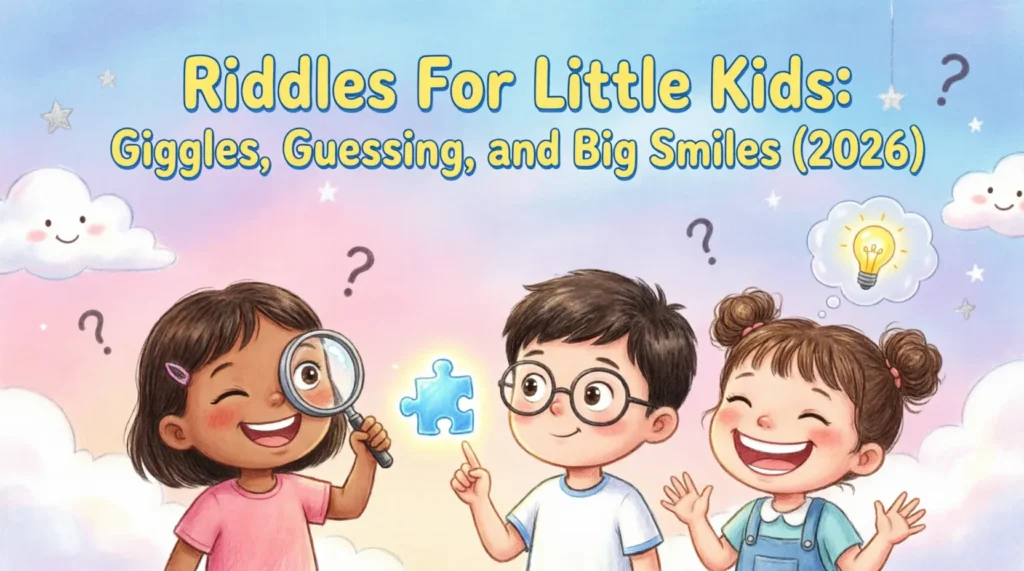
In short, riddles for little kids are playful brain teasers designed to make young children laugh, think, and stay curious while using simple language they can actually understand. They’re perfect for parents, teachers, babysitters, and anyone who wants easy, screen-free fun that keeps kids engaged from the very first question.
Why Riddles For Little Kids Are More Powerful Than You Think
Little kids love surprises, silly answers, and playful questions. That’s exactly why riddles work so well. When you ask a child a funny question with a clever twist, you’re doing more than entertaining them — you’re helping their brain practice problem-solving, listening, and creative thinking.
Educators and child development researchers often encourage word games because they strengthen language skills in a natural, low-pressure way. Kids learn how words can have double meanings, how clues fit together, and how to stay patient while thinking through a problem.
Studies show that children who regularly engage in playful language activities often develop stronger memory and communication skills in early learning years. That makes riddles for little kids more than just fun car-ride entertainment — they can become part of how your child learns to think confidently.
Another reason riddles matter is connection. When you laugh together after a silly answer, your child feels included and encouraged. Those tiny moments of shared fun can turn into favorite family memories surprisingly fast.
What Makes a Great Riddles For Little Kids
A great kids’ riddle feels just tricky enough without becoming frustrating. Little children want the joy of guessing, but they also want a fair chance at solving the puzzle. If the wording is too confusing or the answer feels impossible, the fun disappears quickly.
The best riddles for little kids use familiar ideas like animals, food, school supplies, bedtime, weather, or toys. Young children enjoy clues tied to the world they already know. That sense of familiarity helps them build confidence while still feeling challenged.
Strong kids’ riddles also create a clear “aha!” moment. The answer should make children smile instantly once they hear it. Sometimes the funniest riddles are the simplest ones because little kids love playful logic and unexpected twists.
Clean humor matters too. Parents and teachers usually want jokes and riddles that stay positive, kind, and age-appropriate. Great children’s riddles avoid sarcasm, scary themes, or complicated wordplay that younger kids may not understand yet.
Riddles are a global tradition found in many cultures, classrooms, and storytelling styles. Across generations, adults have used playful questions to teach children curiosity, imagination, and confidence through laughter.
Riddles For Little Kids: 20 Riddles to Try Right Now
Animal Riddles
Riddle: I hop around and love to eat carrots. What am I?
Answer: A rabbit
Riddle: I say “moo” and give milk every day. What am I?
Answer: A cow
Riddle: I have stripes but I’m not wearing pajamas. What am I?
Answer: A zebra
Riddle: I swing from trees and love bananas. What am I?
Answer: A monkey
Riddle: I’m very slow and carry my house on my back. What am I?
Answer: A snail
Riddle: I wag my tail when I’m happy and bark at strangers. What am I?
Answer: A dog
School and Learning Riddles
Riddle: I’m full of pages, but I’m not a newspaper. Kids read me at school. What am I?
Answer: A book
Riddle: You use me to draw, but I get shorter the more you use me. What am I?
Answer: A pencil
Riddle: I ring loudly and tell kids it’s time for class. What am I?
Answer: A school bell
Riddle: I carry your lunch, snacks, and juice to school. What am I?
Answer: A lunchbox
Riddle: I erase mistakes but never make any myself. What am I?
Answer: An eraser
Riddle: Kids sit on me during class, but I’m not a couch. What am I?
Answer: A chair
Food and Kitchen Riddles
Riddle: I’m yellow outside, soft inside, and monkeys love me. What am I?
Answer: A banana
Riddle: I’m cold, sweet, and melt on hot days. What am I?
Answer: Ice cream
Riddle: I pop in the microwave and crunch during movies. What am I?
Answer: Popcorn
Riddle: I’m round, cheesy, and cut into slices. What am I?
Answer: Pizza
Riddle: You crack me before cooking, and I come from a chicken. What am I?
Answer: An egg
Silly Everyday Riddles
Riddle: I go up when the rain comes down. What am I?
Answer: An umbrella
Riddle: I have hands but cannot clap. What am I?
Answer: A clock
Riddle: I shine at night but sleep during the day. What am I?
Answer: The moon
Riddle: The more dirty I get, the cleaner you become. What am I?
Answer: Soap
Riddle: I have four wheels and take kids to school every morning. What am I?
Answer: A school bus
🎯 More riddles for little kids: Easy, Medium, and Hard Challenges
Easy Riddles for riddles for little kids (Grades 6–7)
These easy riddles are perfect for younger learners who enjoy spotting patterns, making observations, and playing with words.
Riddle: I have a face and two hands, but I can never wave hello. What am I? Answer: A clock
Riddle: The more pages I have, the thicker I become, but I never eat a thing. What am I? Answer: A book
Riddle: I follow you on sunny days but disappear when the sky grows dark. What am I? Answer: Your shadow
Riddle: I can be opened, but I’m not a door. I can be closed, but I’m not a window. I help you learn. What am I? Answer: A book
Riddle: I get shorter every time you use me, yet I help you write more. What am I? Answer: A pencil
Riddle: I travel around the world while staying in the same corner. What am I? Answer: A stamp
Medium Riddles for riddles for little kids (Grades 7–8)
These medium-level riddles are best for students ready to use logic, clues, and multi-step thinking.
Riddle: Mia has three brothers. Each brother has two sisters. How many sisters does Mia have? Answer: One sister
Riddle: A classroom has 12 desks in rows of 3. How many rows are there? Answer: Four rows
Riddle: You leave home and take three left turns. When you return, someone is wearing a mask. Who are they? Answer: The catcher in a baseball game
Riddle: A farmer has 20 sheep. All but 7 run away. How many sheep remain? Answer: Seven
Riddle: If yesterday was two days before Monday, what day is today? Answer: Sunday
Riddle: A number becomes larger when you turn it upside down. What number is it? Answer: 6 (it becomes 9)
Riddle: Four friends share 12 apples equally. Then each friend gives away one apple. How many apples do they have altogether? Answer: Eight apples
Hard Riddles for riddles for little kids (Grade 8 and Up)
These harder riddles challenge older students with clever twists, abstract thinking, and careful reasoning.
Riddle: I can be broken without being touched, and once broken, people may feel disappointed. What am I? Answer: A promise
Riddle: You see me once in June, twice in November, and not at all in May. What am I? Answer: The letter E
Riddle: Two people look at the same number. One sees six, the other sees nine. Both are correct. How? Answer: They are standing on opposite sides of the number
Riddle: I become lighter the more of me you remove. What am I? Answer: A hole
Riddle: A student reads a book for 30 minutes every day. After 10 days, how many minutes have they read? Answer: 300 minutes
Riddle: I grow when I share my knowledge, but I never get smaller. What am I? Answer: Knowledge
Riddle: The beginning of eternity, the end of time, and the start of every ending. What am I? Answer: The letter E
Teachers and parents can start with easy riddles to build confidence before moving students into more challenging levels. Mixing difficulty tiers also helps learners practice problem-solving while keeping everyone engaged at their own pace.
📚 Subject-Specific riddles for little kids: Math, Science, and More
Math Riddles for riddles for little kids
These math-themed riddles help students practice number sense, patterns, and logical thinking in a fun way.
Riddle: I am an odd number. Remove one letter, and I become even. What number am I? Answer: Seven
Riddle: What shape has four equal sides and four right angles? Answer: A square
Riddle: I am a number between 20 and 30. If you divide me by 5, you get 5. What number am I? Answer: 25
Riddle: What comes next in this pattern: 2, 4, 8, 16, ___? Answer: 32
Riddle: If two triangles have three sides each, how many sides do they have altogether? Answer: Six sides
Science Riddles for riddles for little kids
These science riddles connect everyday observations to exciting concepts from biology, chemistry, physics, and earth science.
Riddle: I help plants make food using sunlight, water, and air. What process am I? Answer: Photosynthesis
Riddle: I am a force that keeps your feet on the ground and planets in orbit. What am I? Answer: Gravity
Riddle: I fall from clouds as rain, snow, sleet, or hail. What am I? Answer: Precipitation
Riddle: I am the star at the center of our solar system. What am I? Answer: The Sun
Riddle: I have roots, a stem, and leaves, and I make my own food. What am I? Answer: A plant
Language Riddles for riddles for little kids
These language riddles encourage students to think about letters, vocabulary, grammar, and creative wordplay.
Riddle: What word becomes shorter when you add two letters to it? Answer: Short
Riddle: I am the first letter in school but not in classroom. What am I? Answer: The letter S
Riddle: What English word keeps the same pronunciation even after you remove four of its five letters? Answer: Queue
Riddle: I am a word that means the opposite of noisy. What am I? Answer: Quiet
Riddle: Which letter appears most often in the word “teacher”? Answer: The letter E
Use subject-specific riddles as bell-ringer activities to spark curiosity at the start of class.
Turn riddles into exit tickets to quickly review concepts before students leave.
Organize small-group riddle challenges where students explain how they reached each answer.
How to Use Riddles For Little Kids for Maximum Fun
Use them during car rides to keep kids talking and laughing.
Turn them into classroom warm-up activities before lessons begin.
Add them to birthday parties or treasure hunts for extra excitement.
Ask one riddle during dinner each night as a family tradition.
Use easy riddles at bedtime to create calm, happy conversations.
Let kids invent their own riddles after hearing a few examples.
When you use riddles regularly, children start becoming more confident guessers. Even shy kids often join in because riddles feel playful instead of stressful. You can also adapt the difficulty depending on your child’s age and attention span.
Parents and educators often notice that kids begin listening more carefully once riddles become part of the routine. That’s because children naturally want to solve the mystery. The anticipation keeps them focused in a way ordinary questions sometimes cannot.
Tips for Sharing Riddles For Little Kids Without Spoiling the Fun
Give your child enough time to think before revealing the answer. Little kids sometimes need a few extra seconds to connect the clues, especially if they’re excited.
You can also offer tiny hints instead of giving away the solution immediately. If the riddle is about an animal, for example, you might say, “It lives on a farm,” or “It has a tail.”
Keep your tone playful and encouraging. If your child guesses wrong, treat every answer like part of the game. That keeps the experience positive and helps kids feel comfortable trying again.
It also helps to match the riddle to your child’s age. Younger children usually enjoy short clues with familiar objects, while older kids may want more surprising twists and trickier wordplay.
Most importantly, have fun with your delivery. Dramatic pauses, funny voices, and exaggerated suspense can make even simple riddles feel unforgettable.
Bonus: Riddles For Little Kids That Stump Everyone
These bonus riddles are a little trickier than the earlier ones. They still stay kid-friendly, but they add extra twists that make children pause, laugh, and think harder before guessing.
Riddle: What gets wetter the more it dries?
Answer: A towel
Riddle: What has a face and two hands but no arms or legs?
Answer: A clock
Riddle: What has lots of teeth but never bites?
Answer: A comb
Riddle: What can travel around the world while staying in one corner?
Answer: A stamp
Riddle: What kind of tree can you carry in your hand?
Answer: A palm tree
Riddle: What has one eye but cannot see?
Answer: A needle
Riddle: What runs but never walks?
Answer: Water
FAQs About Riddles For Little Kids
What age group are riddles for little kids best for?
Most riddles for little kids work best for children between ages 3 and 8. Younger children usually enjoy simple animal or food riddles, while older kids can handle trickier clues and wordplay.
Are riddles good for early childhood learning?
Yes, many educators use riddles because they encourage listening, memory, and reasoning skills. Kids also practice patience and communication while trying to solve each puzzle.
How hard should riddles for little kids be?
A good kids’ riddle should feel challenging but still understandable. If children become confused too quickly, you can simplify the clues or give gentle hints to keep the fun going.
Can teachers use riddles in the classroom?
Absolutely. Teachers often use riddles as icebreakers, transition activities, writing prompts, or quick brain breaks. They work especially well for keeping young students engaged during busy school days.
What makes riddles for little kids different from regular riddles?
Kids’ riddles use simple vocabulary, familiar topics, and cheerful humor. The goal is to create curiosity and laughter without making children feel frustrated or left out.
Final Thoughts: Keep the Fun Going with Riddles For Little Kids
There’s something timeless about hearing a child laugh after finally guessing the answer to a clever riddle. These tiny puzzles bring together curiosity, imagination, and joy in a way few activities can.
Whether you use riddles during a road trip, in your classroom, or around the dinner table, you’re giving children a chance to think creatively while having genuine fun. That combination matters more than many people realize.
The more often you share riddles for little kids, the more confident and expressive children tend to become. They start inventing their own jokes, asking better questions, and paying closer attention to language and clues around them.
Sometimes the smallest questions create the biggest smiles — and that’s the magic of a great riddle.
Frequently Asked Questions
Why are riddles important for little kids?▼
Riddles help young children develop problem-solving, listening, and creative thinking skills while they engage in playful language activities. These brain teasers not only entertain but also strengthen their memory and communication abilities, contributing to their overall cognitive development.
What makes a good riddle for young children?▼
A great riddle for little kids is tricky yet fair, using familiar concepts like animals or everyday objects. It should create a clear ‘aha!’ moment when they hear the answer, allowing for a joyful and rewarding experience.
How do riddles enhance language skills in children?▼
Riddles expose children to the nuances of language, such as double meanings and wordplay, in a fun and low-pressure way. This playful engagement encourages them to think critically and build their vocabulary naturally.
What types of themes are best for children's riddles?▼
The best riddles for little kids revolve around familiar themes like animals, food, school supplies, and weather. These relatable subjects help children feel confident while also providing a fun challenge.
How can parents and teachers use riddles effectively?▼
Parents and teachers can use riddles as interactive tools to foster curiosity and critical thinking during learning activities. By integrating riddles into playtime or lessons, they can create memorable bonding moments that enhance children’s learning experience.
What should be avoided in children's riddles?▼
It’s important to avoid riddles that include sarcasm, scary themes, or complicated wordplay that may confuse younger kids. Clean humor that is positive and age-appropriate ensures that the experience remains fun and engaging.
Can riddles create lasting memories for families?▼
Yes, the shared laughter and joy from solving riddles can quickly turn into cherished family memories. These moments of connection not only entertain but also strengthen relationships between parents and children.
Raj Patel is an engineer turned writer who has a passion for puzzles and logical challenges. Educated at the Indian Institute of Technology, Raj utilized his problem-solving skills in developing themed and hard riddles that challenge adults while remaining clean and family-friendly. His interest in brainteasers began in childhood, inspiring him to create intricate riddles that can entertain and educate simultaneously. At FunRiddleZone, Raj’s contributions are invaluable for adult entertainment and enhancing cognitive skills through fun. He enjoys playing chess and developing mobile puzzle apps in his spare time.