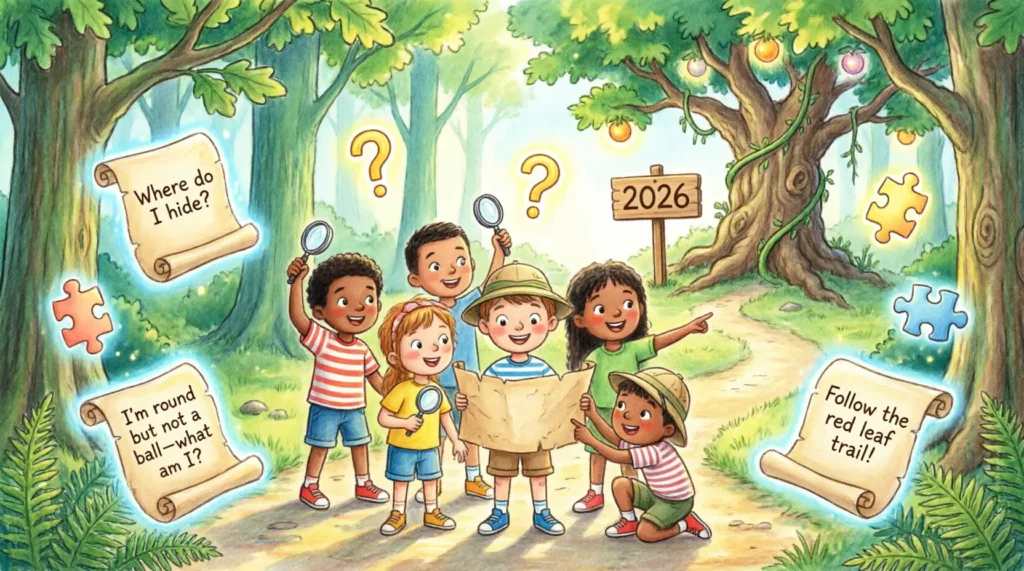
In short, scavenger hunt riddles for kids turn ordinary spaces into exciting treasure-filled adventures packed with laughter, teamwork, and creative thinking. They’re perfect for birthday parties, classrooms, rainy days, family game nights, and outdoor fun. Keep scrolling to discover kid-friendly riddles that will have children racing from clue to clue with huge smiles.
Why Scavenger Hunt Riddles For Kids Are More Powerful Than You Think
Kids love the thrill of solving a mystery, especially when every answer leads to a new surprise. That’s exactly why scavenger hunt riddles for kids are so effective. They combine movement, imagination, and problem-solving into one activity that feels more like an adventure than learning.
Educators and child development researchers often point out that riddles help strengthen memory, vocabulary, and logical thinking. When you add a scavenger hunt element, kids also practice teamwork, patience, and observation skills while staying physically active.
Studies show that children remember information better when learning involves play and movement. A simple clue hidden under a couch cushion or taped near the refrigerator can suddenly become part of a magical quest your child talks about for weeks.
Another reason these riddles work so well is the emotional payoff. Every solved clue gives kids a small burst of confidence. That “I figured it out!” moment matters more than many parents realize.
Across cultures, riddles have long been used to teach wisdom, storytelling, and quick thinking. Today, scavenger hunts continue that tradition in a way that feels modern, energetic, and unforgettable for kids of all ages.
What Makes a Great Scavenger Hunt Riddles For Kids
A great scavenger hunt riddle should challenge kids just enough without making them frustrated. The best clues create curiosity first, then reward children with a satisfying “aha!” moment once the answer clicks into place.
For younger kids, simple language and familiar objects work best. Clues about shoes, beds, toys, trees, or refrigerators keep the hunt exciting without becoming confusing. Older kids usually enjoy more wordplay, tiny twists, and clues that require careful thinking.
The setting matters too. Indoor scavenger hunts need clues tied to common household items, while outdoor hunts can include nature, playground equipment, or backyard hiding spots. The more connected the riddle feels to the environment, the more immersive the adventure becomes.
Good scavenger hunt riddles for kids also stay playful and positive. Clean humor, silly imagery, and imaginative wording help children stay engaged. Instead of sounding like homework, the clues should feel like part of a story or secret mission.
Most importantly, great riddles build momentum. Each clue should make kids eager to find the next one. When the pacing feels smooth, even simple objects around your home can suddenly feel magical.
Scavenger Hunt Riddles For Kids: 20 Riddles to Try Right Now
Indoor Scavenger Hunt Riddles
Riddle: I keep your food cold every day. Open my door and snacks are on display.
Answer: Refrigerator
Riddle: You rest your head on me each night, soft and cozy, warm and white.
Answer: Pillow
Riddle: I spin around but go nowhere fast. Dirty clothes inside me rarely last.
Answer: Washing machine
Riddle: You sit on me while eating your meals, but I don’t have pedals or wheels.
Answer: Chair
Riddle: I have hands but cannot clap. I help you wake from every nap.
Answer: Clock
Riddle: I glow at night when rooms are dark. Flip a switch and I will spark.
Answer: Lamp
Riddle: I’m full of stories, pages, and fun. Open me up when the day is done.
Answer: Book
Riddle: I hold water while you scrub away. You visit me many times each day.
Answer: Sink
Backyard and Outdoor Riddles
Riddle: I grow from the ground and reach for the sky. Birds build homes where my branches lie.
Answer: Tree
Riddle: Kick me around across the grass. Kids chase me quickly when I pass.
Answer: Ball
Riddle: I swing back and forth in the playground air. Sit on me gently if you dare.
Answer: Swing
Riddle: I bloom with colors bright and sweet. Bees and butterflies think I’m a treat.
Answer: Flower
Riddle: I protect your feet wherever you roam. You wear me outside but remove me at home.
Answer: Shoes
Riddle: I carry water through a long green snake. Spray me outside for summer’s sake.
Answer: Garden hose
School-Themed Scavenger Hunt Riddles
Riddle: I’m filled with crayons, pencils, and glue. Kids bring me daily when school is in view.
Answer: Backpack
Riddle: You write on me with chalk or a pen. Teachers use me again and again.
Answer: Whiteboard or chalkboard
Riddle: I sharpen your pencil when the tip breaks down. I make the point neat instead of round.
Answer: Pencil sharpener
Riddle: I carry your lunch from home to school. I keep food fresh and nice and cool.
Answer: Lunchbox
Silly and Fun Clues
Riddle: I have a tongue but cannot taste. Tie my laces so I don’t go to waste.
Answer: Shoe
Riddle: I get wetter the more I dry. Hanging in bathrooms, that’s where I lie.
Answer: Towel
Riddle: I’m full of teeth but cannot bite. I help your hair look clean and right.
Answer: Comb
🎯 More scavenger hunt riddles for kids: Easy, Medium, and Hard Challenges
Easy Riddles for scavenger hunt riddles for kids (Grades 6–7)
These easy riddles are perfect for younger middle schoolers who enjoy simple observation and playful thinking.
Riddle: I help you find your next clue, but I’m usually folded before you begin. What am I? Answer: A map
Riddle: I point in one direction all day long, but I never take a single step. What am I? Answer: An arrow
Riddle: The more teammates look for me, the faster I disappear. What am I? Answer: A hidden clue
Riddle: I have pages but I’m not always read. Sometimes I simply hide a message. What am I? Answer: A book
Riddle: I can hold treasures, clues, or supplies, and I’m easy to carry on your back. What am I? Answer: A backpack
Riddle: I’m full of numbers, but today I’m helping you keep track of clues instead of dates. What am I? Answer: A calendar
Medium Riddles for scavenger hunt riddles for kids (Grades 7–8)
These medium riddles encourage logical thinking and are great for students ready for a bigger challenge.
Riddle: Three clues point to the same room. One mentions books, another says “quiet,” and the last says “check me out.” Where should you go? Answer: The library
Riddle: Every clue tells you to move farther from the entrance. If you’ve followed four clues correctly, are you closer to the exit or the entrance? Answer: The exit
Riddle: You find a clue that says, “Stand where everyone starts but nobody stays.” Where are you? Answer: The starting line
Riddle: One clue says, “Find the tallest object that never grows.” What are you looking for? Answer: A flagpole
Riddle: Your clue says, “The answer is under something that has four legs but never walks.” Where should you search? Answer: Under a table
Riddle: A clue says to look where rain stays outside even when the sun comes back. What are you searching for? Answer: A puddle
Riddle: You receive two clues. One says “left,” one says “right.” A third clue says, “Trust the direction that appears twice.” You notice two arrows pointing left on the page. Which way should you go? Answer: Left
Hard Riddles for scavenger hunt riddles for kids (Grade 8 and Up)
These harder riddles use clever reasoning, abstract thinking, and careful attention to detail.
Riddle: Every clue shortens your journey, but each one also adds another step. What are you collecting? Answer: Directions
Riddle: I reveal where to go only after you’ve already decided where to stand. What am I? Answer: A hidden marker or clue that becomes visible from the correct spot
Riddle: I become easier to solve the more pieces you remove from me. What am I? Answer: A mystery
Riddle: The first clue sends you to the last location, and the last clue sends you to the first. Where should you actually begin? Answer: At the first clue
Riddle: You never carry me, but every player follows me from beginning to end. What am I? Answer: The route
Riddle: I can only be found after you’ve stopped looking in the obvious places. What am I? Answer: The hidden clue
Riddle: The answer isn’t the object itself but what the object helps you discover. What are you really searching for? Answer: The next clue
Using difficulty levels lets every student experience success before tackling bigger challenges. Start with easy riddles to build confidence, then gradually mix in medium and hard puzzles to encourage teamwork and critical thinking.
📚 Subject-Specific scavenger hunt riddles for kids: Math, Science, and More
Math Riddles for scavenger hunt riddles for kids
These math-themed riddles combine numbers, patterns, and logical thinking with the fun of a scavenger hunt.
Riddle: I have four equal sides and four right angles. Find something shaped like me in the classroom. What shape am I? Answer: A square
Riddle: Add me to myself and you get ten. What number am I? Answer: Five
Riddle: I come after every even number and before the next even number. What kind of number am I? Answer: An odd number
Riddle: Turn me upside down, and I still look almost the same. Which number am I? Answer: Eight
Riddle: I have no sides, no corners, and I roll instead of slide. What shape am I? Answer: A circle
Science Riddles for scavenger hunt riddles for kids
These science riddles help students connect everyday observations with important scientific ideas.
Riddle: I help plants make food using sunlight, water, and air. What process am I? Answer: Photosynthesis
Riddle: I pull everything toward Earth, even when you jump high. What force am I? Answer: Gravity
Riddle: I can be solid, liquid, or gas without changing what I’m made of. What am I describing? Answer: Matter
Riddle: I travel faster than sound, helping you see before you hear. What am I? Answer: Light
Riddle: I wear away rocks little by little using wind and water. What process am I? Answer: Erosion
Language Riddles for scavenger hunt riddles for kids
These wordplay riddles build vocabulary and grammar skills while keeping students engaged.
Riddle: Remove the first letter from “plane,” and I become something you can write. What am I? Answer: Pen
Riddle: I always begin a sentence when used correctly, even though I’m only one letter. What am I? Answer: A capital letter
Riddle: I connect two complete ideas with words like “and,” “but,” or “or.” What am I? Answer: A conjunction
Riddle: I describe a noun and often answer the question “What kind?” What part of speech am I? Answer: An adjective
Riddle: Rearrange the letters in “LISTEN” to create another word with the same letters. What word do you make? Answer: Silent
Use one subject riddle as a quick warm-up at the start of class to spark curiosity.
Turn riddles into exit tickets by asking students to solve one before leaving.
Divide students into teams and let each correct answer unlock the next classroom challenge.
How to Use Scavenger Hunt Riddles For Kids for Maximum Fun
Use riddles during birthday parties to turn simple games into full treasure adventures.
Hide clues around your home during rainy days when kids need indoor energy burners.
Add riddles to classroom activities for team-building and creative learning breaks.
Create backyard scavenger hunts during family barbecues or weekend gatherings.
Use bedtime treasure hunts with tiny prizes, stickers, or storybooks as rewards.
Turn road trips into mini clue-solving games using items kids can spot from the car.
You don’t need expensive supplies to make these activities memorable. A few handwritten clues, small treats, and clever hiding spots are usually enough to keep children fully engaged.
Parents and teachers often discover that scavenger hunts work especially well for shy kids. Because everyone focuses on solving clues together, children naturally talk, cooperate, and celebrate each success as a team.
If you want to make the experience even more exciting, give your hunt a theme. Pirates, detectives, jungle explorers, astronauts, and superheroes all work wonderfully with scavenger hunt riddles for kids.
Tips for Sharing Scavenger Hunt Riddles For Kids Without Spoiling the Fun
The way you present the riddles matters almost as much as the clues themselves. Build excitement before the hunt even starts by speaking like a treasure guide, secret agent, or explorer.
Try not to reveal answers too quickly. Kids usually enjoy wrestling with clues for a little while before getting help. If they seem stuck, offer tiny hints instead of giving away the full answer immediately.
You can also adjust the difficulty on the fly. Younger children may need clues read aloud slowly, while older kids often love timed challenges and trickier wordplay.
Keep the energy upbeat even when guesses are wrong. Sometimes the funniest moments happen when kids confidently search the completely wrong place before suddenly realizing the answer.
Most importantly, celebrate every success. A simple “You solved it!” can make kids feel like brilliant detectives.
Bonus: Scavenger Hunt Riddles For Kids That Stump Everyone
These bonus riddles are a little trickier and more surprising than the earlier ones. They work especially well for older kids, mixed-age groups, or children who already love puzzle games.
Riddle: I go up when rain comes down, though I never leave the ground.
Answer: Umbrella
Riddle: I’m cracked before you use me, and breakfast loves me most.
Answer: Egg
Riddle: I have keys but no locks, space but no room, and you can enter but not go inside.
Answer: Keyboard
Riddle: I follow you around all day but disappear when lights go away.
Answer: Shadow
Riddle: I’m easy to lift but hard to throw. The stronger you are, the farther I won’t go.
Answer: Feather
Riddle: I travel around the world while staying in one corner.
Answer: Stamp
Riddle: I’m full of holes but still hold water every day.
Answer: Sponge
FAQs About Scavenger Hunt Riddles For Kids
What age group are scavenger hunt riddles for kids best for?
These riddles work best for children ages 4 to 12, but you can easily adjust the difficulty. Younger kids usually enjoy simple object clues, while older children prefer trickier riddles with wordplay and misdirection.
How long should a kids scavenger hunt last?
Most children stay fully engaged for about 20 to 45 minutes depending on their age. Shorter hunts work well for preschoolers, while older kids often enjoy longer adventures with more complex clues.
Can scavenger hunt riddles for kids be educational?
Absolutely. Teachers and educators frequently use scavenger hunts to build vocabulary, observation skills, reading comprehension, and teamwork. Kids often learn faster when they’re moving, laughing, and solving clues together.
What prizes work best for a kids scavenger hunt?
Small rewards usually work perfectly. Stickers, candy, coloring books, toy treasures, pencils, or even the excitement of finding a “secret chest” at the end can feel magical to children.
Are indoor scavenger hunts as fun as outdoor ones?
Yes, especially when the clues are creative. Indoor hunts often feel more mysterious because kids search under furniture, inside closets, and around familiar spaces in completely new ways.
Final Thoughts: Keep the Fun Going with Scavenger Hunt Riddles For Kids
There’s something special about watching kids race around with huge smiles while trying to solve the next clue. Scavenger hunt riddles for kids turn ordinary moments into adventures packed with curiosity, teamwork, and laughter.
You don’t need a giant party or elaborate decorations to create excitement. A few clever clues and a little imagination can completely transform a living room, classroom, or backyard.
The more often you use riddles, the more confident and creative kids become. Over time, children start inventing their own clues, building stronger communication skills and sharper thinking without even realizing it.
So hide that first clue, gather your tiny treasure hunters, and let the adventure begin—because the best childhood memories often start with a simple riddle.
Frequently Asked Questions
What are the benefits of using scavenger hunt riddles for kids?▼
Scavenger hunt riddles promote movement, imagination, and problem-solving, turning learning into an adventure. They also help strengthen memory, vocabulary, and logical thinking while encouraging teamwork and observation skills.
How can I create effective scavenger hunt riddles for younger kids?▼
For younger kids, use simple language and familiar objects in your clues, such as shoes or toys. This keeps the hunt exciting and prevents frustration, allowing them to enjoy the thrill of solving riddles.
What types of clues work best for older kids in scavenger hunts?▼
Older kids tend to enjoy riddles that involve wordplay and require careful thinking. Incorporating tiny twists and clues related to their environment makes the experience more engaging and challenging.
Where should I hide clues for an indoor scavenger hunt?▼
For indoor scavenger hunts, it’s best to tie clues to common household items like chairs, clocks, or books. The more connected the riddle is to the environment, the more immersive and enjoyable the adventure becomes.
How do scavenger hunt riddles help boost children's confidence?▼
Every solved clue provides kids with a small burst of confidence, leading to the rewarding ‘I figured it out!’ moment. This emotional payoff is significant as it encourages them to tackle new challenges with enthusiasm.
What makes scavenger hunts suitable for various occasions?▼
Scavenger hunts can be tailored for birthday parties, classroom activities, rainy days, or family game nights, making them versatile and fun. Their ability to engage kids in active play allows for memorable adventures in any setting.
How can I ensure the scavenger hunt remains fun and engaging for children?▼
To keep scavenger hunts fun, use playful and positive language in your riddles, incorporating clean humor and imaginative wording. Additionally, maintaining a smooth pacing between clues will build momentum and excitement throughout the hunt.
Liam Nguyen is a seasoned educational consultant with over 15 years of experience in developing engaging content for classrooms across the globe. Holding a degree in Education from the University of Melbourne, Liam has dedicated his career to making learning fun and accessible for students of all ages. His passion for wordplay and critical thinking led him to specialize in writing challenging yet entertaining riddles. At FunRiddleZone, he creates hard and themed riddles that stimulate young minds and serve as great icebreakers for teachers. Outside of riddles, Liam enjoys hiking and exploring local trivia competitions.