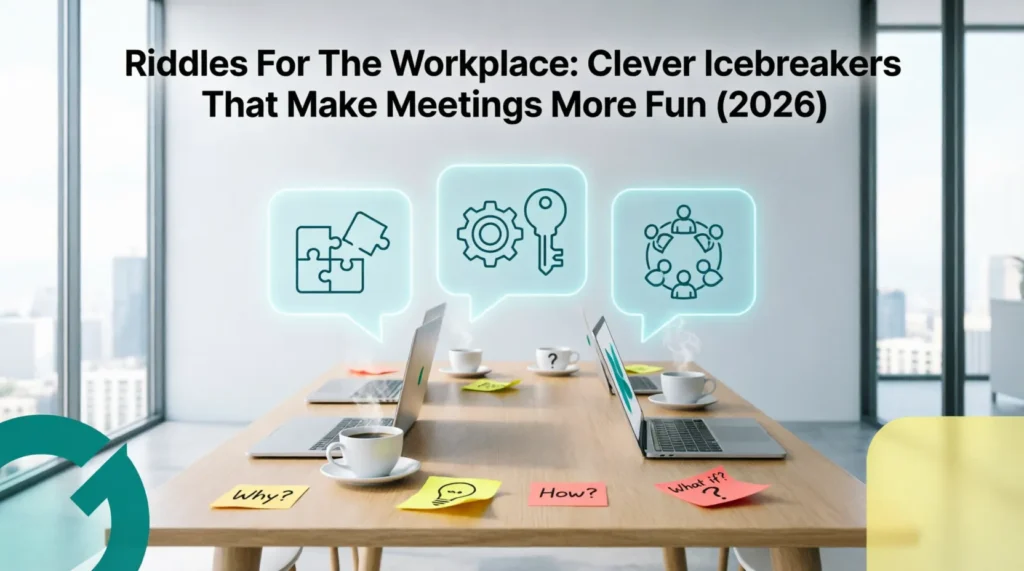
In short, riddles for the workplace are quick, clever brain teasers designed to spark conversation, improve team bonding, and make workdays feel more energetic. They’re perfect for meetings, Slack chats, onboarding sessions, and office breaks — and once you start using them, your team will look forward to the next one.
Planning a specific meeting or workshop? This page focuses on structured, facilitator-led icebreakers for meetings, onboarding sessions, and team workshops. If you just want quick riddles to swap during a coffee break or Slack thread instead, see our broader riddles for work collection.
Why Riddles For The Workplace Are More Powerful Than You Think
A good workplace riddle does more than fill awkward silence. It gets people thinking together, laughing together, and interacting in a way that feels natural instead of forced.
Workplace psychologists often point out that small moments of shared humor can improve team trust and communication. When you give your team a fun challenge, you create a low-pressure way for people to participate, especially during meetings or team-building activities.
Studies show that short mental puzzles can improve focus and boost engagement during collaborative tasks. That matters when your team is juggling deadlines, emails, and nonstop notifications all day.
Riddles for the workplace also work because they’re inclusive. You don’t need special skills, technical knowledge, or a loud personality to join in. A clever riddle gives everyone a chance to contribute, guess, and enjoy the “aha” moment together.
Across cultures, riddles have always been used to teach thinking, sharpen memory, and bring groups closer. The office is simply the modern version of that tradition.
What Makes a Great Riddles For The Workplace
The best workplace riddles hit a very specific balance. They should be smart enough to make people pause, but simple enough that nobody feels embarrassed for missing the answer.
A great office riddle also fits the tone of professional environments. That means clean humor, inclusive wording, and situations that most coworkers recognize instantly. Coffee machines, meetings, deadlines, printers, and email overload all make excellent riddle material because they’re familiar to nearly everyone.
Another key ingredient is misdirection. The strongest riddles for the workplace lead your brain toward one assumption before revealing a playful twist. That surprise is what creates the satisfying reaction people remember later.
You also want riddles that encourage conversation instead of competition. Educators and cognitive scientists often note that collaborative problem-solving helps people communicate more openly. In a workplace setting, that can make meetings feel less stiff and more human.
Most importantly, a workplace riddle should never isolate people or rely on offensive humor. The goal is shared fun, not inside jokes that leave someone out. When your riddles are welcoming and easy to join, your team becomes more willing to engage again next time.
Riddles For The Workplace: 20 Riddles to Try Right Now
Meeting Room Riddles
Riddle: I begin every meeting but rarely get credit for helping. Without me, nobody knows where to click. What am I?
Answer: The meeting link
Riddle: The more people talk over me, the less useful I become. What am I?
Answer: A conference call
Riddle: I’m always shared during meetings, but nobody can physically hold me. What am I?
Answer: A screen
Riddle: I can be full of ideas or completely blank, and everyone stares at me during brainstorming sessions. What am I?
Answer: A whiteboard
Riddle: I arrive every Monday morning and disappear by Friday evening, though nobody remembers creating me. What am I?
Answer: A packed calendar
Riddle: I help people speak without talking and react without interrupting. What am I?
Answer: The chat box in a virtual meeting
Office Life Riddles
Riddle: I’m touched by everyone but appreciated only when I stop working. What am I?
Answer: The office Wi-Fi
Riddle: I’m usually strongest at 9 a.m. and weakest after lunch. What am I?
Answer: Workplace motivation
Riddle: I can save hours or waste entire afternoons depending on who sends me. What am I?
Answer: An email
Riddle: I travel from desk to desk but never move on my own. What am I?
Answer: Office gossip
Riddle: The more you organize me, the harder I am to find later. What am I?
Answer: A computer file
Riddle: I’m small, sticky, colorful, and somehow responsible for remembering everything important. What am I?
Answer: A sticky note
Riddle: People gather around me every morning, yet I’m never invited to meetings. What am I?
Answer: The coffee machine
Teamwork and Productivity Riddles
Riddle: Everyone wants more of me, but when meetings run long, I disappear quickly. What am I?
Answer: Productivity
Riddle: I grow stronger when shared and weaker when ignored. What am I?
Answer: Team communication
Riddle: I can turn confusion into progress, but only if people are willing to ask me. What am I?
Answer: A question
Riddle: I’m often promised at the end of meetings but forgotten by the next morning. What am I?
Answer: An action item
Riddle: The faster you reply to me, the more of me appears. What am I?
Answer: Email threads
Funny Workplace Wordplay Riddles
Riddle: Why did the stapler get promoted?
Answer: Because it always held everything together
Riddle: Why did the employee bring a ladder to work?
Answer: Because they wanted to climb the corporate ladder
Riddle: What office item is best at keeping secrets?
Answer: The mute button
🎯 More riddles for the workplace: Easy, Medium, and Hard Challenges
Easy Riddles for riddles for the workplace (Grades 6–7)
These easy riddles are perfect for beginners who enjoy simple wordplay and everyday observations.
Riddle: I sit on a desk all day, but I never get tired. I hold your thoughts without speaking. What am I? Answer: A notebook
Riddle: The more meetings I attend, the shorter I become. What am I? Answer: A pencil
Riddle: I travel from one coworker to another in seconds, but I never take a step. What am I? Answer: An email
Riddle: I have many pages but no story, and people flip through me to find information. What am I? Answer: A planner
Riddle: I open doors without a key and connect people without a hallway. What am I? Answer: A video call
Riddle: I can be full in the morning and empty by lunch, yet nobody eats me. What am I? Answer: An inbox
Medium Riddles for riddles for the workplace (Grades 7–8)
These medium-level riddles are best for students who enjoy logic, reasoning, and connecting multiple clues.
Riddle: Three coworkers share one printer. Mia prints before Jordan. Jordan prints before Sam. Who printed second? Answer: Jordan
Riddle: A manager schedules four meetings: one at 9, one at 10, one at 11, and one at noon. The team meeting is after the project meeting but before the client meeting. The project meeting is at 9. What time is the team meeting if the client meeting is at 11? Answer: 10 o’clock
Riddle: A report takes 5 minutes to read. Four people each read their own copy at the same time. How long until everyone finishes? Answer: 5 minutes
Riddle: I am shared by many people, but if everyone takes me home, I disappear from work. What am I? Answer: Teamwork
Riddle: A worker arrives at the office every day before 8 but never uses an alarm. How? Answer: They work the night shift and are already awake
Riddle: The more organized I become, the fewer papers you can see. What am I? Answer: A filing cabinet
Riddle: Two coworkers send each other one email every hour for three hours. How many emails were sent in total? Answer: 6 emails
Hard Riddles for riddles for the workplace (Grade 8 and Up)
These challenging riddles are ideal for older students and puzzle lovers who enjoy clever thinking and subtle misdirection.
Riddle: I help solve problems, but I don’t think. I help people remember, but I don’t know anything. What am I? Answer: A checklist
Riddle: Everyone in the office can use me at once, yet I never run out. What am I? Answer: Knowledge
Riddle: A team has five members. Each person shakes hands exactly once with every other member. How many handshakes occur? Answer: 10
Riddle: I become stronger every time someone shares me, but weaker when nobody does. What am I? Answer: An idea
Riddle: A calendar shows meetings for next month, but none of those meetings have happened yet. Even so, the calendar is already accurate. Why? Answer: It is accurately showing future plans
Riddle: I can shorten a project without removing any tasks. What am I? Answer: Better efficiency
Riddle: The boss says, “The person who finished first wasn’t the fastest worker.” How could that be true? Answer: The fastest worker started later
Using different difficulty levels helps everyone participate while still feeling challenged. Teachers and parents can start with easy riddles to build confidence, then gradually introduce medium and hard puzzles for deeper thinking.
📚 Subject-Specific riddles for the workplace: Math, Science, and More
Math Riddles for riddles for the workplace
These math-themed riddles encourage logical thinking while keeping the fun alive.
Riddle: I am a number. Double me and add 6, and the result is 20. What number am I? Answer: 7
Riddle: I have four equal sides and four corners. In an office, I might look like a sticky note. What shape am I? Answer: A square
Riddle: A team completes 3 tasks on Monday and 5 on Tuesday. How many tasks did they complete altogether? Answer: 8
Riddle: I come after 49 and before 51. What am I? Answer: 50
Riddle: If every worker at a table has one chair and there are six workers, how many chairs are needed? Answer: 6
Science Riddles for riddles for the workplace
These science riddles connect everyday workplace ideas to basic scientific concepts.
Riddle: I help plants make food from sunlight, water, and air. What process am I? Answer: Photosynthesis
Riddle: I am the force that keeps your coffee cup from floating away from your desk. What am I? Answer: Gravity
Riddle: I can be solid, liquid, or gas, depending on temperature. What am I? Answer: Water
Riddle: I travel faster than sound and help you see your surroundings every day. What am I? Answer: Light
Riddle: I protect Earth from many harmful rays coming from the Sun. What am I? Answer: The atmosphere
Language Riddles for riddles for the workplace
These word-focused riddles build vocabulary, spelling, and language skills through playful thinking.
Riddle: Remove the first letter from “train” and you get something that falls from the sky. What is it? Answer: Rain
Riddle: I am a word with six letters. Remove one letter and twelve remain. What word am I? Answer: Dozens
Riddle: What word becomes shorter when you add two letters to it? Answer: Short
Riddle: I begin with “e,” end with “e,” and contain only one letter. What am I? Answer: An envelope
Riddle: What English word keeps the same pronunciation even after you remove four of its five letters? Answer: Queue
Use subject-specific riddles as quick warm-up activities before introducing a new lesson.
Turn them into exit tickets to review concepts in a fun, low-pressure way.
Challenge small groups to solve and explain the reasoning behind each answer for collaborative learning.
How to Use Riddles For The Workplace for Maximum Fun
Start meetings with one quick riddle to break the ice before serious discussions begin.
Post a weekly riddle in your team Slack or Microsoft Teams channel to encourage casual interaction.
Use riddles during onboarding to help new employees feel comfortable speaking up early.
Add workplace riddles to team-building events, lunch breaks, or Friday wrap-up sessions.
Turn riddles into small competitions with simple rewards like coffee vouchers or snack privileges.
Use themed riddles during busy seasons to lighten stressful moments without disrupting productivity.
The best part about riddles for the workplace is how flexible they are. You can use them with remote teams, hybrid teams, interns, executives, or entire departments. A two-minute puzzle can completely change the mood of a meeting that starts off tense or quiet.
You also don’t need to overthink delivery. Sometimes the funniest moments come from spontaneous guesses and unexpected answers. If your team starts creating their own riddles, you’ll know the activity is working.
Tips for Sharing Riddles For The Workplace Without Spoiling the Fun
Timing matters more than difficulty. If you reveal the answer too quickly, people don’t get the satisfaction of solving it. Give your coworkers at least a minute to think, debate, and throw out wild guesses.
You should also adapt the challenge level to your audience. A fast-paced sales team may enjoy witty wordplay, while analytical teams might prefer logic-based riddles. Mixing styles keeps everyone engaged.
When someone guesses incorrectly, keep the mood playful instead of competitive. The goal is shared enjoyment, not proving who is smartest in the room.
It also helps to rotate who presents the riddles. When different team members lead the activity, participation feels more natural and inclusive. Over time, your office culture becomes more interactive without feeling forced.
Bonus: Riddles For The Workplace That Stump Everyone
These bonus riddles are a little trickier than the main list. They work especially well when your team already enjoys regular office brain teasers and wants something more challenging.
Riddle: I’m created to save time, yet people spend hours discussing me before I exist. What am I?
Answer: A meeting agenda
Riddle: The more successful I become, the harder I am to schedule. What am I?
Answer: A manager
Riddle: I can make an entire office nervous with just one short notification sound. What am I?
Answer: A message from the boss
Riddle: I’m expected immediately, corrected repeatedly, and forgotten after approval. What am I?
Answer: A draft document
Riddle: Everyone complains about me arriving, but they panic when I disappear. What am I?
Answer: Deadlines
Riddle: I help people avoid work while looking busy at the same time. What am I?
Answer: Rearranging spreadsheets
Riddle: I grow longer the less people prepare for me. What am I?
Answer: A meeting
FAQs About Riddles For The Workplace
Are riddles for the workplace good for team building?
Yes, they’re surprisingly effective for team building because they encourage low-pressure interaction. Your team gets to collaborate, laugh, and think creatively without the stress of formal activities. Workplace psychologists often connect these small shared moments with stronger communication and trust.
How long should workplace riddles take?
Most workplace riddles work best when they take between one and three minutes. You want enough time for discussion, but not so much that the activity interrupts productivity. Quick riddles usually fit perfectly into meeting openings or break times.
Can riddles for the workplace work with remote teams?
Absolutely. In fact, remote teams often benefit even more from short interactive activities because virtual meetings can feel stiff or repetitive. You can post riddles in Slack, use them in Zoom calls, or include them in team newsletters to create more connection.
What makes workplace riddles different from regular riddles?
Workplace riddles focus on professional settings, shared office experiences, and clean humor. They’re designed to be inclusive, lighthearted, and safe for group environments. The best ones reflect real work situations your coworkers instantly recognize.
Are riddles for the workplace appropriate for large companies?
Yes, as long as the riddles stay respectful and broadly relatable. Large organizations often use them during onboarding, workshops, training sessions, and company events because they help people interact across departments in a relaxed way.
Final Thoughts: Keep the Fun Going with Riddles For The Workplace
Workdays can easily become repetitive, especially when meetings, deadlines, and inboxes start blending together. That’s why small moments of humor and curiosity matter more than people realize.
Riddles for the workplace give your team a simple way to connect without pressure. They create quick bursts of energy, encourage conversation, and help people feel more comfortable participating.
You don’t need a huge team-building budget or a complicated activity plan to make your workplace feel more engaging. Sometimes all it takes is one clever question at the right moment.
The more your team laughs, guesses, and solves together, the more natural collaboration becomes — and that’s a win everyone notices long after the riddle ends.
Frequently Asked Questions
What are the benefits of using riddles in the workplace?▼
Riddles can spark conversation, improve team bonding, and make workdays feel more energetic. They also create low-pressure opportunities for participation, enhancing communication and trust among team members.
How do workplace riddles improve team engagement?▼
Short mental puzzles, like riddles, can boost focus and engagement during collaborative tasks. They provide a fun challenge that encourages participation, especially in meetings and team-building activities.
What characteristics should I look for in a great workplace riddle?▼
A great workplace riddle should be smart yet simple enough to avoid embarrassment for those who miss the answer. It should also fit a professional tone, featuring clean humor and relatable situations that most coworkers recognize.
Can riddles be inclusive for all team members?▼
Yes, workplace riddles are designed to be inclusive, requiring no special skills or loud personalities to participate. This allows everyone to contribute and enjoy the shared ‘aha’ moment together.
How can riddles help make meetings more enjoyable?▼
Riddles can lighten the mood during meetings by providing moments of shared humor and interaction, making the atmosphere feel less stiff. They encourage conversation and collaborative problem-solving, which can enhance team dynamics.
What types of themes work well for workplace riddles?▼
Riddles related to common office scenarios, such as meetings, coffee breaks, or everyday technology like Wi-Fi and printers, resonate well. These themes are familiar to almost everyone, making them relatable and engaging.
Are there any tips for introducing riddles in a professional setting?▼
When introducing riddles, ensure they are welcoming and easy to join in on, avoiding offensive humor or inside jokes. This approach fosters a sense of shared fun and encourages team members to engage with each other.
Liam Nguyen is a seasoned educational consultant with over 15 years of experience in developing engaging content for classrooms across the globe. Holding a degree in Education from the University of Melbourne, Liam has dedicated his career to making learning fun and accessible for students of all ages. His passion for wordplay and critical thinking led him to specialize in writing challenging yet entertaining riddles. At FunRiddleZone, he creates hard and themed riddles that stimulate young minds and serve as great icebreakers for teachers. Outside of riddles, Liam enjoys hiking and exploring local trivia competitions.