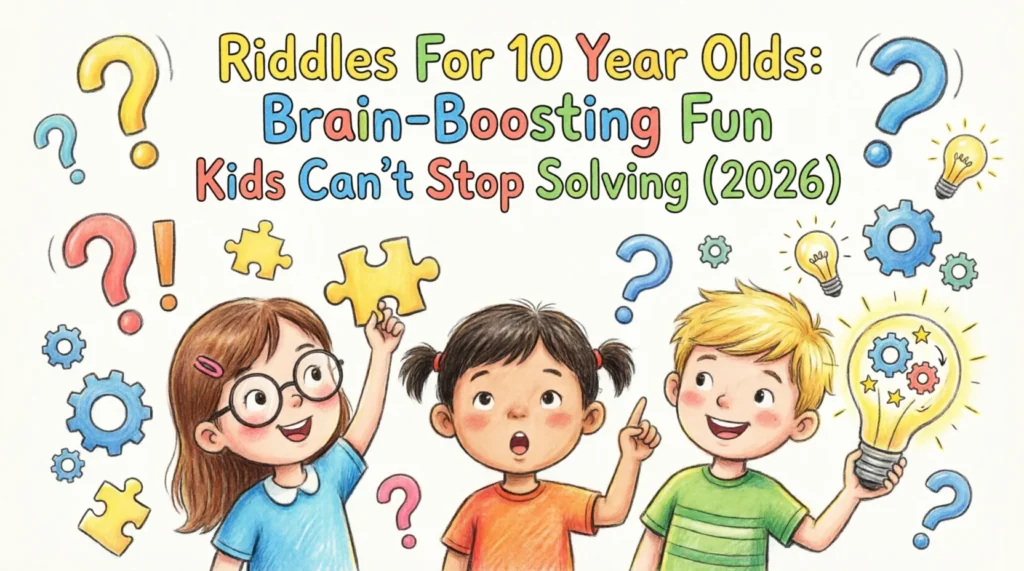
In short, riddles for 10 year olds are fun, brain-boosting puzzles designed to challenge thinking, improve problem-solving, and spark laughter at the same time. They are perfect for classroom activities, family game nights, and solo brain workouts. If you enjoy clever twists and “aha!” moments, you’re about to discover riddles that will keep you hooked for hours.
Why Riddles For 10 Year Olds Are More Powerful Than You Think
Riddles for 10 year olds do far more than entertain — they actively shape how your mind learns to think. At this age, your brain is developing faster connections between logic, language, and imagination, which makes riddles especially powerful for growth.
Educators and cognitive scientists often highlight that puzzle-solving activities strengthen memory retention, attention span, and flexible thinking. When you engage with riddles for 10 year olds, you’re not just playing — you’re training your brain to spot patterns and think outside the box.
Studies in child development suggest that children who regularly solve riddles show improved problem-solving skills and stronger verbal reasoning abilities compared to those who don’t. That means every riddle you try is quietly building your mental toolkit.
Most importantly, riddles make learning feel like play. You don’t feel pressured, yet your brain is working hard behind the scenes. That balance of fun and challenge is what makes riddles so effective at this age.
What Makes a Great Riddles For 10 Year Olds
A great riddle for your age group needs the perfect balance between challenge and clarity. If it’s too easy, you lose interest. If it’s too hard, you feel frustrated. The best riddles for 10 year olds sit right in the middle — tricky enough to make you think, but fair enough that you can solve them with a little creativity.
Wordplay is a huge part of what makes riddles exciting. You’ll often find double meanings, sneaky hints, or unexpected interpretations that make you pause and rethink what you just read. That “aha!” moment when everything clicks is what keeps you coming back for more.
At your age, riddles also need to stay clean, fun, and relatable. That means topics like school, animals, nature, everyday objects, and simple life situations work best. You should be able to picture the answer easily once you figure it out.
The real magic of riddles for 10 year olds is that they reward curiosity. When you slow down, think differently, and trust your instincts, you start solving problems in ways you didn’t expect.
Riddles For 10 Year Olds: 20 Riddles to Try Right Now
School & Everyday Life Riddles
Riddle: I have a face but no eyes, hands but no fingers, and I help you keep track of time. What am I? Answer: A clock
Riddle: The more you take away from me, the bigger I get. What am I? Answer: A hole
Riddle: I’m full of pages but I’m not alive. I help you learn every day. What am I? Answer: A book
Riddle: I get sharper the more you use me, but I am not alive. What am I? Answer: A pencil
Riddle: I travel around the classroom but never move on my own. What am I? Answer: A notebook being passed around
Animal & Nature Riddles
Riddle: I can hop all day but never get tired. I carry my home wherever I go. What am I? Answer: A turtle
Riddle: I’m small, I buzz, and I help flowers grow. What am I? Answer: A bee
Riddle: I change my color to hide, and I climb walls without tools. What am I? Answer: A chameleon
Riddle: I have wings but I’m not a bird, and I come out at night. What am I? Answer: A bat
Riddle: I grow from a tiny seed and reach up toward the sun. What am I? Answer: A tree
Logic & Trick Riddles
Riddle: What has keys but can’t open locks? Answer: A piano
Riddle: What gets wetter the more it dries? Answer: A towel
Riddle: What has a head, a tail, but no body? Answer: A coin
Riddle: What comes once in a minute, twice in a moment, but never in a thousand years? Answer: The letter M
Riddle: What can you break without touching it? Answer: A promise
Riddle: What has cities but no houses, rivers but no water, and roads but no cars? Answer: A map
Riddle: What goes up but never comes down? Answer: Your age
Riddle: What has teeth but cannot bite? Answer: A comb
🎯 More riddles for 10 year olds: Easy, Medium, and Hard Challenges
Easy Riddles for riddles for 10 year olds (Grades 6–7)
These easy riddles are perfect for students who enjoy simple wordplay, careful observation, and confidence-building challenges.
Riddle: I have a face that never smiles, two hands that never wave, and I help you stay on time. What am I? Answer: A clock.
Riddle: I grow shorter every time someone uses me, but I still give light. What am I? Answer: A candle.
Riddle: The more classmates who borrow me, the lighter I become. What am I? Answer: A stack of paper.
Riddle: You can write on me, erase me, and use me again without buying another one. What am I? Answer: A whiteboard.
Riddle: I follow every word you read but never understand the story. What am I? Answer: Your finger.
Riddle: I have many corners, but I never leave the classroom wall. What am I? Answer: A bulletin board.
Medium Riddles for riddles for 10 year olds (Grades 7–8)
These medium riddles are great for students ready to practice logic, careful reasoning, and connecting multiple clues.
Riddle: Three friends each solved a different puzzle. Ava finished before Ben, but after Maya. Who finished first? Answer: Maya.
Riddle: I am always yesterday’s future and tomorrow’s past. What am I? Answer: Today.
Riddle: A number doubles itself when looked at in a mirror, yet it never changes value. What am I? Answer: The number 8.
Riddle: You walk into a room with four chairs. Two people are sitting, one person is standing, and one chair is empty. How many chairs are occupied? Answer: Three.
Riddle: Every page I lose makes me thinner, yet my story stays complete if someone remembers it. What am I? Answer: A book.
Riddle: I always arrive one step after the first, but I can never become the first. What am I? Answer: Second place.
Riddle: If five birds sit on a fence and two fly away, how many birds chose to stay? Answer: Three.
Hard Riddles for riddles for 10 year olds (Grade 8 and Up)
These harder riddles encourage abstract thinking, clever reasoning, and looking beyond the most obvious answer.
Riddle: I become larger every time you remove a piece from me. What am I? Answer: A hole.
Riddle: Two people look at the same map. One sees the fastest route, while the other sees the longest adventure. What changes? Answer: Their goal.
Riddle: I can connect two ideas without touching either one. What am I? Answer: A comparison.
Riddle: I exist only while someone is asking about me, and I disappear the moment I’m answered. What am I? Answer: A question.
Riddle: I can be broken without making a sound, and fixing me often takes much longer than breaking me. What am I? Answer: Trust.
Riddle: The more carefully you organize me, the faster you can find what you need. What am I? Answer: A filing system.
Riddle: I never move, but every traveler depends on me to know where they are going. What am I? Answer: A destination.
Using difficulty tiers helps every learner experience success before tackling bigger challenges. Try mixing easy, medium, and hard riddles during class or family game night so everyone has a chance to solve, explain, and discuss different types of thinking.
📚 Subject-Specific riddles for 10 year olds: Math, Science, and More
Math Riddles for riddles for 10 year olds
These math-themed riddles build number sense and logical thinking while keeping problem-solving fun.
Riddle: I am an even number. Divide me by 2, and then add 5 to get 11. What number am I? Answer: 12.
Riddle: I have four equal sides and four right angles. Who am I? Answer: A square.
Riddle: I come after 49 but before 51, and I am the only number you need. What am I? Answer: 50.
Riddle: Add me to myself and you get 18. What number am I? Answer: 9.
Riddle: I am a shape with three sides, but no matter how you turn me, I still have three corners. What am I? Answer: A triangle.
Science Riddles for riddles for 10 year olds
These science riddles connect everyday observations with exciting scientific ideas.
Riddle: I help plants make food using sunlight, water, and air. What process am I? Answer: Photosynthesis.
Riddle: I pull everything toward Earth, even when you jump high. What am I? Answer: Gravity.
Riddle: I can be solid, liquid, or gas, but I am still the same substance. What am I? Answer: Water.
Riddle: I shine during the day, give Earth light and warmth, but I am actually a star. What am I? Answer: The Sun.
Riddle: I protect your brain like a natural helmet and am made of bone. What am I? Answer: The skull.
Language Riddles for riddles for 10 year olds
These language riddles encourage students to think about words, letters, spelling, and vocabulary in creative ways.
Riddle: Remove the first letter from “smile,” and I become something you can measure. What am I? Answer: Mile.
Riddle: I am a word that becomes shorter when you add two letters to it. What word am I? Answer: Short.
Riddle: I am the only letter that appears once in “teacher,” once in “student,” and not at all in “school.” What letter am I? Answer: T.
Riddle: I begin every sentence but never appear at the end unless someone forgets punctuation. What am I? Answer: A capital letter.
Riddle: I connect two complete ideas with just one small word: “and,” “but,” or “or.” What part of speech am I? Answer: A conjunction.
Teachers can easily bring subject riddles into everyday lessons by:
Use one riddle as a warm-up to spark curiosity before introducing a new topic.
Turn riddles into exit tickets that encourage students to explain their thinking before leaving class.
Divide students into small groups and have each team solve, discuss, and create their own subject-themed riddles to share.
How to Use Riddles For 10 Year Olds for Maximum Fun (or Impact)
Use them during family dinner to spark conversation and laughter
Turn them into a classroom warm-up activity before lessons
Share them during car rides to make travel more fun
Use them in birthday parties as mini brain games
Challenge your friends in group chats or school breaks
When you start using riddles for 10 year olds regularly, you’ll notice how quickly they turn ordinary moments into fun thinking games. You can even create your own riddles once you understand how they work. The more you practice, the sharper your mind becomes, and the easier it gets for you to spot tricky patterns in everyday life.
Tips for Sharing Riddles For 10 Year Olds Without Spoiling the Fun
When you share riddles, don’t rush the answer. Give your friends or classmates enough time to think. You’ll enjoy the game more when everyone gets a fair chance to solve it.
If someone struggles, you can gently give small hints instead of revealing everything. This keeps the excitement alive and helps them reach the solution on their own.
You should also adjust difficulty depending on who you’re playing with. If your friends are new to riddles, start simple. If they’re experienced, challenge them with trickier ones.
Finally, always celebrate effort, not just correct answers. Even wrong guesses can lead to fun discussions and surprising thinking paths.
Bonus: Riddles For 10 Year Olds That Stump Everyone
These bonus riddles are trickier and designed to really stretch your thinking. If you can solve them without help, you’ve got excellent problem-solving skills.
Riddle: I fly without wings, I cry without eyes. Wherever I go, darkness flies. What am I? Answer: A cloud
Riddle: I’m always in front of you but can’t be seen. What am I? Answer: The future
Riddle: The more you share me, the less I become. What am I? Answer: A secret
Riddle: I speak without a mouth and hear without ears. What am I? Answer: An echo
Riddle: I have no life, but I can die if not fed. What am I? Answer: Fire
Riddle: I can fill a room but take up no space. What am I? Answer: Light
Riddle: I run but never walk, I have a bed but never sleep. What am I? Answer: A river
FAQs About Riddles For 10 Year Olds
Are riddles for 10 year olds good for brain development?
Yes, riddles for 10 year olds are excellent for brain development because they improve logic, memory, and language skills. When you solve them regularly, you train your brain to think more flexibly and creatively.
How hard should riddles for 10 year olds be?
They should be moderately challenging — not too easy, but not frustrating either. The best riddles for 10 year olds make you think for a moment, then reward you with a satisfying “aha!” when you figure them out.
Can riddles for 10 year olds be used in classrooms?
Absolutely. Teachers often use riddles for 10 year olds as warm-up exercises, group activities, or brain breaks. They help students stay engaged and improve focus before lessons.
What skills do riddles for 10 year olds improve?
They improve critical thinking, problem-solving, vocabulary, and attention to detail. You also become better at understanding wordplay and hidden meanings.
How often should kids practice riddles?
Even a few minutes a day can make a difference. The more you practice riddles for 10 year olds, the more confident and quick your thinking becomes over time.
Final Thoughts: Keep the Fun Going with Riddles For 10 Year Olds
Riddles for 10 year olds are more than just games — they’re powerful tools for learning, laughter, and creativity. Every riddle you solve strengthens your thinking skills in a fun and relaxed way.
If you make riddles part of your daily routine, you’ll start noticing how quickly your brain adapts to new challenges. You’ll think faster, stay more curious, and enjoy problem-solving in everyday life.
Keep challenging yourself, keep sharing with friends, and keep enjoying the thrill of discovery — because the next great “aha!” moment could be just one riddle away.
Frequently Asked Questions
What are the benefits of solving riddles for 10 year olds?▼
Solving riddles for 10 year olds helps improve problem-solving skills, enhances memory retention, and boosts flexible thinking. They actively engage the brain, making learning feel like play, which is essential for cognitive development at this age.
How can I use riddles in classroom activities?▼
Riddles can be incorporated into classroom activities as fun challenges that promote critical thinking and teamwork among students. They can be used as warm-up exercises, brain teasers during lessons, or even as part of a game night to enhance engagement.
What makes a riddle suitable for 10 year olds?▼
A suitable riddle for 10 year olds strikes a balance between challenge and clarity, ensuring it is tricky yet solvable with creativity. Additionally, the topics should be relatable, focusing on school, animals, and everyday life, allowing kids to easily visualize the answers.
Why are wordplay and double meanings important in riddles?▼
Wordplay and double meanings add an element of excitement and challenge to riddles, encouraging kids to think outside the box. These aspects help develop language skills and enhance their ability to recognize patterns and interpret clues.
Can riddles help improve verbal reasoning abilities?▼
Yes, studies suggest that children who regularly engage with riddles demonstrate stronger verbal reasoning abilities compared to peers who do not. This is because riddles require them to think critically about language and its meanings, fostering better communication skills.
What types of riddles are best for 10 year olds?▼
The best types of riddles for 10 year olds involve clean, fun topics that are relatable and easy to visualize, such as school-related scenarios, animals, and nature. These riddles should also encourage curiosity and creative thinking.
How do riddles create 'aha!' moments for kids?▼
Riddles create ‘aha!’ moments by presenting challenges that require kids to pause and rethink their assumptions. When they finally solve a riddle, it leads to a sense of accomplishment and reinforces their problem-solving abilities.
Raj Patel is an engineer turned writer who has a passion for puzzles and logical challenges. Educated at the Indian Institute of Technology, Raj utilized his problem-solving skills in developing themed and hard riddles that challenge adults while remaining clean and family-friendly. His interest in brainteasers began in childhood, inspiring him to create intricate riddles that can entertain and educate simultaneously. At FunRiddleZone, Raj’s contributions are invaluable for adult entertainment and enhancing cognitive skills through fun. He enjoys playing chess and developing mobile puzzle apps in his spare time.