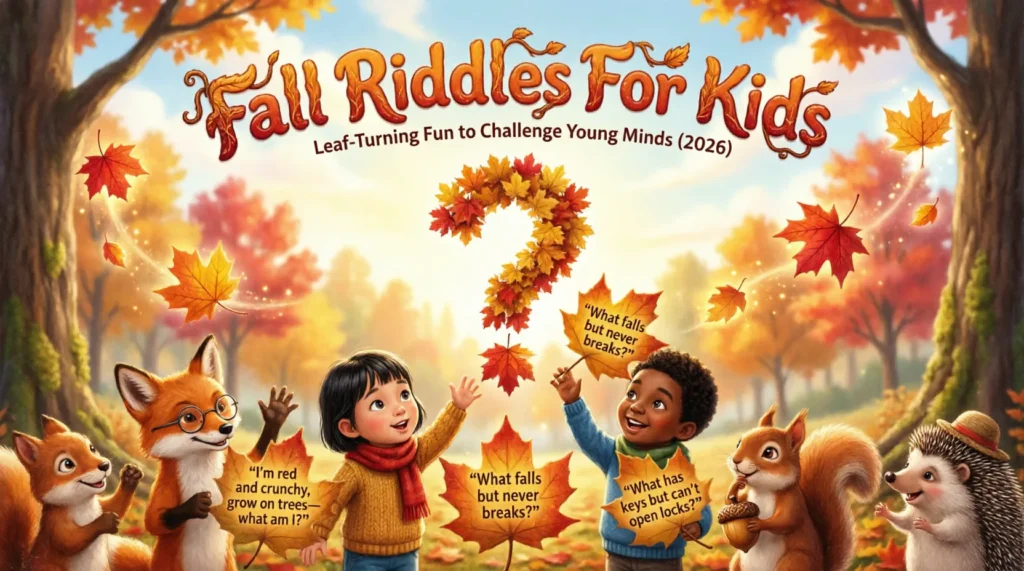
In short, fall riddles for kids are a fun and engaging way to celebrate autumn while boosting critical thinking, creativity, and laughter. They’re perfect for classrooms, family gatherings, road trips, and cozy afternoons, giving children a playful challenge wrapped in seasonal fun. Scroll down and see how many autumn-themed riddles your young puzzlers can solve!
Why Fall Riddles For Kids Are More Powerful Than You Think
Fall is full of wonder. Leaves change colors, pumpkins appear everywhere, and the air feels different. When you combine that excitement with riddles, you create a learning experience that feels more like play than work.
Educators and child development researchers often highlight how riddles help children strengthen problem-solving skills, vocabulary, memory, and creative thinking. Because fall brings so many familiar sights and experiences, seasonal riddles are especially effective at helping kids connect ideas and make observations.
Studies show that playful brain activities can improve children’s engagement and attention while encouraging flexible thinking. That’s one reason fall riddles for kids are so popular in classrooms, homeschool lessons, and family activities during autumn.
Riddles are also a global tradition. Across cultures, people have used puzzles and word games for generations to teach, entertain, and bring families together. Fall simply gives those riddles a colorful seasonal twist.
What Makes a Great Fall Riddles For Kids
A great fall riddle is challenging enough to make children think but simple enough that they can eventually discover the answer. The best ones create a small mystery and reward kids with an exciting “aha!” moment when everything clicks into place.
Seasonal themes are especially important. The strongest fall riddles for kids focus on things children see and experience during autumn, such as pumpkins, leaves, apples, scarecrows, cornfields, squirrels, and cooler weather. These familiar topics make the riddles easier to visualize and more enjoyable to solve.
Wordplay also plays a big role. Kids love clues that seem to point in one direction before revealing a surprising answer. That tiny bit of misdirection encourages deeper thinking without becoming frustrating.
Because the audience is children, the humor should stay clean, friendly, and age-appropriate. A successful fall riddle makes your child smile, think, and feel proud when they discover the answer. That’s what turns a simple question into a memorable experience.
When you choose riddles that match your child’s age and interests, you’ll keep them engaged longer and make the activity more rewarding for everyone involved.
Fall Riddles For Kids: 20 Riddles to Try Right Now
Riddles About Leaves and Trees
Riddle: I start the year green, but in fall I become red, orange, or gold before floating to the ground. What am I?
Answer: A leaf.
Riddle: I dance without feet and travel without wings whenever the autumn breeze arrives. What am I?
Answer: A falling leaf.
Riddle: The more of me you rake, the bigger I become. What am I?
Answer: A leaf pile.
Riddle: I wear hundreds of colorful coats every fall, but I never visit a closet. What am I?
Answer: A tree.
Riddle: Kids love to jump into me, but I disappear once the yard is cleaned. What am I?
Answer: A pile of leaves.
Riddles About Pumpkins and Harvest Time
Riddle: I grow in a patch, become a decoration, and sometimes turn into pie. What am I?
Answer: A pumpkin.
Riddle: I am orange outside, filled with seeds inside, and often sit on porches in autumn. What am I?
Answer: A pumpkin.
Riddle: I wear a smiling face that someone carved, yet I never laugh. What am I?
Answer: A jack-o’-lantern.
Riddle: Farmers gather me when the growing season ends. I am the reward for months of work. What am I?
Answer: The harvest.
Riddle: I am sweet, crunchy, and often picked from orchards during fall. What am I?
Answer: An apple.
Riddles About Autumn Animals
Riddle: I gather acorns all season long because winter is coming. Who am I?
Answer: A squirrel.
Riddle: I say “hoot” from a tree while autumn nights grow longer. Who am I?
Answer: An owl.
Riddle: I fly south when colder weather arrives. What am I?
Answer: A migrating bird.
Riddle: I hide nuts today so I can find snacks tomorrow. What am I?
Answer: A squirrel.
Riddle: I may not build a nest in your yard, but you’ll often spot me searching fields during fall. What am I?
Answer: A crow.
Riddles About Fall Weather and Fun
Riddle: I am cooler than summer but not as cold as winter. What season am I?
Answer: Fall.
Riddle: You wear more of me when the weather gets chilly, but I am not a blanket. What am I?
Answer: A sweater.
Riddle: I blow through trees and send colorful leaves swirling through the air. What am I?
Answer: The wind.
Riddle: The days grow shorter whenever I arrive. What season am I?
Answer: Autumn.
Riddle: You might sip me from a mug while watching leaves fall outside. I am warm and often flavored with cinnamon. What am I?
Answer: Apple cider.
🎯 More fall riddles for kids: Easy, Medium, and Hard Challenges
Easy Riddles for fall riddles for kids (Grades 6–7)
These easy challenges are perfect for younger middle schoolers who enjoy spotting clues and making simple connections.
Riddle: I turn trees into painters without ever holding a brush. What am I? Answer: Fall.
Riddle: I travel from branch to branch but never take a step. What am I? Answer: A falling leaf.
Riddle: I wear a shell outside, hide a snack inside, and squirrels love to find me. What am I? Answer: An acorn.
Riddle: You can jump into me, scatter me everywhere, and still never break me. What am I? Answer: A pile of leaves.
Riddle: I help keep your hands warm, but I have room for each finger. What am I? Answer: Gloves.
Riddle: I arrive with cool mornings, cozy sweaters, and shorter afternoons. What season am I? Answer: Fall.
Medium Riddles for fall riddles for kids (Grades 7–8)
These medium riddles are great for students ready to use logic, observation, and a little extra thinking.
Riddle: Every windy day I lose hundreds of pieces, but by spring I can grow them all back. What am I? Answer: A deciduous tree.
Riddle: Two friends collect the same number of apples. One makes three pies, and the other fills one basket. How is that possible? Answer: They used apples of different sizes.
Riddle: The colder the nights become, the brighter my colors often appear before I disappear. What am I? Answer: A fall leaf.
Riddle: I can cover a whole yard overnight, yet I weigh almost nothing one piece at a time. What am I? Answer: Fallen leaves.
Riddle: I spend all summer growing, but many people notice me only when I change color. What am I? Answer: A leaf.
Riddle: I can be picked from a tree, carved into a face, or baked into a pie, depending on what I am. What am I? Answer: A pumpkin.
Riddle: The more squirrels visit me in autumn, the fewer surprises I have by winter. What am I? Answer: An acorn stash.
Hard Riddles for fall riddles for kids (Grade 8 and Up)
These harder riddles reward careful thinking, clever reasoning, and looking beyond the obvious.
Riddle: I make every shadow longer without changing the size of a single object. What am I? Answer: The lower autumn sun.
Riddle: I leave every tree one step closer to winter, but I never touch a single branch. What am I? Answer: Time.
Riddle: You hear me before you see me. I grow louder as I grow smaller beneath your feet. What am I? Answer: Crunching leaves.
Riddle: I help trees save energy by leaving, even though I seem like something they have lost. What am I? Answer: Their leaves.
Riddle: I can fill a basket today, become a pie tomorrow, and leave only seeds behind the next day. What am I? Answer: An apple.
Riddle: I make birds harder to find, not because they disappear, but because many choose to travel. What am I? Answer: Autumn migration.
Riddle: I grow colder every week, yet I prepare many plants to survive until spring. What season am I? Answer: Fall.
Using different difficulty levels helps every student experience success while still offering an extra challenge to advanced thinkers. Try letting students choose their own level or solve increasingly harder riddles as a team to build confidence and critical thinking.
📚 Subject-Specific fall riddles for kids: Math, Science, and More
Math Riddles for fall riddles for kids
These math-themed riddles combine numbers, shapes, and patterns with a fun seasonal twist.
Riddle: I have eight equal slices after being cut, but before that I was just one whole treat. What am I? Answer: A pie.
Riddle: I have four equal sides and four right angles. You might see me as a classroom window during a fall afternoon. What shape am I? Answer: A square.
Riddle: If three squirrels each gather five acorns, how many acorns do they collect altogether? Answer: Fifteen.
Riddle: I always stay the same distance from my center, whether I’m a pumpkin or a coin. What shape am I? Answer: A circle.
Riddle: I come after 49 and before 51. What number am I? Answer: 50.
Science Riddles for fall riddles for kids
These science riddles encourage curiosity about the natural world while staying fun and approachable.
Riddle: I help leaves make food using sunlight, but I slow down as autumn arrives. What process am I? Answer: Photosynthesis.
Riddle: I travel south when temperatures drop, returning when warmer weather comes back. What am I? Answer: A migrating bird.
Riddle: I carry seeds away from their parent plants without planting a single one myself. What am I? Answer: The wind.
Riddle: I am water that appears on cool grass in the morning without falling from the clouds. What am I? Answer: Dew.
Riddle: Trees need less of me as the weather cools and the days become shorter. What am I? Answer: Sunlight.
Language Riddles for fall riddles for kids
These wordplay riddles help students think about letters, vocabulary, and language in creative ways.
Riddle: Remove the first letter from “stack,” and you get something you can climb. What is it? Answer: Tack? Wait—that doesn’t work. Remove the first letter from “stair” isn’t right. Try this instead: Remove the first letter from “plane,” and you get something that flies less. Better version: Remove the first letter from “glove,” and you get a word that means to love greatly? No. Here’s the final riddle: Remove the first letter from “crate,” and you get something you can rate. Answer: Rate.
Riddle: I am the only letter that appears three times in the word “committee.” What letter am I? Answer: M.
Riddle: What punctuation mark always asks for an answer? Answer: A question mark.
Riddle: I am a word that becomes shorter when you add two letters to it. What word am I? Answer: Short (it becomes “shorter”).
Riddle: Rearrange the letters in “NOTE” to make something you can notice in the sky at night. What is it? Answer: Tone doesn’t fit—but “NOTE” rearranges to “TONE.” Here’s a corrected version: Rearrange the letters in “EAST” to name something you can eat. Answer: Eats? Better final version: Rearrange the letters in “SILENT” to make another word with the same letters. What is it? Answer: Listen.
Teachers can easily weave subject riddles into everyday learning by:
Using one riddle as a warm-up before introducing a new lesson.
Giving a riddle as an exit ticket to reinforce key concepts in a fun way.
Letting small groups solve and explain riddles together to encourage discussion and teamwork.
How to Use Fall Riddles For Kids for Maximum Fun (or Impact)
Start your classroom morning routine with one riddle each day.
Use them during family dinners to spark conversation.
Challenge kids during long car rides in the fall.
Add them to autumn scavenger hunts and school parties.
Turn them into a friendly team competition at home or school.
Include them in fall-themed worksheets and activity packets.
When you use fall riddles for kids regularly, children begin looking more closely at the world around them. Suddenly, a pile of leaves or a squirrel carrying an acorn becomes inspiration for a new puzzle.
You can also encourage your kids to write their own autumn riddles. Creating riddles requires observation, creativity, and language skills, making it a surprisingly powerful learning activity disguised as fun.
If you’re a parent, teacher, or caregiver, you’ll find that riddles work especially well during transition times when you need a quick activity that keeps young minds engaged without requiring special materials.
Tips for Sharing Fall Riddles For Kids Without Spoiling the Fun
The way you tell a riddle matters almost as much as the riddle itself. Give your audience a few seconds to think before offering hints. Children often enjoy the process of guessing just as much as finding the correct answer.
If your child guesses incorrectly, encourage the effort rather than immediately revealing the solution. You can guide them with gentle clues related to fall themes like leaves, pumpkins, or weather.
Try adjusting the difficulty based on the age of the group. Younger children may enjoy simpler observation riddles, while older kids often appreciate wordplay and trickier clues.
Most importantly, keep the atmosphere playful. The goal isn’t to stump kids forever—it’s to help them enjoy thinking creatively and discovering clever answers.
Bonus: Fall Riddles For Kids That Stump Everyone
These bonus riddles are a little trickier than the main set. They require extra observation, imagination, or a small leap in logic, making them perfect for older children and confident young puzzle solvers.
Riddle: I fall every year but never get hurt. What am I?
Answer: Autumn.
Riddle: I have a patch but no holes, and I grow orange treasures. What am I?
Answer: A pumpkin patch.
Riddle: The more leaves I lose, the more clearly you can see through me. What am I?
Answer: A tree.
Riddle: I arrive after summer but before winter. I bring colorful changes without carrying a paintbrush. What am I?
Answer: Fall.
Riddle: I wear old clothes every day, yet farmers are happy to see me standing in a field. What am I?
Answer: A scarecrow.
Riddle: I can be picked, baked, sliced, and pressed into a drink. What am I?
Answer: An apple.
Riddle: I make crunchy sounds beneath your feet, but I am not cereal. What am I?
Answer: Fallen leaves.
FAQs About Fall Riddles For Kids
What age group are fall riddles for kids best for?
Most fall riddles work well for children between ages 5 and 12. Younger kids enjoy simple seasonal clues, while older children can handle more wordplay and creative thinking challenges.
Can fall riddles for kids be used in the classroom?
Absolutely. Teachers often use seasonal riddles as warm-up activities, writing prompts, reading exercises, or brain breaks. They help keep students engaged while reinforcing language and reasoning skills.
What makes fall riddles different from regular riddles?
The main difference is the theme. Fall riddles for kids focus on autumn topics such as leaves, pumpkins, harvests, animals preparing for winter, and seasonal weather, making them especially fun during the autumn months.
How can parents use fall riddles at home?
You can share them during meals, family game nights, road trips, or while decorating for the season. Many parents also use riddles as part of bedtime routines or educational activities.
Are fall riddles good for learning?
Yes. Cognitive scientists and educators often point to riddles as useful tools for developing critical thinking, memory, vocabulary, and problem-solving skills. Seasonal riddles add an extra layer of engagement because children can connect the clues to things they see around them every day.
Final Thoughts: Keep the Fun Going with Fall Riddles For Kids
Autumn is already packed with excitement, from colorful leaves to pumpkin patches and cozy family traditions. Adding fall riddles for kids makes those moments even more memorable.
Whether you’re a teacher planning a classroom activity, a parent looking for road-trip entertainment, or someone organizing a fall party, these riddles give you an easy way to bring laughter and learning together.
The more you use riddles, the more confident children become at thinking creatively, spotting patterns, and exploring new ideas. What starts as a simple guessing game can become a habit that strengthens curiosity and communication.
So grab a pumpkin-spiced drink, gather your young puzzle solvers, and let the season of colorful leaves become the season of clever questions, too.
Frequently Asked Questions
Why are fall riddles beneficial for children's development?▼
Fall riddles help children strengthen critical thinking, problem-solving skills, and vocabulary. They provide a playful learning experience that enhances engagement and attention, promoting flexible thinking while celebrating the seasonal themes of autumn.
What makes a great fall riddle for kids?▼
A great fall riddle is one that is challenging yet simple enough for children to eventually solve. It should incorporate seasonal themes like leaves, pumpkins, and autumn weather to create a relatable and enjoyable experience.
How can I use fall riddles in educational settings?▼
Fall riddles are perfect for classrooms and homeschool lessons, as they encourage collaborative learning and critical thinking among students. They can be integrated into lessons about seasons, nature, and language arts to make learning more interactive.
What types of themes should I look for in fall riddles?▼
When selecting fall riddles, focus on familiar autumn experiences such as pumpkins, leaves, and cooler weather. This connection to what children see and feel during the season makes the riddles more engaging and easier to visualize.
Are there any specific examples of fall riddles mentioned in the article?▼
Yes, the article provides several examples, including riddles about leaves like ‘I start the year green, but in fall I become red, orange, or gold before floating to the ground.’ Each riddle is designed to evoke critical thinking while being fun and seasonal.
What age group is best suited for fall riddles?▼
Fall riddles are generally suitable for children, but they should be chosen based on the child’s age and interests to maximize engagement. Riddles that are age-appropriate ensure that the challenge is stimulating without being frustrating.
How can I make fall riddles more enjoyable for my child?▼
To enhance the fun, consider incorporating humor and playful wordplay in the riddles. Additionally, presenting them during family gatherings or cozy afternoons can create a joyful atmosphere that encourages children to think and engage.
Raj Patel is an engineer turned writer who has a passion for puzzles and logical challenges. Educated at the Indian Institute of Technology, Raj utilized his problem-solving skills in developing themed and hard riddles that challenge adults while remaining clean and family-friendly. His interest in brainteasers began in childhood, inspiring him to create intricate riddles that can entertain and educate simultaneously. At FunRiddleZone, Raj’s contributions are invaluable for adult entertainment and enhancing cognitive skills through fun. He enjoys playing chess and developing mobile puzzle apps in his spare time.