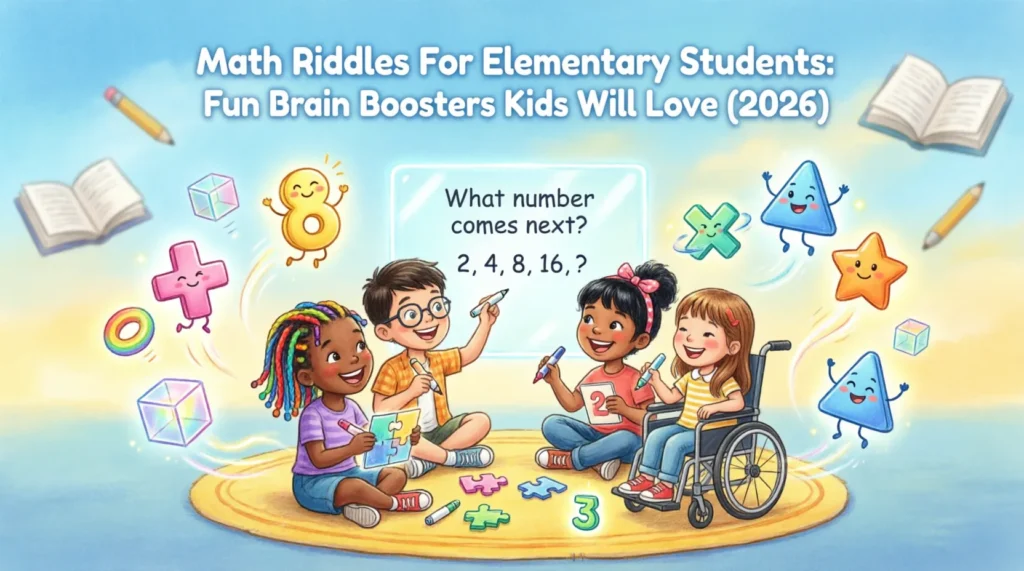
In short, math riddles for elementary students combine learning and play in a way that keeps young minds engaged. They help children practice number sense, logical thinking, and problem-solving while having fun. Scroll down and see how many of these kid-friendly math riddles your students can solve today!
Why Math Riddles For Elementary Students Are More Powerful Than You Think
Math can sometimes feel intimidating to young learners, but riddles turn numbers into exciting puzzles. Instead of focusing on getting the right answer immediately, children learn to think creatively, explore possibilities, and enjoy the challenge.
Educators and child development researchers often highlight puzzle-based learning because it encourages critical thinking and persistence. When students tackle a riddle, they practice analyzing clues, making connections, and testing ideas.
Studies show that children who regularly engage in problem-solving activities often develop stronger reasoning skills and greater confidence when approaching new academic challenges.
Math riddles for elementary students also create opportunities for laughter and teamwork. Whether you use them in the classroom, at home, or during a road trip, they transform learning into a shared adventure.
Math puzzles have been part of learning traditions around the world for generations. Their appeal is simple: they make children curious, and curiosity is one of the strongest drivers of learning.
What Makes a Great Math Riddles For Elementary Students
A great math riddle challenges children without frustrating them. The best riddles sit right in that sweet spot where students need to think carefully but still feel capable of finding the answer.
For elementary students, simple language is essential. The focus should be on the puzzle itself, not on decoding difficult vocabulary. When children can clearly understand the question, they can spend their energy solving it.
Good math riddles often include a small twist or surprise. Sometimes the answer involves counting differently than expected. Other times, students need to look at the clues from a new angle. That moment of realization creates the satisfying “aha!” experience that makes riddles memorable.
The strongest math riddles for elementary students also stay age-appropriate and encouraging. They build confidence while reinforcing foundational skills such as counting, addition, subtraction, patterns, measurement, and logical reasoning.
Most importantly, great riddles make children want to try another one. The goal isn’t just finding answers—it’s helping young learners enjoy thinking.
Math Riddles For Elementary Students: 20 Riddles to Try Right Now
Number Fun Riddles
Riddle: I am an odd number. Take away one letter, and I become even. What number am I?
Answer: Seven
Riddle: I am a number between 20 and 30. I have three tens and no more than two ones. What number am I?
Answer: 22
Riddle: If two ducks each have two ducklings, how many ducks are there altogether?
Answer: 6
Riddle: What number becomes larger when you turn it upside down?
Answer: 6 becomes 9
Riddle: I am less than 10. Double me and I become 8. What number am I?
Answer: 4
Riddle: What comes next: 2, 4, 6, 8, ___?
Answer: 10
Riddle: I am a number with two digits. My digits add up to 5, and I am greater than 20. What am I?
Answer: 23
School and Classroom Math Riddles
Riddle: A teacher has 12 pencils and gives away 5. How many pencils are left?
Answer: 7
Riddle: Three students share 15 stickers equally. How many stickers does each student get?
Answer: 5
Riddle: There are 10 books on a shelf. Four are borrowed. How many remain?
Answer: 6
Riddle: A clock shows 3 o’clock. How many hours until 8 o’clock?
Answer: 5 hours
Riddle: You have two hands. How many fingers do you have altogether?
Answer: 10
Riddle: Five crayons are in a box. Another five are added. How many crayons are there now?
Answer: 10
Logic and Observation Riddles
Riddle: What has four sides, four corners, and is often found on a classroom whiteboard?
Answer: A rectangle
Riddle: If one triangle has three sides, how many sides do two triangles have?
Answer: 6
Riddle: I have four equal sides and four corners. What shape am I?
Answer: A square
Riddle: Which weighs more: a pound of feathers or a pound of rocks?
Answer: They weigh the same
Riddle: How many months have 28 days?
Answer: All 12 months
Riddle: I am a shape with no corners and no sides. What am I?
Answer: A circle
Riddle: Two fathers and two sons go fishing and catch three fish. Each person gets one fish. How is that possible?
Answer: They are a grandfather, father, and son
🎯 More math riddles for elementary students: Easy, Medium, and Hard Challenges
Easy Riddles for math riddles for elementary students (Grades 6–7)
These easy challenges are perfect for students who enjoy simple observation and playful thinking while building confidence.
Riddle: I have four sides, but if you tilt me, I still have four. What am I? Answer: A square.
Riddle: What number can you double without adding anything to it? Answer: The number shown in a mirror (its reflection appears doubled).
Riddle: I can be full of numbers but never hold water. What am I? Answer: A calculator.
Riddle: Which shape can roll smoothly but has no corners to bump into things? Answer: A circle.
Riddle: If every page in your math notebook has numbers, what is the one thing every page also shares? Answer: Paper.
Riddle: I always stand between 4 and 6, no matter how many times you count. What am I? Answer: The number 5.
Medium Riddles for math riddles for elementary students (Grades 7–8)
These medium-level riddles are great for students ready to combine logic, careful reading, and a few reasoning steps.
Riddle: Mia has three boxes. Each box holds four pencils. She gives away two pencils from each box. How many pencils does she have left? Answer: Six.
Riddle: A shape has more than three sides but fewer than six. It also has one more side than a triangle. What shape is it? Answer: A quadrilateral.
Riddle: Two clocks show the same time exactly once every twelve hours. What are they showing? Answer: The same time.
Riddle: You count by fives starting at 10. Which number is the sixth one you say? Answer: 35.
Riddle: A number is even. If you divide it by two, you get nine. What is the number? Answer: 18.
Riddle: I have three equal sides and three equal angles. What am I? Answer: An equilateral triangle.
Riddle: A class lines up in rows of five. There are four complete rows. How many students are in line? Answer: 20.
Hard Riddles for math riddles for elementary students (Grade 8 and Up)
These harder puzzles reward careful reasoning, flexible thinking, and looking at problems from a different angle.
Riddle: I become larger every time you divide me into equal parts. What am I? Answer: A collection or group (the number of pieces increases).
Riddle: A number multiplied by itself equals 49. Name both possible whole-number answers. Answer: 7 and -7.
Riddle: I am always halfway between 20 and 30, even if you measure carefully. What number am I? Answer: 25.
Riddle: Three friends each solve a different puzzle. No two solve the same one, and each finishes exactly one puzzle. How many puzzles were solved? Answer: Three.
Riddle: I have six faces, eight corners, and twelve edges. What solid shape am I? Answer: A cube.
Riddle: A pattern goes 2, 6, 12, 20, __. What comes next? Answer: 30.
Riddle: I can describe how likely something is to happen, but I’m never a guarantee. What math idea am I? Answer: Probability.
Using different difficulty levels helps every learner experience success while still feeling challenged. Teachers and parents can start with easier riddles to build confidence before inviting students to tackle the medium and hard puzzles together.
📚 Subject-Specific math riddles for elementary students: Math, Science, and More
Math Riddles for math riddles for elementary students
These math-themed riddles encourage students to notice patterns, numbers, and shapes in fun ways.
Riddle: I am the only even prime number. Who am I? Answer: 2.
Riddle: What shape has exactly one pair of parallel sides? Answer: A trapezoid.
Riddle: Add me to myself and you get sixteen. What number am I? Answer: 8.
Riddle: Which number comes next: 3, 6, 9, 12, __? Answer: 15.
Riddle: I tell you how far it is around a shape. What am I? Answer: Perimeter.
Science Riddles for math riddles for elementary students
These science riddles connect everyday observations with exciting scientific ideas.
Riddle: I pull dropped objects toward Earth, but you can’t see me. What am I? Answer: Gravity.
Riddle: I help plants make food using sunlight, water, and air. What process am I? Answer: Photosynthesis.
Riddle: I change from a liquid into a gas when heated. What process am I? Answer: Evaporation.
Riddle: I am the layer of gases surrounding Earth that helps protect life. What am I? Answer: The atmosphere.
Riddle: I carry messages between your brain and the rest of your body. What am I? Answer: The nervous system.
Language Riddles for math riddles for elementary students
These language riddles strengthen vocabulary, grammar, and creative thinking through playful word challenges.
Riddle: Remove the first letter from “smile,” and I become something measured in distance. What am I? Answer: Mile.
Riddle: What punctuation mark always asks a question without speaking? Answer: A question mark.
Riddle: I describe a noun, but I am not the noun itself. What part of speech am I? Answer: An adjective.
Riddle: Which letter appears twice in “letter” but only once in “word”? Answer: The letter T.
Riddle: I have many meanings depending on the sentence, but my spelling stays the same. What kind of word am I? Answer: A homonym.
Use one subject riddle as a daily warm-up to spark curiosity before the lesson begins.
Turn riddles into exit tickets by asking students to solve one before leaving class.
Divide students into small groups and let them create and swap their own subject-themed riddles for collaborative problem-solving.
How to Use Math Riddles For Elementary Students for Maximum Fun
Start your school day with a riddle challenge.
Use riddles as warm-up activities before math lessons.
Turn car rides into puzzle competitions.
Add riddles to birthday parties and family game nights.
Create classroom teams and award points for creative thinking.
Let students write their own riddles after solving a few examples.
When you use math riddles regularly, children begin to view problem-solving as something enjoyable rather than stressful. Even students who feel nervous about math often become more willing to participate when lessons include games and puzzles.
You can also encourage students to explain how they found their answers. This helps strengthen communication skills and gives you insight into how they think through challenges.
Tips for Sharing Math Riddles For Elementary Students Without Spoiling the Fun
The secret to a great riddle session is patience. Give students enough time to think before revealing the answer.
If someone guesses incorrectly, encourage them to explain their reasoning. Sometimes a wrong answer leads to an interesting discussion and helps the group discover the correct solution.
You can adjust difficulty on the fly by offering hints. Start with a broad clue, then provide more specific guidance if needed.
Keep the atmosphere light and positive. The goal is to celebrate creative thinking, not just correct answers. When children feel comfortable making guesses, they become more confident learners.
Bonus: Math Riddles For Elementary Students That Stump Everyone
These bonus riddles require a little more thinking and are perfect for older elementary students who enjoy an extra challenge.
Riddle: I am a number. Add me to myself and you get 12. What am I?
Answer: 6
Riddle: There are 8 birds sitting on a fence. Half fly away. How many remain?
Answer: 4
Riddle: If you count by fives starting at 5, what is the fifth number you say?
Answer: 25
Riddle: A square has four corners. If you cut one corner off, how many corners remain?
Answer: 5
Riddle: What number is exactly halfway between 20 and 30?
Answer: 25
Riddle: A farmer has 10 sheep. All but 3 run away. How many are left?
Answer: 3
Riddle: I am an even number. Remove one letter from my name and I become odd. What number am I?
Answer: Seven (remove the “s” and it becomes “even”)
FAQs About Math Riddles For Elementary Students
What age group are math riddles for elementary students best for?
Most math riddles for elementary students work well for children between ages 6 and 11. You can adjust the difficulty depending on grade level and math skills.
Can math riddles improve problem-solving skills?
Yes. Many educators use riddles because they encourage logical thinking, pattern recognition, and creative reasoning. Students learn to evaluate clues and test possible solutions.
How often should students practice math riddles?
A few riddles each week can make a difference. Even five minutes of puzzle-solving can help keep young minds active and engaged.
Are math riddles useful in the classroom?
Absolutely. Teachers often use riddles as warm-ups, brain breaks, discussion starters, and review activities. They help create a fun learning environment while reinforcing math concepts.
What makes math riddles different from regular riddles?
Math riddles include numbers, patterns, shapes, measurements, or logical reasoning connected to mathematical thinking. They encourage students to apply math skills while solving a puzzle.
Final Thoughts: Keep the Fun Going with Math Riddles For Elementary Students
Math riddles for elementary students prove that learning doesn’t have to feel like work. They blend curiosity, creativity, and problem-solving into one enjoyable activity.
Whether you’re a parent, teacher, tutor, or caregiver, you can use these riddles to make math more approachable and exciting. A single riddle can spark discussion, laughter, and confidence.
Over time, regular exposure to puzzles helps children develop stronger reasoning skills and a more positive attitude toward challenges. Those benefits often extend far beyond the math classroom.
The next time you want to make learning memorable, start with a riddle—and watch young minds light up with curiosity.
Frequently Asked Questions
How do math riddles benefit elementary students' learning?▼
Math riddles engage young learners by combining fun and education, helping them practice number sense, logical thinking, and problem-solving. They encourage critical thinking and persistence, allowing children to explore possibilities rather than just focusing on getting the right answer.
What characteristics make a great math riddle for kids?▼
A great math riddle should challenge children without causing frustration, using simple language that allows them to focus on solving the puzzle. Additionally, the best riddles often include a twist or surprise that leads to an ‘aha!’ moment, making the experience memorable and enjoyable.
Can math riddles be used in different learning environments?▼
Yes, math riddles can be effectively used in classrooms, at home, or even during road trips, making learning a shared adventure. Their versatility helps create opportunities for laughter and teamwork while reinforcing essential math skills.
What types of skills do math riddles help develop in children?▼
Math riddles help develop a variety of skills, including counting, addition, subtraction, patterns, measurement, and logical reasoning. Engaging with these puzzles also builds children’s confidence in tackling new academic challenges.
Why are math riddles considered more effective than traditional math problems?▼
Math riddles transform numbers into exciting puzzles, encouraging creativity and exploration. This approach makes learning less intimidating for children, fostering curiosity, which is a strong driver of learning.
What age group is appropriate for these math riddles?▼
The math riddles discussed in the article are specifically designed for elementary students, ensuring they are age-appropriate and encouraging. They focus on foundational skills that are essential for young learners.
What are some examples of math riddles provided in the article?▼
The article includes several riddles, such as ‘I am an odd number. Take away one letter, and I become even. What number am I?’ with the answer being seven. Another example is, ‘A teacher has 12 pencils and gives away 5. How many pencils are left?’ with the answer being 7.
Liam Nguyen is a seasoned educational consultant with over 15 years of experience in developing engaging content for classrooms across the globe. Holding a degree in Education from the University of Melbourne, Liam has dedicated his career to making learning fun and accessible for students of all ages. His passion for wordplay and critical thinking led him to specialize in writing challenging yet entertaining riddles. At FunRiddleZone, he creates hard and themed riddles that stimulate young minds and serve as great icebreakers for teachers. Outside of riddles, Liam enjoys hiking and exploring local trivia competitions.