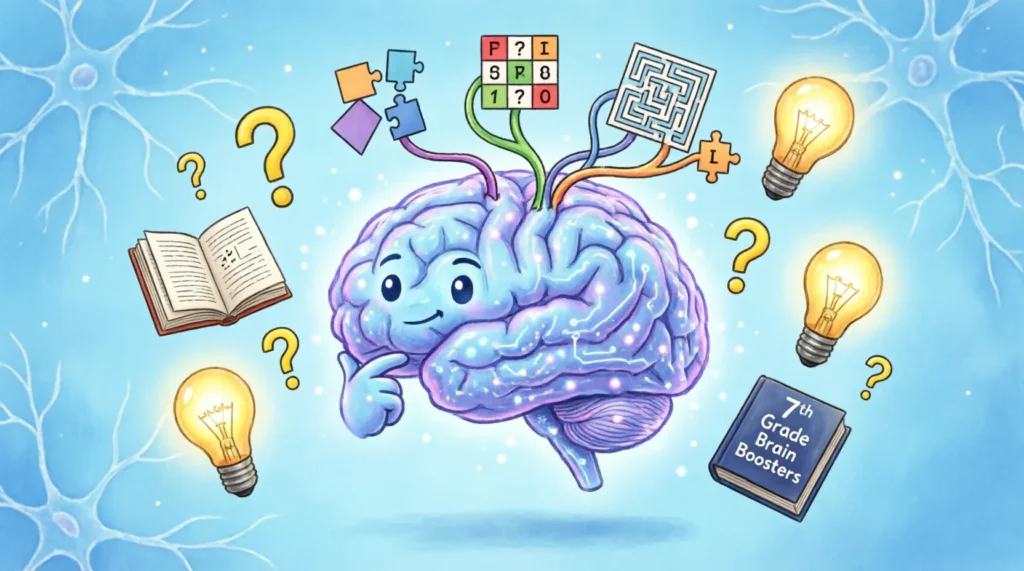
In short, riddles for 7th graders are the perfect mix of fun, creativity, and critical thinking. They challenge middle school students without being too easy or frustrating, making them ideal for classrooms, family game nights, and friendly competitions. Scroll down and see how many of these clever riddles you can solve before checking the answers!
Why Riddles For 7th Graders Are More Powerful Than You Think
Seventh grade is a unique stage of learning. Students are developing stronger reasoning skills, expanding their vocabulary, and becoming more confident problem-solvers. That makes riddles for 7th graders more than just entertainment—they’re mental workouts disguised as fun.
Educators often use riddles because they encourage students to think beyond obvious answers. Instead of memorizing facts, students learn to analyze clues, recognize patterns, and approach problems from different angles.
Cognitive scientists and child development researchers frequently highlight activities that strengthen flexible thinking and language development. Riddles naturally combine both skills in a way that feels more like a game than a lesson.
Studies show that students who regularly engage in puzzles and word challenges often improve problem-solving confidence and verbal reasoning skills. That’s one reason riddles remain popular in classrooms around the world.
Whether you’re a teacher planning a warm-up activity, a parent looking for screen-free fun, or a student who enjoys a challenge, these riddles can keep your brain active while making everyone laugh.
What Makes a Great Riddle For 7th Graders
A great riddle for this age group sits right in the sweet spot between easy and difficult. If the answer is obvious, students lose interest quickly. If it’s too confusing, frustration replaces fun.
The best riddles for 7th graders use clever wordplay, simple logic, and a little misdirection. They encourage you to pay attention to every detail while avoiding clues that are impossible to understand.
An excellent riddle also delivers that satisfying “aha!” moment. The answer should feel surprising at first, but completely logical once you hear it. That’s what makes people smile and immediately want another challenge.
Age-appropriate humor matters too. Middle school students enjoy clever twists, funny observations, and school-related situations they can relate to. Clean, creative riddles often get the strongest reactions because everyone can participate comfortably.
Since riddles are a global tradition enjoyed across cultures, they offer a fun way to bring people together while sharpening important thinking skills.
Riddles For 7th Graders: 20 Riddles to Try Right Now
School-Themed Riddles
Riddle: I travel from desk to desk, but I never walk. I help students learn, yet I never speak. What am I?
Answer: A textbook
Riddle: The more mistakes you make with me, the smaller I become. What am I?
Answer: An eraser
Riddle: I hold hundreds of answers but never take a test. What am I?
Answer: A library
Riddle: I have many pages but no story. I help you stay organized all year. What am I?
Answer: A planner
Riddle: Every student uses me, but nobody studies me. I tell everyone when to move. What am I?
Answer: The school bell
Riddle: I can be full of numbers, words, and drawings at the same time. What am I?
Answer: A notebook
Riddle: You carry me every day, but the heavier I get, the smarter you become. What am I?
Answer: A backpack filled with schoolwork
Logic and Observation Riddles
Riddle: Two friends are born on the same day, in the same month, and the same year, but they aren’t twins. How is that possible?
Answer: They are part of a set of triplets or more
Riddle: What gets sharper the more you use it?
Answer: Your mind
Riddle: I can be broken without being touched. What am I?
Answer: A promise
Riddle: What has corners but can travel around the world?
Answer: A postage stamp
Riddle: If you remove one from me, I become stronger. What am I?
Answer: A team (removing one challenge can strengthen teamwork)
Riddle: What comes once in a minute, twice in a moment, but never in an hour?
Answer: The letter M
Riddle: I grow when you share me. What am I?
Answer: Knowledge
Nature and Everyday Life Riddles
Riddle: I never stop moving, but I never leave my path. What am I?
Answer: A river
Riddle: I arrive after rain without making a sound and disappear without saying goodbye. What am I?
Answer: A rainbow
Riddle: The more sunlight I receive, the shorter I become. What am I?
Answer: A shadow
Riddle: I wear a crown but rule no kingdom. What am I?
Answer: A pineapple
Riddle: I can fill a room without taking up any space. What am I?
Answer: Light
Riddle: I have roots that nobody sees and leaves that nobody rakes. What am I?
Answer: A family tree
🎯 More riddles for 7th graders: Easy, Medium, and Hard Challenges
Easy Riddles for riddles for 7th graders (Grades 6–7)
These easy riddles for 7th graders are perfect for building confidence with simple wordplay and careful observation.
Riddle: I grow shorter every time you use me, but I help you see. What am I? Answer: A pencil.
Riddle: I can be full of stories without saying a single word out loud. What am I? Answer: A bookshelf.
Riddle: I have corners but never move, and I help you find places. What am I? Answer: A map.
Riddle: I always follow you during the day but disappear when the lights go out. What am I? Answer: Your shadow.
Riddle: The more pages I lose, the closer I get to my ending. What am I? Answer: A calendar.
Riddle: I can carry thousands of words, but I don’t speak unless you open me. What am I? Answer: A book.
Medium Riddles for riddles for 7th graders (Grades 7–8)
These medium riddles for 7th graders encourage logical thinking and are great for students ready for a bigger mental challenge.
Riddle: Emma is taller than Noah. Noah is taller than Mia. Who is the shortest? Answer: Mia.
Riddle: Three friends each shake hands with every other friend exactly once. How many handshakes happen? Answer: Three.
Riddle: A train leaves the station heading east. A strong wind blows west. Which direction does the train’s smoke go? Answer: Nowhere—an electric train doesn’t produce smoke.
Riddle: I have twelve faces, but only one is showing at a time. What am I? Answer: A calendar month.
Riddle: You read me from beginning to end, but I can also send you back to the beginning with just one page. What am I? Answer: A “Table of Contents” or an index reference.
Riddle: If you double me, I become less than ten. If you triple me, I become more than ten. What number am I? Answer: Four.
Riddle: Five students stand in a line. Ava is behind Ben but in front of Chloe. Chloe is behind Diego. Who must be last? Answer: Chloe.
Hard Riddles for riddles for 7th graders (Grade 8 and Up)
These hard riddles for 7th graders use clever reasoning, careful thinking, and a bit of creative problem-solving.
Riddle: I become larger every time you remove a piece of me. What am I? Answer: A hole.
Riddle: I can divide a room without taking up any space. What am I? Answer: A line.
Riddle: The more accurate I become, the more often I need to be adjusted. What am I? Answer: A clock.
Riddle: I can connect two ideas even though I’m only one small mark. What am I? Answer: A hyphen.
Riddle: You can fill me with knowledge, but you’ll never run out of room. What am I? Answer: Your mind.
Riddle: I always arrive after today but never become yesterday. What am I? Answer: Tomorrow.
Riddle: I change every second, but I can never go backward. What am I? Answer: Time.
Using different difficulty levels helps every student experience success while still providing opportunities to stretch their thinking. Try starting with easy riddles to build confidence, then gradually introduce medium and hard challenges for individuals or teams.
📚 Subject-Specific riddles for 7th graders: Math, Science, and More
Math Riddles for riddles for 7th graders
These math-themed riddles turn numbers and patterns into fun brain teasers.
Riddle: I am a number that stays the same whether you multiply me by one or divide me by one. What am I? Answer: Any number.
Riddle: I have four equal sides and four right angles. Who am I? Answer: A square.
Riddle: I am an odd number. Remove one letter from my name, and I become even. What number am I? Answer: Seven.
Riddle: I am greater than 20 but less than 30. My digits add up to 7. What number could I be? Answer: 25.
Riddle: What shape has one continuous edge and no corners? Answer: A circle.
Science Riddles for riddles for 7th graders
These science riddles introduce everyday scientific ideas in a fun and approachable way.
Riddle: I help plants make food using sunlight, water, and air. What process am I? Answer: Photosynthesis.
Riddle: I pull everything toward Earth, even when you can’t see me. What am I? Answer: Gravity.
Riddle: I can be solid, liquid, or gas without changing what I’m made of. What am I? Answer: Water.
Riddle: I protect your body by fighting germs you can’t see. What system am I? Answer: The immune system.
Riddle: I travel faster than sound and let you see the world around you. What am I? Answer: Light.
Language Riddles for riddles for 7th graders
These language riddles build vocabulary, spelling, and grammar skills through playful thinking.
Riddle: Remove my first letter and I still sound exactly the same. What word am I? Answer: Queue.
Riddle: I am the only letter that never appears when writing the names of the months. Which letter am I? Answer: The letter Q.
Riddle: I describe a noun, but I am not the noun itself. What part of speech am I? Answer: An adjective.
Riddle: What word becomes shorter when you add two letters to it? Answer: Short.
Riddle: I connect words, phrases, or clauses into longer sentences. What am I? Answer: A conjunction.
Teachers can easily weave subject riddles into everyday lessons by:
Using one riddle as a quick warm-up before introducing a new topic.
Giving a riddle as an exit ticket to reinforce key concepts in a fun way.
Letting small groups solve riddles together to encourage teamwork, discussion, and critical thinking.
How to Use Riddles For 7th Graders for Maximum Fun
Start your classroom lesson with a riddle challenge.
Use riddles during car rides to keep everyone engaged.
Turn family dinners into friendly guessing competitions.
Create team-based riddle contests for school clubs.
Use riddles as icebreakers before group projects.
Challenge friends to solve one riddle each day.
You can also make the experience more interactive by setting a timer and rewarding creative guesses. Sometimes the funniest wrong answers become just as memorable as the correct ones.
If you’re working with a group of students, encourage them to create their own riddles. Designing a good riddle requires careful thinking and helps strengthen both writing and reasoning skills.
Many teachers find that riddles for 7th graders work especially well as transition activities between lessons because they quickly capture attention and encourage participation.
Tips for Sharing Riddles For 7th Graders Without Spoiling the Fun
Give people enough time to think before revealing the answer. A few extra seconds often lead to creative reasoning and lively discussion.
If someone gives a wrong answer, treat it as part of the game. Encourage them to explain their thinking because their logic may be surprisingly clever.
Pay attention to your audience. If your group solves riddles easily, gradually increase the difficulty. If they seem stuck, offer a small hint instead of immediately revealing the answer.
Most importantly, keep the energy positive. The goal isn’t simply getting the right answer—it’s enjoying the challenge together.
Bonus: Riddles For 7th Graders That Stump Everyone
These bonus riddles are a little trickier. They require closer attention to wording and reward creative thinking.
Riddle: The more of me you take away, the larger I become. What am I?
Answer: A hole
Riddle: I have keys but open no doors. I have space but no room. What am I?
Answer: A keyboard
Riddle: A student leaves home, turns left three times, and returns home wearing a mask. Who is the student?
Answer: A baseball player running the bases
Riddle: What can run but never walks, has a mouth but never talks?
Answer: A river
Riddle: I begin with T, end with T, and have T inside. What am I?
Answer: A teapot
Riddle: The more you know me, the less mysterious I become. Yet I started as a mystery. What am I?
Answer: A puzzle
Riddle: What question can you never answer yes to honestly?
Answer: Are you asleep?
FAQs About Riddles For 7th Graders
What age group are riddles for 7th graders best for?
Most riddles designed for 7th graders work well for ages 12 to 13. However, many younger students who enjoy puzzles and older students looking for quick brain challenges can enjoy them too.
How difficult should riddles for 7th graders be?
The ideal difficulty level should require some thinking without causing frustration. Students should feel challenged but still capable of solving the riddle with careful reasoning and attention to clues.
Can riddles for 7th graders be used in the classroom?
Absolutely. Many teachers use riddles as bell-ringer activities, discussion starters, writing prompts, or team-building exercises. They help students practice critical thinking while creating an engaging classroom atmosphere.
What skills do riddles help develop in middle school students?
Riddles support logical reasoning, vocabulary growth, reading comprehension, memory, and creative thinking. Educators often value them because students practice multiple cognitive skills at the same time.
How often should students practice riddles?
Even a few riddles each week can provide benefits. Regular exposure helps students become more comfortable with problem-solving and encourages curiosity, which can carry over into other academic subjects.
Final Thoughts: Keep the Fun Going with Riddles For 7th Graders
The best riddles for 7th graders do much more than fill a few spare minutes. They encourage creative thinking, strengthen reasoning skills, and create moments of laughter that people remember.
Whether you’re using them in a classroom, around the dinner table, during a road trip, or with friends, these riddles offer an easy way to make learning feel exciting.
The more often you challenge your brain with clever questions, the stronger your problem-solving habits can become. That’s one reason riddles have remained popular for generations.
Pick a few favorites, share them today, and watch how quickly a simple question can spark curiosity, conversation, and a room full of smiles.
When a great riddle makes someone pause, think, and grin, you’ve already won the game.
Frequently Asked Questions
Why are riddles particularly beneficial for 7th graders?▼
Riddles are beneficial for 7th graders because they enhance critical thinking and creativity. This age group is developing stronger reasoning skills and vocabulary, making riddles a fun way to exercise their minds while promoting problem-solving confidence.
What characteristics make a riddle great for 7th graders?▼
A great riddle for 7th graders strikes a balance between being easy and difficult. It should incorporate clever wordplay, simple logic, and a bit of misdirection, delivering a satisfying ‘aha!’ moment that feels surprising yet logical.
How can riddles be used in educational settings?▼
Riddles can be effectively used as warm-up activities in classrooms, encouraging students to think beyond obvious answers. They foster engagement and make learning enjoyable while strengthening flexible thinking and language development.
What types of riddles are included in the article?▼
The article features school-themed riddles and logic observation riddles. These riddles are designed to be relatable for students and challenge their reasoning skills in a fun, engaging way.
How do riddles help improve problem-solving skills?▼
Engaging with riddles encourages students to analyze clues and recognize patterns, which enhances their problem-solving skills. Regularly solving puzzles and word challenges has been shown to boost verbal reasoning skills and overall confidence.
What role does humor play in the effectiveness of riddles for this age group?▼
Age-appropriate humor is crucial for engaging 7th graders with riddles. Clever twists and relatable school-related situations in riddles make them more enjoyable, ensuring that everyone can participate comfortably.
Can riddles be used for family activities or competitions?▼
Absolutely! Riddles serve as excellent entertainment for family game nights and friendly competitions, making them a versatile activity that encourages fun and laughter while keeping minds active.
Raj Patel is an engineer turned writer who has a passion for puzzles and logical challenges. Educated at the Indian Institute of Technology, Raj utilized his problem-solving skills in developing themed and hard riddles that challenge adults while remaining clean and family-friendly. His interest in brainteasers began in childhood, inspiring him to create intricate riddles that can entertain and educate simultaneously. At FunRiddleZone, Raj’s contributions are invaluable for adult entertainment and enhancing cognitive skills through fun. He enjoys playing chess and developing mobile puzzle apps in his spare time.