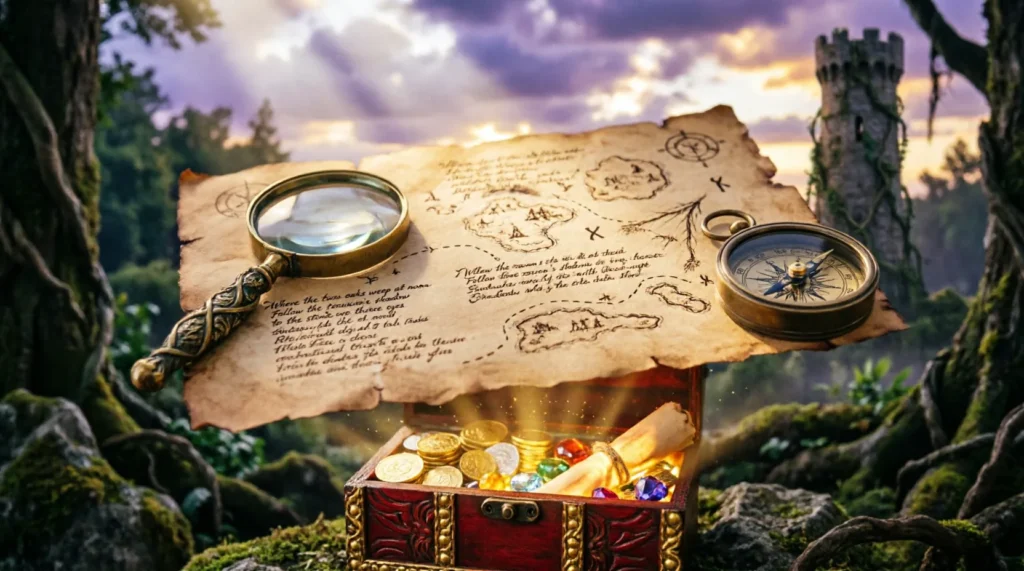
In short, riddles for treasure hunt games transform an ordinary scavenger hunt into an exciting challenge filled with mystery, teamwork, and problem-solving. They are perfect for birthday parties, family gatherings, classrooms, team events, and anyone who wants to make finding a hidden prize more memorable. Scroll down and discover riddles you can use right away to create an unforgettable treasure hunt.
Why Riddles For Treasure Hunt Are More Powerful Than You Think
A treasure hunt is fun on its own, but the right riddle turns every step into a mini adventure. Instead of simply following directions, participants must think, laugh, and work together to uncover the next clue.
Researchers who study problem-solving and learning often note that puzzles encourage critical thinking, memory, and creative reasoning. When you add riddles for treasure hunt activities, you create moments that challenge the brain while keeping the experience playful and rewarding.
Studies show that people tend to remember experiences more vividly when they actively solve problems rather than passively receive information. That is one reason treasure hunts remain popular across cultures and generations.
Whether you are planning a hunt for children, teens, adults, or mixed-age groups, a well-crafted riddle creates anticipation. Every solved clue feels like a small victory that motivates players to keep going.
Another hidden benefit is connection. When people gather around a clue, discuss possibilities, and celebrate a correct answer together, they build shared memories that often become the best part of the event.
What Makes a Great Riddles For Treasure Hunt
The best treasure hunt riddles strike a balance between challenge and clarity. If a clue is too easy, players rush through it without much excitement. If it is too difficult, frustration can replace fun.
A great riddle points toward a location, object, or landmark without naming it directly. It uses clever wordplay, observation, or gentle misdirection to encourage participants to think differently about familiar surroundings.
The most satisfying clues create an “aha moment.” Players may feel uncertain at first, but once they discover the answer, everything suddenly makes sense. That feeling is what keeps people engaged from the first clue to the final treasure.
For treasure hunts, relevance matters. A clue about a refrigerator belongs in a home hunt. A clue about books works well in a classroom or library. Matching your riddles to the environment makes the experience feel seamless and immersive.
Good riddles for treasure hunt events also remain fair. The answer should be discoverable from the clue itself rather than requiring specialized knowledge. The goal is excitement, not confusion.
Because treasure hunts often involve groups, the strongest riddles invite discussion. Participants should be able to debate possibilities and test ideas together before reaching the correct answer.
Riddles For Treasure Hunt: 20 Riddles to Try Right Now
Around the House
Riddle: I keep your food cold every day, and hungry visitors often come my way. Where is your next clue hiding?
Answer: Refrigerator
Riddle: I have many keys but open no locks. Music comes alive when my fingers are rocked. Where should you look?
Answer: Piano
Riddle: You visit me before you sleep, and every morning I help you leap. Find the clue where dreams begin.
Answer: Bed
Riddle: I wash your plates without complaint, though I never eat a bite. Where is the next clue?
Answer: Dishwasher
Riddle: I tell you stories without speaking a word. Open my cover and adventure is heard.
Answer: Book
Riddle: You sit on me to watch a show, relax a while, and take things slow.
Answer: Couch
Riddle: I have hands but cannot clap. I help you track every nap.
Answer: Clock
Classroom and Indoor Locations
Riddle: I hold many answers but ask no questions. Students visit me when knowledge is their mission.
Answer: Bookshelf
Riddle: Teachers write on me every day, and lessons appear when markers play.
Answer: Whiteboard
Riddle: I carry pencils, pens, and more. Open me up to find your score.
Answer: Pencil case
Riddle: I brighten the room when daylight is near. Look through me, but do not disappear.
Answer: Window
Riddle: I stand in a corner and hold many coats. Find your clue where jackets stay afloat.
Answer: Coat rack
Outdoor Treasure Hunt Riddles
Riddle: I have roots nobody sees, yet I proudly wave among the breeze.
Answer: Tree
Riddle: Birds may visit me for a drink, especially when the weather is warm and pink.
Answer: Birdbath
Riddle: I guard the yard without a sword. Open me and move forward.
Answer: Gate
Riddle: I shine at night but rest by day. Look beneath me along the way.
Answer: Garden lamp
Riddle: Flowers surround me in colorful rows. The next clue is where something grows.
Answer: Garden
Everyday Treasure Hunt Favorites
Riddle: I swallow dirty clothes all week, then return them fresh and neat.
Answer: Washing machine
Riddle: You hear me ring before you know who is calling.
Answer: Telephone
Riddle: I help you enter and help you leave, turning quietly with every key.
Answer: Door
Riddle: I reflect your face but keep no memory. Look closely to continue your mystery.
Answer: Mirror
🎯 More riddles for treasure hunt: Easy, Medium, and Hard Challenges
Easy Riddles for riddles for treasure hunt (Grades 6–7)
These easy challenges are perfect for younger middle school students who enjoy observation, simple clues, and confidence-building puzzles.
Riddle: I point the way without speaking, and I never leave my place. What am I? Answer: A sign
Riddle: I’m filled with paths but have no grass. Follow me, and you’ll know where to go. What am I? Answer: A map
Riddle: You may open me to find a surprise, but I’m not a present. What am I? Answer: A treasure chest
Riddle: I help you count your steps but never move my own feet. What am I? Answer: A measuring tape
Riddle: I’m often folded, covered in clues, and happiest in your pocket. What am I? Answer: A clue card
Riddle: Every team wants to reach me, but I never run the race. What am I? Answer: The finish spot
Medium Riddles for riddles for treasure hunt (Grades 7–8)
These medium-level riddles encourage logical thinking and are great for students ready to connect multiple clues.
Riddle: I always stand between the entrance and the classroom, but I’m never inside either one. What am I? Answer: The hallway
Riddle: If each clue sends you ten steps east and then five steps north, where should you look after following three clues? Answer: Thirty steps east and fifteen steps north from the starting point
Riddle: I disappear every time you solve me, yet I help you move forward. What am I? Answer: A mystery
Riddle: Three boxes are labeled Red, Blue, and Green. Only one label is correct. You open the Red box and find a blue marble. Which label is correct? Answer: Blue
Riddle: I’m the only place where everyone must stop before moving to the next clue. What am I? Answer: The current clue location
Riddle: I can be hidden under a chair, inside a book, or behind a plant, but I always have the same job. What am I? Answer: A clue
Riddle: The shortest path isn’t always the best path when you’re following me. What am I? Answer: Directions
Hard Riddles for riddles for treasure hunt (Grade 8 and Up)
These challenging riddles reward creative thinking, careful reading, and clever problem-solving.
Riddle: I tell you to look where stories sleep, but I don’t mean a bed. Where should you search? Answer: A bookshelf or library shelf
Riddle: The next clue says, “Stand where shadows disappear.” Where is the best place to look at noon on a sunny day? Answer: Directly beneath an object
Riddle: The clue reads, “Find the only corner that can travel around the world.” What is it? Answer: A postage stamp
Riddle: I become easier to notice after every clue, even though I never change. What am I? Answer: The overall pattern connecting the clues
Riddle: The map shows four identical trees, but only one casts a morning shadow toward the path. Which tree hides the clue? Answer: The tree west of the path
Riddle: I grow more valuable the closer you get to the treasure, even though I’m only words on paper. What am I? Answer: A clue
Riddle: The clue says, “Turn me upside down, and I still help you.” What am I? Answer: A map (you can still use it by reorienting it)
Using different difficulty levels keeps every learner engaged while allowing students to build confidence before tackling bigger challenges. Teachers and parents can also mix easy, medium, and hard riddles so everyone contributes to solving the treasure hunt together.
📚 Subject-Specific riddles for treasure hunt: Math, Science, and More
Math Riddles for riddles for treasure hunt
These math-themed riddles make numbers and patterns feel like part of the adventure.
Riddle: I have four equal sides and four right angles. Hide the clue inside me. What shape am I? Answer: A square
Riddle: Double me, subtract four, and you get twelve. What number am I? Answer: Eight
Riddle: I come after every even number if you’re counting by twos. What am I? Answer: The next even number
Riddle: I have three sides and three corners. What am I? Answer: A triangle
Riddle: If five teams each solve two clues, how many clues are solved altogether? Answer: Ten
Science Riddles for riddles for treasure hunt
These science riddles spark curiosity while connecting everyday discoveries to classroom learning.
Riddle: I pull every treasure chest toward the ground without anyone seeing me. What am I? Answer: Gravity
Riddle: Plants use me to make food, and I shine during the day. What am I? Answer: Sunlight
Riddle: I can be solid, liquid, or gas without changing what I’m made of. What am I? Answer: Water
Riddle: I carry messages from your eyes to your brain while you search for clues. What am I? Answer: Light
Riddle: I’m the layer beneath your feet where many outdoor clues can be hidden. What am I? Answer: Soil
Language Riddles for riddles for treasure hunt
These wordplay riddles encourage careful reading, vocabulary practice, and creative thinking.
Riddle: Remove the first letter from “stone,” and what remains can still make a sound. What is it? Answer: Tone
Riddle: I begin every sentence when I’m written correctly. What am I? Answer: A capital letter
Riddle: I’m a word that means the opposite of “hidden.” What am I? Answer: Visible
Riddle: Rearrange the letters in “NOTE” to find something often used to write clues. What is it? Answer: TONE is another word, but “NOTE” itself is what you write clues on
Riddle: I separate ideas without ending the sentence. What punctuation mark am I? Answer: A comma
Teachers can easily bring these subject-themed riddles into everyday lessons by:
Use one as a warm-up activity to introduce a new math, science, or language concept.
Turn them into exit tickets where students solve a riddle before leaving class.
Create small-group treasure hunt stations that combine teamwork with subject review.
How to Use Riddles For Treasure Hunt for Maximum Fun
Start with an easy clue to build confidence.
Increase the difficulty gradually as the hunt progresses.
Hide clues in logical locations connected to the answers.
Mix indoor and outdoor clues when possible.
End with a memorable treasure or surprise reward.
Encourage teamwork rather than speed alone.
When planning your treasure hunt, think about the age and experience of your players. Younger participants usually enjoy direct clues with obvious locations, while older groups often appreciate layered hints and clever wordplay.
You can also personalize your hunt. Add clues that reference favorite family traditions, classroom topics, party themes, or special memories. Personal touches make the adventure feel unique and unforgettable.
If you are organizing a large event, consider testing the hunt yourself first. Walking through the clues ensures that each riddle leads naturally to the next location.
Tips for Sharing Riddles For Treasure Hunt Without Spoiling the Fun
Give participants enough time to think before offering hints. A few minutes of discussion often leads to the most satisfying discoveries.
If players become stuck, provide a small nudge rather than the complete answer. This keeps the challenge alive while preventing frustration.
Match the difficulty to your audience. Younger children may need simpler wording, while teens and adults often enjoy clues with extra layers of meaning.
Celebrate clever guesses even when they are incorrect. Treasure hunts are most enjoyable when curiosity and creativity are rewarded.
Most importantly, keep the pace moving. A treasure hunt should feel like an adventure, not a test.
Bonus: Riddles For Treasure Hunt That Stump Everyone
These bonus clues are a little trickier and work especially well near the end of a treasure hunt when players are fully engaged.
Riddle: I travel up and down all day, yet never leave the place I stay.
Answer: Stairs
Riddle: I grow shorter when I am working hardest.
Answer: Candle
Riddle: The more of me you take away, the larger I become.
Answer: Hole
Riddle: I have a face but never smile, hands but never wave, and numbers all the while.
Answer: Clock
Riddle: I am full of holes but still hold water.
Answer: Sponge
Riddle: I hide behind every photo but never appear in one.
Answer: Camera lens
Riddle: The more people use me, the thinner I become.
Answer: Pencil
Riddle: I follow you all day but disappear when darkness comes.
Answer: Shadow
FAQs About Riddles For Treasure Hunt
How many riddles should a treasure hunt have?
Most treasure hunts work best with 8 to 15 clues. Shorter hunts are great for younger children, while older participants often enjoy longer adventures with more complex puzzles.
What age group are riddles for treasure hunt best for?
They can work for nearly any age group. The key is adjusting the difficulty, vocabulary, and clue locations to match the participants’ abilities and interests.
How difficult should treasure hunt riddles be?
A good rule is that players should solve most clues within a few minutes. The challenge should create excitement rather than frustration.
Can I use treasure hunt riddles indoors?
Absolutely. Many of the most popular treasure hunts happen inside homes, classrooms, offices, and community centers. Indoor hunts are easy to organize and work in any weather.
What makes riddles for treasure hunt different from regular riddles?
Treasure hunt riddles usually point toward a specific location, object, or next clue. Their purpose is not just solving a puzzle but guiding participants through an interactive adventure.
Final Thoughts: Keep the Fun Going with Riddles For Treasure Hunt
Treasure hunts become far more memorable when every clue sparks curiosity. A simple hiding game turns into a journey filled with discovery, laughter, and teamwork.
The beauty of riddles for treasure hunt activities is their flexibility. You can use them for birthday parties, classrooms, family gatherings, holiday celebrations, or just a fun weekend challenge.
The more you experiment with clues, themes, and surprises, the more creative your hunts will become. Over time, you will develop a feel for the perfect balance of mystery and reward.
So hide a clue, gather your players, and let the adventure begin—because the best treasure is often the fun you discover along the way.
Frequently Asked Questions
What are the benefits of using riddles in a treasure hunt?▼
Riddles transform a simple scavenger hunt into an engaging adventure that fosters teamwork and critical thinking. They encourage participants to think creatively, improving memory and problem-solving skills while adding excitement to the experience.
How can I ensure my riddles are challenging yet clear?▼
A great riddle strikes a balance between being difficult enough to provoke thought but clear enough to avoid frustration. Use clever wordplay or gentle misdirection to guide participants while keeping the answer discoverable from the clue itself.
What types of events are suitable for treasure hunt riddles?▼
Treasure hunt riddles are versatile and can enhance various events, including birthday parties, family gatherings, classrooms, and team-building activities. They create memorable experiences for participants of all ages, making any event more engaging.
How do I match riddles to the environment of my treasure hunt?▼
To create an immersive experience, ensure that your riddles are relevant to the location where the hunt takes place. For example, clues about a refrigerator are ideal for home hunts, while clues related to books work well in classrooms or libraries.
What makes a riddle create an 'aha moment' for participants?▼
An ‘aha moment’ occurs when participants feel uncertain initially, but the answer suddenly makes sense upon discovery. This satisfying realization keeps players engaged and motivated throughout the treasure hunt.
Why is it important for riddles to invite discussion among participants?▼
Riddles that encourage discussion foster collaboration and enhance the overall experience. When participants debate possibilities and share ideas, they build connections and create shared memories, which are often the highlights of the event.
How many riddles should I include in my treasure hunt?▼
The number of riddles can vary based on the length and complexity of your treasure hunt. However, a good starting point is to have 5 to 10 well-crafted riddles that provide a balance of challenge and fun, ensuring a memorable adventure.
Raj Patel is an engineer turned writer who has a passion for puzzles and logical challenges. Educated at the Indian Institute of Technology, Raj utilized his problem-solving skills in developing themed and hard riddles that challenge adults while remaining clean and family-friendly. His interest in brainteasers began in childhood, inspiring him to create intricate riddles that can entertain and educate simultaneously. At FunRiddleZone, Raj’s contributions are invaluable for adult entertainment and enhancing cognitive skills through fun. He enjoys playing chess and developing mobile puzzle apps in his spare time.