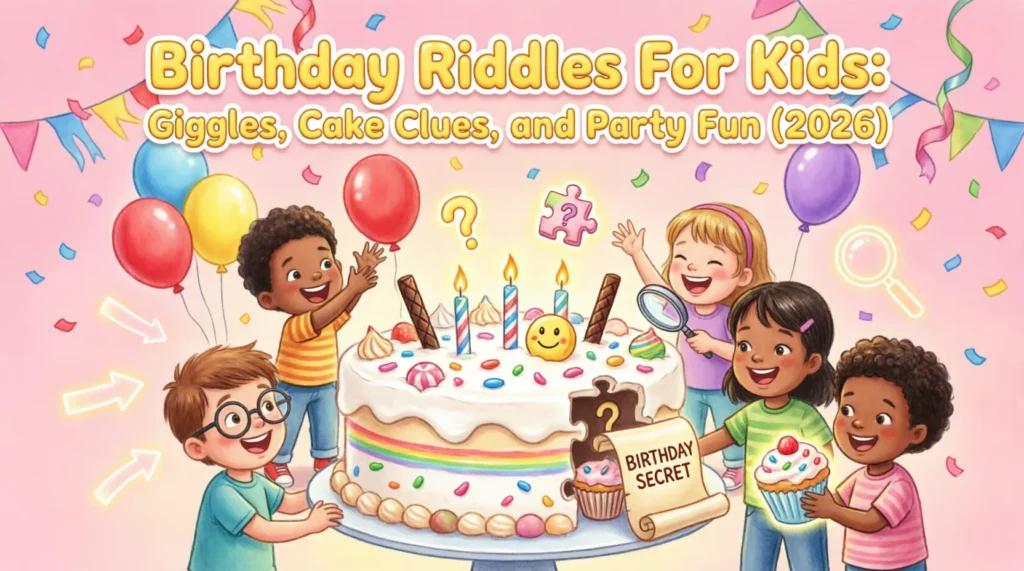
In short, birthday riddles for kids are playful brain teasers designed to make parties, classrooms, and family celebrations more exciting. They mix laughter, imagination, and easy problem-solving in a way kids genuinely enjoy. Scroll down to discover fun riddles you can use at your next birthday celebration right away.
Why Birthday Riddles For Kids Are More Powerful Than You Think
Birthday parties are already exciting, but riddles add something extra: curiosity. The moment you ask a child a funny birthday question, you turn passive party guests into active thinkers who want to shout out answers and join the fun.
Educators and child development researchers often point out that simple riddles help kids practice memory, language skills, and creative thinking without feeling like schoolwork. That matters because children learn best when they are laughing, moving, and interacting with others.
Studies show that playful problem-solving activities can improve attention and verbal reasoning in elementary-age children. That is one reason birthday riddles for kids work so well during parties, classroom celebrations, and family gatherings.
Riddles also create shared moments. One silly answer can make an entire table of kids burst into laughter, and those little moments often become the best memories of the day. Across cultures around the world, riddles have long been used to teach, entertain, and bring people together.
What Makes a Great Birthday Riddle For Kids
A great birthday riddle feels surprising without becoming frustrating. Kids should have to think for a few seconds, but they should still feel excited when they hear the answer. That “aha” moment is what makes the game rewarding.
The best birthday riddles for kids usually include familiar party themes like cake, balloons, candles, presents, hats, games, and friends. Children connect faster with riddles built around things they already see at the celebration.
Good kid-friendly riddles also use clean humor and simple wording. You want children to focus on solving the puzzle instead of trying to understand complicated language. Cognitive scientists often explain that younger kids respond especially well to visual clues and playful misdirection.
Another important detail is pacing. A strong birthday riddle should move quickly so kids stay energized. Long explanations or overly tricky clues can slow the party down. Short, clever questions work best because they keep the momentum going.
The funniest riddles often hide the answer in plain sight. Kids love discovering that the solution was simpler than they expected. That tiny burst of confidence keeps them eager for the next challenge.
Birthday Riddles For Kids: 20 Riddles to Try Right Now
Cake and Candle Riddles
Riddle: I get taller before a birthday wish and shorter after. What am I?
Answer: A birthday candle
Riddle: I am sweet, layered, and covered in frosting, but you should not wear me as a hat. What am I?
Answer: A birthday cake
Riddle: The more kids sing to me, the faster I disappear. What am I?
Answer: Birthday candles
Riddle: I arrive in slices but start as one big circle at many parties. What am I?
Answer: A birthday cake
Riddle: I can hold candles, frosting, and sprinkles, but I am not a table. What am I?
Answer: A cake stand
Balloon and Decoration Riddles
Riddle: I float at birthday parties but cry loudly if you squeeze me too hard. What am I?
Answer: A balloon
Riddle: Kids throw me in the air after singing, but I am not a beach ball. What am I?
Answer: Confetti
Riddle: I hang across walls and usually have cheerful words written on me. What am I?
Answer: A birthday banner
Riddle: I twist into animal shapes at parties, but I am not alive. What am I?
Answer: A balloon animal
Riddle: I sparkle at birthday parties even though I am not a star. What am I?
Answer: Glitter decorations
Present and Surprise Riddles
Riddle: You shake me before opening me, but I am not a soda can. What am I?
Answer: A wrapped present
Riddle: I hide toys and surprises under colorful paper. What am I?
Answer: A gift box
Riddle: The more ribbons I wear, the happier kids become. What am I?
Answer: A birthday present
Riddle: I am full of treats and toys, and kids swing at me with excitement. What am I?
Answer: A piñata
Riddle: I travel from guest to guest at a party but never walk on my own. What am I?
Answer: A party favor bag
Silly Party Riddles
Riddle: What birthday treat can never keep a secret?
Answer: A blabber-cake
Riddle: Why did the cupcake go to school?
Answer: Because it wanted to be a smartie tartie
Riddle: What kind of music do balloons hate?
Answer: Pop music
Riddle: What party item always tells the truth?
Answer: An honest candle because it never hides when it is burning
Riddle: What gets bigger every birthday but never weighs more?
Answer: Your age
🎯 More birthday riddles for kids: Easy, Medium, and Hard Challenges
Easy Riddles for birthday riddles for kids (Grades 6–7)
These easy birthday riddles for kids are perfect for younger middle schoolers who enjoy simple clues and clever observations.
Riddle: I arrive once a year, bring cake and candles, and everyone knows my name before I get here. What am I? Answer: A birthday
Riddle: The more candles I have, the older I usually am. What am I? Answer: A birthday cake
Riddle: People wrap me up before a party, but I’m not a sandwich. What am I? Answer: A present
Riddle: You can blow me out, but only after making a wish. What am I? Answer: A birthday candle
Riddle: I’m full of names and dates, and I help you remember special days. What am I? Answer: A calendar
Riddle: Everyone sings to you, but it’s not a concert. What event is it? Answer: A birthday celebration
Medium Riddles for birthday riddles for kids (Grades 7–8)
These medium birthday riddles for kids require a bit more reasoning and are great for students ready for a challenge.
Riddle: Mia celebrated her 12th birthday in 2024. How many birthdays had she celebrated before that day? Answer: 11
Riddle: Two friends were born on the same day, in the same year, to the same parents, but they aren’t twins. How is that possible? Answer: They are two of a set of triplets (or more)
Riddle: A birthday party starts at 3:00 PM and lasts 2 hours and 45 minutes. What time does it end? Answer: 5:45 PM
Riddle: I get shorter during a birthday party even though no one cuts me. What am I? Answer: A candle
Riddle: If every guest brings one gift and 10 guests attend, but two guests forget theirs, how many gifts arrive? Answer: 8
Riddle: You see me before the party starts, but by the end I’m usually gone. I’m sweet and often shared. What am I? Answer: Birthday cake
Riddle: Sarah is 13 today. Last year she was 12, and next year she’ll be 14. How is that possible? Answer: Her birthday is today
Hard Riddles for birthday riddles for kids (Grade 8 and Up)
These hard birthday riddles for kids use clever thinking, misdirection, and logic for older students.
Riddle: Every person has one, but nobody can celebrate it before it exists. What is it? Answer: Their birthday
Riddle: I can be counted every year, but I never get larger no matter how many you have. What am I? Answer: The date of your birthday
Riddle: A room contains five birthday candles. Three are blown out. How many candles remain? Answer: Five candles remain
Riddle: The more birthdays you celebrate, the less likely people are to ask your age. What increases while the question decreases? Answer: Your age
Riddle: I mark the passing of time, yet I return to the same spot every year. What am I? Answer: A birthday date on the calendar
Riddle: Emma’s birthday falls on a date that appears only every four years. She is 16 years old but has had only four actual birthday dates. What date was she born on? Answer: February 29
Riddle: I am always in front of your next birthday but always behind your last one. What am I? Answer: Today
Tip for teachers and parents: Start with easy riddles to build confidence, then gradually increase the difficulty to encourage deeper thinking. Mixing difficulty levels in teams can also promote collaboration and help students learn different problem-solving strategies from one another.
📚 Subject-Specific birthday riddles for kids: Math, Science, and More
Math Riddles for birthday riddles for kids
These math-themed riddles encourage students to think about numbers, patterns, and problem-solving in a fun way.
Riddle: I am an odd number. Remove one letter, and I become even. What number am I? Answer: Seven
Riddle: I have four equal sides and four right angles. What shape am I? Answer: A square
Riddle: Double me and add six. The result is sixteen. What number am I? Answer: Five
Riddle: I am a number that becomes larger when you turn me upside down. What am I? Answer: Six (becomes nine)
Riddle: What comes next in this pattern: 2, 4, 8, 16, ___? Answer: 32
Science Riddles for birthday riddles for kids
These science riddles connect everyday observations to exciting scientific ideas.
Riddle: I need sunlight, water, and air to make food for myself. What am I? Answer: A plant
Riddle: I travel around the Earth but never land on it. What am I? Answer: The Moon
Riddle: I am a force that pulls things toward the ground. What am I? Answer: Gravity
Riddle: I can be solid, liquid, or gas, yet I am the same substance. What am I? Answer: Water
Riddle: I rumble in the sky after a flash of light. What am I? Answer: Thunder
Language Riddles for birthday riddles for kids
These language and wordplay riddles help students explore letters, vocabulary, and creative thinking.
Riddle: What word becomes shorter when you add two letters to it? Answer: Short
Riddle: I am a word with six letters. Remove one letter, and twelve remain. What am I? Answer: Dozens
Riddle: What begins with T, ends with T, and has T inside? Answer: A teapot
Riddle: I am found once in a minute, twice in a moment, and never in an hour. What am I? Answer: The letter M
Riddle: What English word keeps the same pronunciation even after removing four of its five letters? Answer: Queue
Ideas for teachers:
Use subject-specific riddles as bell-ringer activities or lesson warm-ups to spark curiosity.
Turn riddles into exit tickets where students explain how they found the answer.
Organize small-group riddle challenges to reinforce academic concepts through teamwork and discussion.
How to Use Birthday Riddles For Kids for Maximum Fun
Use riddles as a party game between cake and presents.
Turn them into a birthday scavenger hunt with hidden clues around the room.
Ask riddles during car rides on the way to the celebration.
Add riddles to birthday invitations or thank-you cards.
Let kids compete in teams for tiny prizes or stickers.
Use riddles as classroom warm-up activities during birthday celebrations at school.
You can also make the experience more interactive by acting out clues or using props. Hold up a balloon, point to the cake, or dramatically whisper the question before revealing the answer. Kids respond strongly to energy and excitement.
Parents and teachers often find that birthday riddles for kids work especially well when mixed with movement. Let children hop, clap, or race to answer. The more involved they feel, the more memorable the activity becomes.
If you are planning a large birthday party, you can even create “riddle stations” around the room. Kids solve one clue before moving to the next area. This keeps the group busy and helps avoid boredom between activities.
Tips for Sharing Birthday Riddles For Kids Without Spoiling the Fun
Timing matters more than you think. After asking a riddle, give kids a few extra seconds before revealing the answer. Children often need a little pause to connect the clues.
You should also match the difficulty to the age group. Younger kids usually enjoy direct clues about cakes, balloons, or gifts, while older kids like trickier wordplay and silly surprises.
Keep your reactions encouraging, even when guesses are wrong. A funny incorrect answer can make the game even better. Laugh with the kids and build excitement instead of focusing only on correct answers.
If a riddle seems too hard, give tiny hints instead of immediately revealing the solution. That helps kids feel clever when they finally figure it out on their own.
Most importantly, stay playful. Your energy shapes the mood of the game more than the riddles themselves.
Bonus: Birthday Riddles For Kids That Stump Everyone
These bonus riddles are a little trickier and more surprising. They work especially well for older kids who enjoy clever twists and funny logic.
Riddle: I can light up a birthday room without using electricity. What am I?
Answer: Birthday candles
Riddle: The more people at the party who share me, the smaller I become. What am I?
Answer: The birthday cake
Riddle: I am opened once a year by one special person but touched by many hands. What am I?
Answer: Birthday presents
Riddle: Kids wait all day to hit me, yet I am invited to the party anyway. What am I?
Answer: A piñata
Riddle: I can make everyone cheer even before anyone eats me. What am I?
Answer: A birthday cake
Riddle: What party decoration gets sad when the celebration is over?
Answer: A deflated balloon
Riddle: I am full of surprises, wrapped with care, and impossible to guess perfectly every time. What am I?
Answer: A birthday gift
FAQs About Birthday Riddles For Kids
What age group are birthday riddles for kids best for?
Most birthday riddles for kids work best for ages 5 to 12 because children in that range enjoy playful word games and simple logic puzzles. Younger kids usually prefer short and visual riddles, while older kids enjoy trickier clues and sillier twists.
Can birthday riddles be used in classrooms?
Yes, teachers often use birthday-themed riddles during classroom celebrations because they encourage participation and group interaction. Educators also like them because kids practice listening, vocabulary, and creative thinking while having fun.
How hard should birthday riddles for kids be?
The best riddles feel challenging for a moment but still solvable. If children become frustrated too quickly, the fun disappears. You want kids smiling, guessing, and feeling proud when they discover the answer.
What makes birthday riddles different from regular riddles?
Birthday riddles focus on party themes children already love, including cake, presents, balloons, games, and candles. That familiar setting makes the riddles easier to enjoy and more exciting during celebrations.
Are birthday riddles good for party games?
Absolutely. You can use them during scavenger hunts, team competitions, cake time, or even while guests arrive. Many parents use birthday riddles for kids as quick icebreakers to help shy children join the fun faster.
Final Thoughts: Keep the Fun Going with Birthday Riddles For Kids
Birthday parties are about more than cake and presents. They are about laughter, connection, and the little moments kids remember long after the decorations come down. That is exactly why birthday riddles for kids are such a great addition to any celebration.
You do not need fancy supplies or complicated games to make children smile. A few clever riddles can instantly energize a room, spark creativity, and bring kids together in a way that feels natural and exciting.
The more you use riddles during birthdays, family dinners, road trips, and classroom celebrations, the more confident and imaginative kids become. Child development researchers often note that playful learning experiences help children build communication and problem-solving skills while having fun.
So grab a slice of cake, gather the kids, and start asking questions that make everyone laugh, think, and cheer together — because the best birthday memories usually begin with a simple smile and a clever riddle.
Frequently Asked Questions
What are birthday riddles for kids and why are they beneficial?▼
Birthday riddles for kids are playful brain teasers that add excitement to parties and celebrations. They encourage active thinking, enhance memory and language skills, and help children learn through laughter and interaction.
How do birthday riddles enhance a child's party experience?▼
Birthday riddles transform passive guests into active participants, sparking curiosity and engagement. When children laugh and solve riddles together, they create shared moments that often become cherished memories.
What characteristics make a great birthday riddle for kids?▼
A great birthday riddle should be surprising yet not frustrating, providing an ‘aha’ moment when solved. It’s best to incorporate familiar party themes and use simple language to keep kids focused and energized.
Can you provide examples of birthday riddles mentioned in the article?▼
Sure! Some examples include: ‘I get taller before a birthday wish and shorter after. What am I?’ Answer: A birthday candle. Another is: ‘I float at birthday parties but cry loudly if you squeeze me too hard. What am I?’ Answer: A balloon.
Why is pacing important when using riddles at a birthday party?▼
Pacing is crucial because it keeps the energy high and the atmosphere fun. Short and clever riddles help maintain momentum, while long explanations or tricky clues can slow down the party.
How do riddles contribute to children's cognitive development?▼
Engaging with riddles helps children practice problem-solving, attention, and verbal reasoning skills. These playful activities provide a learning experience that feels enjoyable rather than like schoolwork.
What themes should I consider when creating my own birthday riddles?▼
When creating birthday riddles, consider themes like cake, balloons, presents, or party hats. Using familiar elements from the celebration allows children to connect more easily with the riddles.
Raj Patel is an engineer turned writer who has a passion for puzzles and logical challenges. Educated at the Indian Institute of Technology, Raj utilized his problem-solving skills in developing themed and hard riddles that challenge adults while remaining clean and family-friendly. His interest in brainteasers began in childhood, inspiring him to create intricate riddles that can entertain and educate simultaneously. At FunRiddleZone, Raj’s contributions are invaluable for adult entertainment and enhancing cognitive skills through fun. He enjoys playing chess and developing mobile puzzle apps in his spare time.