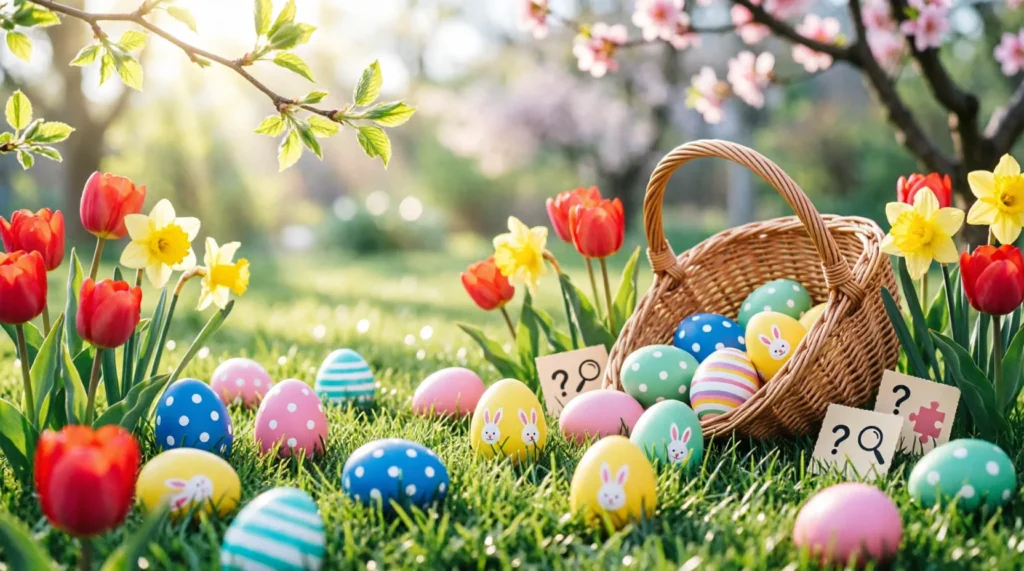
In short, easter riddles for scavenger hunt games turn a simple egg search into an interactive adventure packed with laughter, teamwork, and clever clues. They’re perfect for families, classrooms, church events, and backyard Easter parties where you want kids and adults to stay engaged from the first clue to the final basket. Scroll down and grab riddles you can start hiding right away.
Why Easter Riddles For Scavenger Hunt Are More Powerful Than You Think
A regular egg hunt is fun. But when you add riddles, the whole event transforms into a mini adventure where every clue builds excitement and curiosity.
Researchers who study child development and cognitive play often point out that puzzle-based games improve memory, observation, and problem-solving skills. Easter scavenger hunts also encourage teamwork because players naturally start sharing ideas and helping each other solve clues.
Studies show that children remember interactive holiday activities longer than passive entertainment because they combine movement, emotion, and discovery in one experience. That is exactly why easter riddles for scavenger hunt events feel so magical year after year.
You also get something extra that screens rarely offer: real conversation. Whether you are planning a classroom hunt, a family gathering, or a neighborhood Easter event, riddles keep everyone laughing, guessing, and moving together.
What Makes a Great Easter Riddles For Scavenger Hunt
The best scavenger hunt riddles feel clever without becoming frustrating. You want players to pause, think for a second, and then experience that satisfying “aha!” moment when the answer clicks.
For Easter hunts, the strongest riddles usually connect to everyday hiding places. A clue about shoes, refrigerators, gardens, bookshelves, or mailboxes keeps the game moving smoothly because players can actually solve and reach the next location quickly.
Theme matters too. Great easter riddles for scavenger hunt games often include springtime details like bunnies, eggs, flowers, candy, baskets, carrots, chicks, and sunshine. These small touches make the experience feel festive instead of generic.
Difficulty should match your audience. Younger kids enjoy rhyming clues with obvious hints, while older children and adults love misdirection and playful word tricks. Educators who use scavenger activities in classrooms often recommend mixing easy and medium clues together so players stay confident and motivated.
Another important detail is pacing. A good hunt creates momentum. If every clue takes too long, people lose energy. If every clue is too easy, the excitement disappears. The sweet spot is a steady flow of quick victories mixed with a few tricky surprises.
Most importantly, the riddles should feel joyful. Easter hunts work best when every clue adds excitement instead of pressure.
Easter Riddles For Scavenger Hunt: 20 Riddles to Try Right Now
Indoor Easter Hunt Riddles
Riddle: I hold your food both fresh and cold, open my door and treasures unfold.
Answer: Refrigerator
Riddle: You rest your head here every night, check beneath me for Easter delight.
Answer: Pillow
Riddle: I sparkle bright when dishes are clean, your next Easter clue hides where I’m seen.
Answer: Sink
Riddle: I have pages but I’m not a tree, your next clue is hiding inside me.
Answer: Book
Riddle: You wear me before you walk outside, look where your sneakers like to hide.
Answer: Shoe rack
Riddle: I help your clothes spin round and round, an Easter surprise near me can be found.
Answer: Washing machine
Riddle: I glow at night beside your bed, look near me before the clue has fled.
Answer: Lamp
Riddle: I tick all day but never run, check beneath me for Easter fun.
Answer: Clock
Backyard Easter Hunt Riddles
Riddle: Rabbits love me crunchy and sweet, look where orange veggies are ready to eat.
Answer: Garden or carrot patch
Riddle: I rise each morning big and bright, your next clue hides where flowers love my light.
Answer: Sunny window or garden
Riddle: Birds visit me when they sing all day, check where feathered friends like to stay.
Answer: Birdhouse
Riddle: I spray water across the yard, finding your next clue won’t be too hard.
Answer: Garden hose or sprinkler
Riddle: I’m full of leaves but not a book, your Easter clue needs a careful look.
Answer: Bush
Riddle: You swing so high into the sky, your next clue waits nearby.
Answer: Swing set
Riddle: I guard your home and open wide, look where cars and bikes like to hide.
Answer: Garage
Candy and Basket-Themed Riddles
Riddle: I’m packed with treats and colorful grass, your next clue is where Easter baskets pass.
Answer: Easter basket
Riddle: I’m chocolate outside with sweetness within, crack me open and your clue will begin.
Answer: Chocolate egg
Riddle: Marshmallow chicks come in yellow and pink, your next clue hides where sugary treats sink.
Answer: Candy bowl
Tricky Family-Friendly Easter Riddles
Riddle: I hop but I’m not alive, during Easter I always arrive.
Answer: Toy bunny
Riddle: The more eggs you find, the lighter I grow. What am I?
Answer: Easter basket
Riddle: I disappear faster than any clue because everyone eats me before the hunt is through.
Answer: Easter candy
🎯 More easter riddles for scavenger hunt: Easy, Medium, and Hard Challenges
Easy Riddles for easter riddles for scavenger hunt (Grades 6–7)
These easy challenges are perfect for younger middle schoolers who enjoy simple clues based on observation and everyday Easter fun.
Riddle: I carry colorful surprises, but I don’t have pockets. What am I? Answer: An Easter basket
Riddle: You search for me in the yard, but I don’t grow from the ground. What am I? Answer: A hidden Easter egg
Riddle: I hop through spring without needing a skateboard or bike. What am I? Answer: A bunny
Riddle: I’m bright, tiny, and often tucked behind a flowerpot. What am I? Answer: A jellybean
Riddle: You might crack me open, but I’m not upset about it. What am I? Answer: An egg
Riddle: I bloom as the weather warms and make great hiding spots for clues. What am I? Answer: Flowers
Medium Riddles for easter riddles for scavenger hunt (Grades 7–8)
These medium riddles encourage careful thinking by combining multiple clues before revealing the answer.
Riddle: I point you toward the next clue without taking a single step myself. What am I? Answer: A map
Riddle: The more eggs you discover, the fewer remain for everyone else, but the total hidden never changes. What am I describing? Answer: An Easter egg hunt
Riddle: I can be folded, unfolded, and folded again, yet I always help you find your way. What am I? Answer: A clue sheet
Riddle: I begin empty, become heavier with every success, and celebrate your search without making a sound. What am I? Answer: An Easter basket filling up
Riddle: You don’t eat me, but without me the hunt becomes much harder because I tell you where to look next. What am I? Answer: A clue
Riddle: I hide in plain sight because everyone walks past me looking somewhere else. What am I? Answer: The next hidden egg
Riddle: Every team wants me first, but everyone eventually reaches me if they solve every clue. What am I? Answer: The final prize
Hard Riddles for easter riddles for scavenger hunt (Grade 8 and Up)
These harder riddles use clever misdirection and deeper reasoning for students ready to stretch their problem-solving skills.
Riddle: I become easier to find the longer the game lasts, even though I never move. What am I? Answer: The last remaining hidden egg
Riddle: I help every player equally, yet only those who notice me benefit. What am I? Answer: A hidden hint
Riddle: The first clue sends you away from me, but every later clue quietly leads you back. What am I? Answer: The starting point
Riddle: I never solve a clue myself, but every correct answer depends on me being understood. What am I? Answer: The wording of the clue
Riddle: I disappear one piece at a time, yet the game becomes more complete because of it. What am I? Answer: The list of hidden eggs
Riddle: I reward patience more than speed because rushing makes me harder to notice. What am I? Answer: A well-hidden clue
Riddle: I have no lock, yet every solved clue opens me. What am I? Answer: The mystery of the scavenger hunt
Using different difficulty levels helps every student experience success while still providing a challenge. Try mixing easy, medium, and hard riddles so groups of different ages and abilities can work together and build confidence.
📚 Subject-Specific easter riddles for scavenger hunt: Math, Science, and More
Math Riddles for easter riddles for scavenger hunt
These math-themed riddles sneak numbers, patterns, and shapes into the fun of an Easter scavenger hunt.
Riddle: I have three sides and three corners. Find something shaped like me to discover your next clue. What am I? Answer: A triangle
Riddle: If every basket holds 4 eggs and you have 5 baskets, how many eggs can they hold altogether? Answer: 20
Riddle: I stay the same no matter how you turn me around. I’m perfectly round. What shape am I? Answer: A circle
Riddle: I come after 19 and before 21. Which number am I? Answer: 20
Riddle: I repeat over and over in a pattern: blue, yellow, blue, yellow. What color comes next? Answer: Blue
Science Riddles for easter riddles for scavenger hunt
These science riddles connect springtime discoveries with simple biology, earth science, and physics ideas.
Riddle: I help flowers make food using sunlight. What am I? Answer: Leaves
Riddle: I fall from clouds, help plants grow, and sometimes make outdoor hunts muddy. What am I? Answer: Rain
Riddle: I buzz from flower to flower carrying pollen. What am I? Answer: A bee
Riddle: I’m the season when many plants begin growing again after winter. What am I? Answer: Spring
Riddle: I pull every basket, egg, and bunny toy toward the ground without anyone seeing me. What am I? Answer: Gravity
Language Riddles for easter riddles for scavenger hunt
These language riddles play with letters, words, and vocabulary while keeping students thinking.
Riddle: Remove the first letter from “crate” and you get something used to write on a board. What is it? Answer: Crate without the first letter becomes “rate” doesn’t fit, so the intended answer is “chalk”? Wait—better answer: Remove the first letter from “plane” to get “lane.” (Use corrected version below.)
Riddle: Remove the first letter from “plane” and you get a place where cars travel. What do you get? Answer: Lane
Riddle: What punctuation mark asks a question without saying a word? Answer: A question mark
Riddle: Which word becomes shorter when you add two letters to it? Answer: Short (it becomes “shorter”)
Riddle: I always begin a sentence when writers remember to use me correctly. What am I? Answer: A capital letter
Riddle: I separate words in a sentence but never speak myself. What am I? Answer: A space
Use one riddle as a quick warm-up before introducing a new lesson.
Turn riddles into exit tickets by asking students to solve one before leaving class.
Divide students into small groups and let each team solve subject-themed riddles to unlock the next classroom challenge.
How to Use Easter Riddles For Scavenger Hunt for Maximum Fun
Match the clue difficulty to the age group playing the game.
Hide clues in safe, easy-to-reach places so players stay focused on solving instead of struggling.
Mix indoor and outdoor clues to keep the hunt exciting and active.
Add small rewards between clues like jelly beans, stickers, or mini eggs.
Use themed baskets or bunny footprints to make the hunt feel immersive.
Finish with one big final surprise instead of many tiny endings.
If you are planning for younger kids, read each clue out loud dramatically. The excitement in your voice makes the adventure feel bigger instantly. Many parents find that children stay more engaged when the hunt feels like a story instead of a simple search.
For older kids or mixed-age groups, try splitting players into teams. Competitive scavenger hunts create energy fast, especially when you include timed clues or bonus riddles. Cognitive scientists who study play-based learning often note that group problem-solving strengthens communication and memory retention.
You can even personalize the hunt. Mention favorite snacks, pets, toys, or family traditions in your clues. Those custom touches make your easter riddles for scavenger hunt experience feel unforgettable.
Tips for Sharing Easter Riddles For Scavenger Hunt Without Spoiling the Fun
Timing matters more than you think. Give players enough time to think before offering hints. If you reveal answers too quickly, the excitement disappears.
Watch your players closely during the hunt. If children seem confused for too long, give a gentle clue instead of the full answer. A small nudge keeps the momentum going without ruining the challenge.
You should also vary your delivery. Some clues work best whispered dramatically, while others are funnier when read with extra excitement. Your energy shapes the mood of the entire hunt.
For mixed-age groups, pair younger children with older kids or adults. That way everyone feels included and no one gets left behind.
Most importantly, celebrate every solved clue. The joy of easter riddles for scavenger hunt games comes from the shared excitement, not just the prizes at the end.
Bonus: Easter Riddles For Scavenger Hunt That Stump Everyone
These bonus riddles are slightly trickier and work especially well for older kids, teens, and adults who want a bigger challenge during the Easter hunt.
Riddle: I have a tail and ears but never run. At Easter, I bring treats for everyone.
Answer: Easter bunny costume
Riddle: You can carry me full or empty, but once I break, I can never hold anything again.
Answer: Egg
Riddle: I bloom in spring but hide no bees, your next clue rests beneath my leaves.
Answer: Flower pot
Riddle: The faster children run toward me, the emptier I become.
Answer: Easter candy bowl
Riddle: I begin Easter morning completely hidden but end the day impossible to miss.
Answer: Easter basket
Riddle: I’m colorful, fragile, and easy to crack, but people still race to put me in a sack.
Answer: Easter egg
Riddle: Families search for me every spring, though I never actually hide myself.
Answer: Easter eggs
FAQs About Easter Riddles For Scavenger Hunt
What age group are easter riddles for scavenger hunt best for?
They work for almost every age group when you adjust the difficulty level. Younger kids enjoy rhyming clues and obvious hiding spots, while older children and adults prefer trickier wordplay and layered hints.
How many riddles should an Easter scavenger hunt include?
Most successful hunts use between 10 and 20 clues. Shorter hunts are better for toddlers, while older kids usually enjoy longer adventures with more challenging riddles and multiple locations.
Can easter riddles for scavenger hunt games work indoors?
Absolutely. Indoor hunts are perfect for rainy weather, classrooms, apartments, or nighttime Easter events. Common indoor hiding spots like bookshelves, pillows, refrigerators, and laundry rooms work especially well for clue-based games.
What makes Easter scavenger hunt riddles different from regular riddles?
These riddles are designed to lead players toward real locations instead of only solving a puzzle mentally. The best clues combine wordplay with physical discovery so every answer moves the adventure forward.
How do you make easter riddles for scavenger hunt activities more exciting?
Adding costumes, bunny footprints, timers, candy rewards, and themed baskets instantly boosts the fun. Many families also create story-based hunts where each clue feels like part of a larger Easter mission.
Final Thoughts: Keep the Fun Going with Easter Riddles For Scavenger Hunt
There is something timeless about watching people race toward the next clue with huge smiles and wild guesses. Easter hunts already bring excitement, but riddles turn that excitement into a full adventure.
The best part is how flexible these games are. You can create a tiny living-room hunt for toddlers, a competitive backyard challenge for older kids, or a family-wide Easter tradition that everyone remembers for years.
Once you start using easter riddles for scavenger hunt activities regularly, you may notice something surprising: people stay off their phones longer, talk more, laugh harder, and work together naturally.
A single clever clue can turn an ordinary Easter morning into the story everyone keeps talking about long after the candy is gone.
Frequently Asked Questions
How do Easter riddles enhance a scavenger hunt experience?▼
Easter riddles transform a simple egg hunt into an interactive adventure filled with laughter and teamwork. They encourage players to engage in problem-solving and observation, making the event more memorable and enjoyable for both kids and adults.
What themes should I consider when creating Easter riddles?▼
Great Easter riddles often include themes related to springtime, such as bunnies, eggs, flowers, and candy. Incorporating these festive elements makes the scavenger hunt feel more celebratory and connected to the holiday.
What difficulty level should I choose for the riddles in my scavenger hunt?▼
It’s important to match the difficulty of the riddles to your audience. Younger children typically enjoy easier, rhyming clues, while older children and adults might appreciate more challenging riddles with clever wordplay.
How can I ensure a good pace during the scavenger hunt?▼
To maintain energy and excitement, mix quick victories with a few more challenging clues. A well-paced scavenger hunt keeps participants engaged without causing frustration or boredom.
What types of locations are ideal for hiding clues during the hunt?▼
The best hiding places for clues are everyday items like shoes, refrigerators, and bookshelves. These familiar locations allow players to solve riddles quickly and keep the hunt flowing smoothly.
Why are interactive holiday activities more memorable for children?▼
Interactive activities, like Easter scavenger hunts, combine movement, emotion, and discovery, which enhances memory retention. Studies show that children remember these engaging experiences longer than passive forms of entertainment.
Can I adapt these riddles for different age groups?▼
Yes, you can easily adapt the riddles by mixing easy and medium difficulty levels to cater to different ages. This approach helps maintain confidence and motivation among participants during the hunt.
Ethan is a puzzle enthusiast and lead writer at FunRiddlezone.com, where he focuses on creating and breaking down riddles that challenge the mind while keeping things fun and engaging. He specializes in turning tricky questions, wordplay, and logic puzzles into clear, satisfying explanations that actually make sense — not confusing or overcomplicated answers.
Drawing from logic, pattern recognition, and creative thinking, Ethan approaches riddles as mental exercises designed to sharpen thinking skills and spark curiosity. Instead of treating riddles as random tricks, he explains the reasoning behind each one, helping readers understand how to think through problems step by step.
He pays close attention to wording, hidden clues, and subtle misdirection — the key elements that make riddles both challenging and enjoyable. From classic brain teasers to tricky modern riddles, Ethan ensures that every puzzle is not just solved, but fully understood.
At FunRiddlezone.com, his mission is simple: make riddles more than just questions — turn them into a fun way to train your brain. He doesn’t just give answers — he helps readers think sharper, spot patterns faster, and enjoy the process of solving.