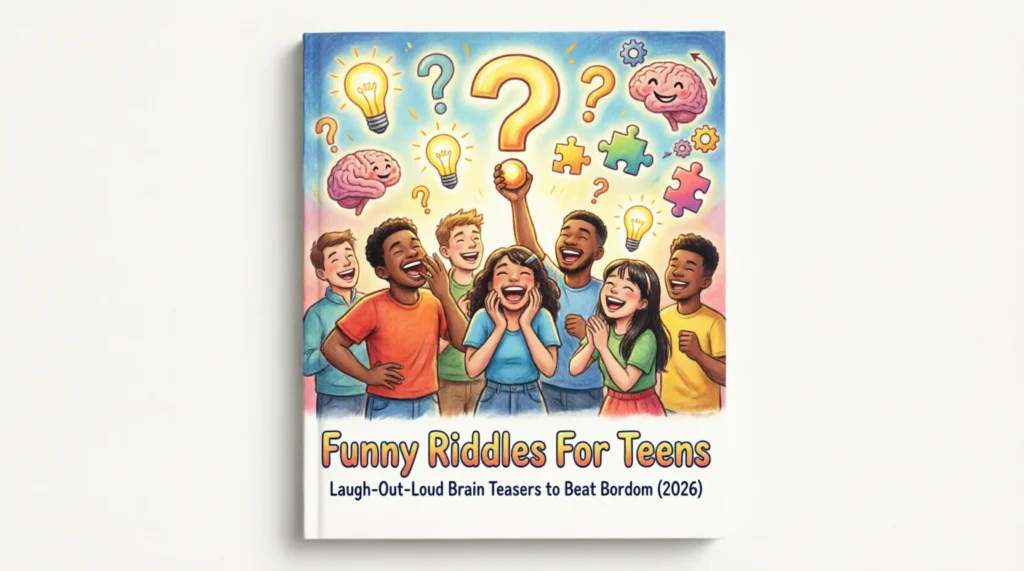
In short, funny riddles for teens combine clever humor, unexpected twists, and just the right amount of challenge to keep young minds entertained. They’re perfect for school breaks, road trips, parties, and group chats where laughter and quick thinking go hand in hand. Scroll down and see how many you can solve before checking the answers!
Why Funny Riddles For Teens Are More Powerful Than You Think
Funny riddles for teens do more than fill a few spare minutes. They encourage creative thinking, sharpen problem-solving skills, and bring people together through shared laughter.
Educators and cognitive scientists often point out that puzzles requiring humor and logic engage multiple parts of the brain at once. When teens work through a riddle, they’re practicing flexible thinking while learning to look at problems from different angles.
Studies show that playful mental challenges can improve attention, memory, and communication skills. That’s one reason funny riddles remain popular everywhere from classrooms to family game nights.
Riddles are also a global tradition. Across cultures, people have long used puzzles, wordplay, and clever questions to entertain friends while teaching critical thinking in a fun way.
What Makes a Great Funny Riddles For Teens
The best funny riddles for teens sit in the sweet spot between easy and impossible. If a riddle is solved instantly, it loses its impact. If it’s too difficult, it becomes frustrating instead of fun.
Great teen riddles often rely on wordplay, unexpected interpretations, and amusing misdirection. The answer feels surprising at first, but once you hear it, everything suddenly makes sense.
Another important ingredient is the “aha moment.” That’s the instant when your brain connects the clues and the answer clicks into place. The combination of surprise and understanding creates the satisfaction that keeps people asking for more riddles.
Since teens often share riddles with friends, classmates, siblings, and family members, the strongest riddles stay clean, inclusive, and easy to enjoy in almost any setting. A good laugh works best when everyone can join in.
Funny Riddles For Teens: 20 Riddles to Try Right Now
School and Student Riddles
Riddle: What school supply gets better grades than everyone else?
Answer: The ruler, because it always measures up.
Riddle: Why did the notebook become a comedian?
Answer: It was full of good lines.
Riddle: What sits in class all day but never learns a thing?
Answer: The classroom clock.
Riddle: Why was the math book smiling?
Answer: It finally solved its problems.
Riddle: What kind of test can you eat?
Answer: A taste test.
Riddle: Why did the pencil break up with the eraser?
Answer: The eraser kept rubbing out its mistakes.
Riddle: What student is always cool under pressure?
Answer: The one sitting next to the fan.
Everyday Life Riddles
Riddle: What gets bigger every time you take something away from it?
Answer: A hole.
Riddle: What can travel through your phone without using any data?
Answer: A crack in the screen.
Riddle: Why did the backpack apply for a vacation?
Answer: It was carrying too much baggage.
Riddle: What runs around your house all day but never gets tired?
Answer: The Wi-Fi signal.
Riddle: What kind of key opens absolutely nothing?
Answer: A monkey.
Riddle: Why did the mirror become famous?
Answer: It always reflected well on others.
Silly Wordplay Riddles
Riddle: What kind of music do balloons hate?
Answer: Pop music.
Riddle: Why did the calendar get promoted?
Answer: It had all the right dates.
Riddle: What wears glasses but can’t see?
Answer: A drinking glass.
Riddle: Why did the cookie go to therapy?
Answer: It felt crumbled under pressure.
Riddle: What kind of room has no walls, doors, or ceiling?
Answer: A mushroom.
Teen Life and Technology Riddles
Riddle: What social media post never gets any likes?
Answer: A sticky note.
Riddle: Why was the smartphone nervous?
Answer: It lost all its contacts.
Riddle: What has thousands of followers but never posts a selfie?
Answer: A school hallway.
🎯 More funny riddles for teens: Easy, Medium, and Hard Challenges
Easy Riddles for funny riddles for teens (Grades 6–7)
These easy challenges are perfect for students in grades 6–7 who enjoy quick thinking and playful observations.
Riddle: I can be cracked, made, told, and played, but I’m never made of wood. What am I? Answer: A joke.
Riddle: The more friends I have, the bigger I become, but I never take up any extra space in your room. What am I? Answer: A group chat.
Riddle: I travel from one backpack to another every school day without walking. What am I? Answer: Homework.
Riddle: I can be full of stories, but I never speak unless someone opens me. What am I? Answer: A book.
Riddle: I follow every sentence but never lead one. What am I? Answer: A period.
Riddle: I get shorter every time you sharpen me, yet I help your ideas grow. What am I? Answer: A pencil.
Medium Riddles for funny riddles for teens (Grades 7–8)
These medium-level riddles are great for grades 7–8 and encourage careful reasoning before jumping to an answer.
Riddle: Mia has three notebooks. She gives one away and buys two more. Without counting pages, what has increased the most? Answer: Her choices of notebooks.
Riddle: Every student in a club high-fives every other student exactly once. If six students join, how many different high-fives happen? Answer: 15.
Riddle: Two classmates start reading the same book at the same speed. One begins ten minutes earlier. Who finishes first? Answer: The one who started earlier.
Riddle: I always arrive after today but become today when I finally get here. What am I? Answer: Tomorrow.
Riddle: You see me once in every minute, twice in every moment, but never in an hour. What am I? Answer: The letter M.
Riddle: A classroom has one door. Ten students enter, and ten students leave. What never changed? Answer: The number of doors.
Riddle: I become lighter every time you use me, even though I never lose weight. What am I? Answer: A battery.
Hard Riddles for funny riddles for teens (Grade 8 and Up)
These harder riddles are best for grade 8 and up, using clever misdirection and deeper thinking.
Riddle: I can erase mistakes without touching paper, but only after they’ve already happened. What am I? Answer: Experience.
Riddle: I grow stronger when shared, yet weaker when hidden. What am I? Answer: Trust.
Riddle: The more accurately you describe me, the less mysterious I become. What am I? Answer: A mystery.
Riddle: I connect people across the world, but I don’t move an inch myself. What am I? Answer: The internet.
Riddle: You can’t borrow me from tomorrow, but you can waste me today. What am I? Answer: Time.
Riddle: I begin as one idea, become many conversations, and end as one memory. What am I? Answer: A school day.
Riddle: I am always in front of you, but you’ll never reach me because I keep moving with you. What am I? Answer: The future.
Using different difficulty levels helps every learner find success while still offering opportunities for growth. Try mixing easy, medium, and hard riddles during class or family game night so everyone gets a chance to solve—and create—clever puzzles.
📚 Subject-Specific funny riddles for teens: Math, Science, and More
Math Riddles for funny riddles for teens
These math-themed riddles build number sense and logical thinking while keeping the fun front and center.
Riddle: I have four equal sides and four right angles. What shape am I? Answer: A square.
Riddle: Double me, then add six, and you get sixteen. What number am I? Answer: Five.
Riddle: I stay exactly the same whether you turn me upside down or right side up. Which number am I? Answer: 8.
Riddle: I have no corners, no edges, and I roll instead of slide. What am I? Answer: A sphere.
Riddle: Which operation makes numbers grow the fastest when you repeat it over and over? Answer: Multiplication.
Science Riddles for funny riddles for teens
These science riddles introduce familiar concepts from biology, chemistry, physics, and earth science in a playful way.
Riddle: I help plants make food using sunlight, water, and air. What process am I? Answer: Photosynthesis.
Riddle: I pull dropped pencils toward the floor, even though you can’t see me. What am I? Answer: Gravity.
Riddle: I can be solid, liquid, or gas without changing what I’m made of. What am I? Answer: Water.
Riddle: I protect Earth by blocking much of the Sun’s harmful ultraviolet light. What am I? Answer: The ozone layer.
Riddle: I carry messages between your brain and the rest of your body faster than you can blink. What am I? Answer: Nerves.
Language Riddles for funny riddles for teens
These language riddles encourage students to think about letters, vocabulary, grammar, and clever wordplay.
Riddle: Remove my first letter and I still sound exactly the same. What word am I? Answer: Honest.
Riddle: I join two complete ideas with a small connecting word like “and” or “but.” What am I? Answer: A compound sentence.
Riddle: I am a word that means the opposite of another word. What am I called? Answer: An antonym.
Riddle: I make a question even though I don’t say a single word. What am I? Answer: A question mark.
Riddle: Rearrange the letters in “LISTEN” and you’ll discover what good students should do. What word appears? Answer: Silent.
Teachers can easily weave subject riddles into everyday learning by:
Using one or two riddles as bell ringers or warm-up activities before introducing a new lesson.
Turning riddles into exit tickets that encourage students to explain how they reached the answer.
Organizing small-group riddle challenges where students solve puzzles together and create new ones for classmates.
How to Use Funny Riddles For Teens for Maximum Fun
Start a lunch-table riddle challenge with friends.
Use riddles as icebreakers at teen parties or youth events.
Turn family road trips into friendly guessing competitions.
Add a daily riddle to classroom warm-up activities.
Share one in your group chat and see who solves it first.
Create a tournament where each correct answer earns points.
You can make riddles even more entertaining by acting out parts of them or delivering them with dramatic pauses. The suspense often creates as many laughs as the answer itself.
If you’re using funny riddles for teens at school or social events, mix easy and challenging questions together. Early successes help everyone feel confident before tackling the trickier brain teasers.
The best part is that you don’t need any equipment, apps, or preparation. A good riddle can instantly turn an ordinary moment into a memorable one.
Tips for Sharing Funny Riddles For Teens Without Spoiling the Fun
Timing matters. After asking the riddle, give people enough time to think before revealing the answer.
Encourage creative guesses. Sometimes the wrong answers are even funnier than the correct one, especially when friends start building on each other’s ideas.
Pay attention to your audience. If your group solves riddles quickly, increase the difficulty. If people seem stuck, offer a small hint instead of immediately giving away the answer.
Most importantly, keep the mood light. The goal isn’t to prove who’s smartest—it’s to create laughter, conversation, and a few surprising moments.
When sharing funny riddles for teens, your delivery can make a huge difference. A confident pause right before the answer often gets the biggest reaction.
Bonus: Funny Riddles For Teens That Stump Everyone
These bonus riddles are a little trickier. They still have a funny twist, but they may take a few extra seconds of thinking before the answer becomes obvious.
Riddle: What gets wetter the more it dries?
Answer: A towel.
Riddle: Why did the shadow get detention?
Answer: It kept following people around.
Riddle: What can be broken without ever being touched?
Answer: A promise.
Riddle: What starts every race but never moves?
Answer: The starting line.
Riddle: Why was the ladder so popular?
Answer: It was always helping people get up in the world.
Riddle: What has many stories but can’t read a book?
Answer: A building.
Riddle: Why did the sneaker become a motivational speaker?
Answer: It always encouraged people to take the next step.
FAQs About Funny Riddles For Teens
What age group are funny riddles for teens best suited for?
Most funny riddles for teens work well for ages 13 to 19. The ideal riddles combine humor, logic, and relatable topics such as school, technology, friendships, and everyday experiences.
Are funny riddles for teens good for classrooms?
Yes. Many teachers use riddles as warm-up activities because they encourage participation, critical thinking, and discussion. They can help students engage their minds before moving into academic work.
How difficult should funny riddles for teens be?
The best riddles provide a challenge without causing frustration. A mix of easy, medium, and slightly difficult riddles usually keeps teens interested and entertained.
Can funny riddles for teens be used at parties?
Absolutely. Riddles make excellent icebreakers because they encourage conversation and friendly competition. They’re especially useful when people don’t know each other very well yet.
What makes funny riddles for teens different from regular riddles?
Teen-focused riddles often include topics that feel familiar and relevant, such as school life, social media, technology, hobbies, and friendships. They balance humor and clever thinking in a way that matches teen interests.
Final Thoughts: Keep the Fun Going with Funny Riddles For Teens
Funny riddles for teens are a simple way to combine laughter, learning, and social connection. They challenge your brain while creating moments that people remember long after the answer is revealed.
Whether you’re hanging out with friends, looking for a classroom activity, or trying to make a road trip more entertaining, riddles offer a quick and easy solution. You can use them almost anywhere and with almost anyone.
The more often you practice solving riddles, the stronger your creative thinking and problem-solving skills can become. At the same time, you’ll build memories filled with laughs, surprising guesses, and unexpected answers.
So pick your favorite riddle, challenge someone today, and see how long it takes before the laughter starts.
Frequently Asked Questions
Why are funny riddles beneficial for teens?▼
Funny riddles stimulate creative thinking and sharpen problem-solving skills, making them more than just a fun activity. They encourage laughter and interaction among peers, helping to build social bonds while engaging multiple parts of the brain.
What characteristics make a great funny riddle for teens?▼
A great funny riddle strikes a balance between being easy and impossible, often relying on wordplay and amusing misdirection. The best riddles provide an ‘aha moment’ that leads to satisfaction and encourages sharing among friends.
Where can I use funny riddles for teens?▼
Funny riddles are perfect for various situations like school breaks, road trips, parties, and group chats. They provide entertainment and mental stimulation in settings where laughter and quick thinking are appreciated.
How do funny riddles enhance cognitive skills?▼
Engaging with funny riddles can improve attention, memory, and communication skills. By challenging teens to think flexibly and view problems from different angles, these riddles foster essential cognitive development.
Are the riddles in the article suitable for all ages?▼
Yes, the riddles in the article are designed to be clean, inclusive, and enjoyable for a wide audience, making them suitable for sharing among friends, classmates, and family members. The humor is accessible, ensuring everyone can join in the fun.
What types of riddles are included in the article?▼
The article features a variety of funny riddles categorized into school and student riddles, everyday life riddles, and silly wordplay riddles. Each category offers unique humor that resonates with teens and encourages laughter.
How can I encourage my teen to solve riddles?▼
Encouraging your teen to solve riddles can be as simple as making it a fun family activity or integrating them into social gatherings. Create a friendly competition or share riddles during road trips to make it engaging and enjoyable.
Raj Patel is an engineer turned writer who has a passion for puzzles and logical challenges. Educated at the Indian Institute of Technology, Raj utilized his problem-solving skills in developing themed and hard riddles that challenge adults while remaining clean and family-friendly. His interest in brainteasers began in childhood, inspiring him to create intricate riddles that can entertain and educate simultaneously. At FunRiddleZone, Raj’s contributions are invaluable for adult entertainment and enhancing cognitive skills through fun. He enjoys playing chess and developing mobile puzzle apps in his spare time.