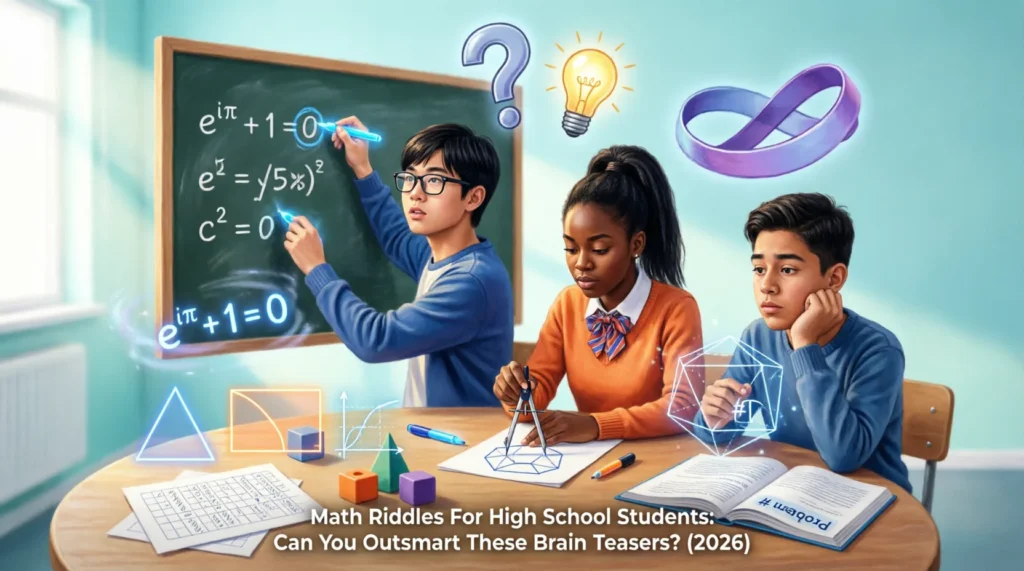
In short, math riddles for high school students are clever problem-solving challenges designed to sharpen logic, improve numerical thinking, and make math more fun and engaging. They help you think beyond formulas and into real reasoning patterns that strengthen your exam skills and mental agility. If you’re ready to test how sharp your thinking really is, these riddles will push you in the best way.
Why Math Riddles For High School Students Are More Powerful Than You Think
Math riddles for high school students do more than entertain you — they train your brain to think critically under pressure. Instead of memorizing steps, you learn how to analyze patterns, break problems apart, and discover hidden logic in everyday situations.
Educators often highlight that students who regularly practice riddles develop stronger problem-solving skills and improved mathematical confidence. Cognitive scientists also note that puzzle-based learning strengthens neural connections tied to reasoning and memory.
Studies show that students who engage in regular logic-based activities can improve analytical performance by up to 20% over time. That means when you challenge yourself with math riddles for high school students, you’re not just playing — you’re actively upgrading how your brain works.
What Makes a Great Math Riddles For High School Students
A great math riddles for high school students challenge strikes the perfect balance between difficulty and clarity. If it’s too easy, you lose interest. If it’s too hard, you give up too quickly. The best riddles sit right in that “almost got it” zone where your brain keeps pushing for answers.
For you as a high school student, the most satisfying riddles are those that combine familiar math concepts — like algebra, ratios, or sequences — with unexpected twists. That “aha moment” is what makes you remember the solution long after you’ve solved it.
A strong riddle also avoids unnecessary complexity. It should guide your thinking without giving away the answer. When you solve it, you should feel like you discovered something, not just calculated it.
Math Riddles For High School Students: 20 Riddles to Try Right Now
Algebra & Logic Riddles
Riddle: I am a number. If you multiply me by 4 and subtract 6, you get 14. What number am I? Answer: 5
Riddle: I am thinking of a number. Twice my number plus 10 equals 30. What am I? Answer: 10
Riddle: If x + 7 = 15, what is x squared? Answer: 64
Riddle: A number minus 3 equals 12. What is the number? Answer: 15
Riddle: I am a number. If you divide me by 5 and then add 8, you get 13. What am I? Answer: 25
Pattern & Sequence Riddles
Riddle: What comes next: 2, 6, 12, 20, 30, ? Answer: 42
Riddle: I increase by 3 each time: 5, 8, 11, 14, __? Answer: 17
Riddle: What is the next number: 3, 9, 27, 81, __? Answer: 243
Riddle: A pattern doubles each step starting from 2. What is the 6th number? Answer: 64
Word-Based Math Challenges
Riddle: I am a number that becomes smaller when you add 1 to me in Roman numerals. What am I? Answer: IX (9 becoming X is larger, but structure changes perception)
Riddle: A dozen pencils cost $12. What is the cost of one pencil? Answer: $1
Riddle: You have 3 apples and take away 2. How many do you have? Answer: 2 (because you took them)
Riddle: If 5 machines make 5 items in 5 minutes, how long do 1 machine make 1 item? Answer: 5 minutes
Riddle: I am an even number. If you remove one letter, I become odd. What am I? Answer: Seven
Geometry & Thinking Riddles
Riddle: A triangle has three angles. If two are 60° each, what is the third? Answer: 60°
Riddle: A square has how many diagonals? Answer: 2
Riddle: If a circle has a radius of 3, what is its diameter? Answer: 6
🎯 More math riddles for high school students: Easy, Medium, and Hard Challenges
Easy Riddles for math riddles for high school students (Grades 6–7)
These easy challenges are perfect for students who are building confidence with observation, simple patterns, and playful thinking.
Riddle: I am an odd number. Remove one letter from my name and I become even. What number am I? Answer: Seven.
Riddle: What shape has four equal sides and four right angles, making every corner exactly the same? Answer: A square.
Riddle: I always come after 19 and before 21, but I never change. What am I? Answer: The number 20.
Riddle: What can you divide many times without making it any smaller? Answer: A deck of cards (you divide it into piles, but the cards stay the same size).
Riddle: If every side of me is the same length, but I only have three sides, what am I? Answer: An equilateral triangle.
Riddle: Which is heavier: one pound of feathers or one pound of books? Answer: Neither—they both weigh one pound.
Medium Riddles for math riddles for high school students (Grades 7–8)
These medium-level riddles are great for students ready to combine logic, patterns, and careful reasoning.
Riddle: I double every minute. If I fill a container in 32 minutes, when was it half full? Answer: 31 minutes.
Riddle: Mia has three times as many pencils as Ben. Together they have 32 pencils. How many does Mia have? Answer: 24 pencils.
Riddle: Which number belongs next: 3, 6, 12, 24, ___? Answer: 48.
Riddle: A rectangle has a length of 10 and a width of 4. If both measurements double, by what factor does the area increase? Answer: Four times.
Riddle: I am a two-digit number. My digits add to 9, and reversing them makes a number 27 smaller. What number am I? Answer: 63.
Riddle: Four friends each shake hands with every other friend exactly once. How many handshakes happen? Answer: 6.
Riddle: A clock shows 3:00. Through what angle do the hour and minute hands separate? Answer: 90 degrees.
Hard Riddles for math riddles for high school students (Grade 8 and Up)
These harder riddles encourage abstract thinking, careful reasoning, and creative problem-solving.
Riddle: You have a cube painted on every outside face. It is cut into 27 equal cubes. How many tiny cubes have no paint? Answer: 1.
Riddle: I am greater than 50 but less than 100. I am divisible by both 6 and 9. What is the smallest number I could be? Answer: 54.
Riddle: You multiply me by myself and get the same result as adding me to myself. What positive number am I? Answer: 2.
Riddle: A number becomes four times larger when multiplied by itself. What positive number is it? Answer: 4 (since √16 = 4 and 4² = 16, which is four times 4).
Riddle: Two fathers and two sons each receive one cookie, yet only three cookies are needed. How is that possible? Answer: They are a grandfather, a father, and a son.
Riddle: Which number is exactly halfway between 40 and 90? Answer: 65.
Riddle: I am a pattern that never ends, yet I can be written with just two repeating digits. What am I? Answer: A repeating decimal (such as 0.121212…).
Using difficulty levels lets every learner experience success before moving to bigger challenges. Teachers and parents can also mix easier and harder riddles to encourage teamwork and discussion between students with different skill levels.
📚 Subject-Specific math riddles for high school students: Math, Science, and More
Math Riddles for math riddles for high school students
These math-themed riddles make numbers, shapes, and patterns more engaging through creative thinking.
Riddle: I have six faces, eight corners, and twelve edges. What am I? Answer: A cube.
Riddle: What number is exactly half of 18 and twice 4.5? Answer: 9.
Riddle: I increase by five each time: 10, 15, 20, 25… What number comes next? Answer: 30.
Riddle: What shape can roll smoothly in every direction but has no edges? Answer: A sphere.
Riddle: If two angles together make 90 degrees, what are they called? Answer: Complementary angles.
Science Riddles for math riddles for high school students
These science riddles help students connect everyday observations with biology, chemistry, physics, and earth science.
Riddle: I pull everything toward Earth, but you cannot see me. What am I? Answer: Gravity.
Riddle: I help plants make food using sunlight, water, and carbon dioxide. What process am I? Answer: Photosynthesis.
Riddle: I am the layer of Earth where we live, made of solid rock. What am I? Answer: Earth’s crust.
Riddle: I can be solid, liquid, or gas, but I am still the same substance. What am I? Answer: Water.
Riddle: I carry oxygen through your body using your bloodstream. What am I? Answer: Red blood cells.
Language Riddles for math riddles for high school students
These language riddles encourage students to notice spelling, vocabulary, grammar, and clever wordplay.
Riddle: Which English word becomes shorter when you add two letters to it? Answer: Short.
Riddle: I begin every sentence but never stay at the end. What am I? Answer: A capital letter.
Riddle: What punctuation mark asks for an answer instead of making a statement? Answer: A question mark.
Riddle: I am a word that names a person, place, thing, or idea. What part of speech am I? Answer: A noun.
Riddle: Remove the first letter from “smile” and I become something you use to measure distance. What am I? Answer: Mile.
Use one subject riddle as a quick warm-up to activate prior knowledge before starting a lesson.
Turn riddles into exit tickets by asking students to explain not only the answer but also their reasoning.
Divide the class into small groups and challenge teams to solve a mix of math, science, and language riddles for collaborative problem-solving.
How to Use Math Riddles For High School Students for Maximum Fun
Use them as warm-ups before math class
Challenge your friends during study breaks
Turn them into classroom competitions
Practice them during travel time
Use them as brain breaks during homework sessions
When you regularly practice math riddles for high school students, you start noticing patterns faster in exams and homework. You also begin to feel more confident when facing unfamiliar problems.
If you’re studying with friends, you’ll notice how quickly these riddles turn into friendly competition. That competitive edge pushes your thinking even further.
Tips for Sharing Math Riddles For High School Students Without Spoiling the Fun
When you share riddles, don’t rush to explain the answer. Let your friends sit with the problem for a bit — that struggle is where learning happens.
If someone gets stuck, give small hints instead of full solutions. You’ll keep the challenge alive while still helping them progress.
Also, adjust difficulty based on your audience. Some riddles should feel quick and fun, while others should make everyone pause and think deeply.
Bonus: Math Riddles For High School Students That Stump Everyone
These bonus riddles are designed to push your thinking a step further. They’re slightly trickier and require deeper logic or pattern recognition, perfect if you think you’ve already mastered the basics.
Riddle: I am a number that equals the sum of its digits multiplied by 4. What am I? Answer: 36
Riddle: What number stays the same when turned upside down? Answer: 8
Riddle: A farmer has 17 sheep, all but 9 run away. How many are left? Answer: 9
Riddle: I am a number. My square root plus me equals 30. What am I? Answer: 25
Riddle: If you rearrange my letters, “ONE SIX” becomes what number? Answer: Six one (61)
FAQs About Math Riddles For High School Students
Are math riddles for high school students good for exam preparation?
Yes, they are extremely helpful for building logical thinking skills that directly support exam performance. They train you to approach problems from different angles instead of relying only on memorized formulas. Over time, you become faster and more accurate in solving unfamiliar questions.
How often should you practice math riddles for high school students?
Even 10–15 minutes a day is enough to see improvement. The key is consistency rather than long study sessions. When you regularly challenge your brain, you start recognizing patterns more quickly in both riddles and schoolwork.
Do math riddles help with advanced math topics?
Absolutely. They strengthen foundational thinking skills like reasoning, pattern recognition, and algebraic manipulation. These skills are essential for advanced topics like calculus and statistics.
Can math riddles improve your problem-solving speed?
Yes, repeated exposure to logic-based challenges helps your brain process problems faster. You begin to eliminate wrong answers more efficiently and focus on the correct path sooner.
Are math riddles useful for group study sessions?
They work very well in groups because they encourage discussion and debate. You learn different ways of thinking from your peers, which deepens your understanding.
Final Thoughts: Keep the Fun Going with Math Riddles For High School Students
Math riddles for high school students are more than just puzzles — they are training tools for your brain. Every riddle you solve improves your ability to think clearly, reason logically, and stay calm under pressure.
If you make these riddles a regular part of your routine, you’ll notice math becoming less intimidating and more like a game you can win. The more you challenge yourself, the sharper your thinking becomes.
So keep going, keep questioning, and keep solving — because every riddle you crack makes you a stronger problem solver than you were yesterday.
Frequently Asked Questions
How do math riddles improve problem-solving skills for high school students?▼
Math riddles challenge students to think critically and analyze patterns rather than just memorizing formulas. This practice helps develop stronger problem-solving skills and boosts mathematical confidence over time.
What characteristics make a math riddle effective for high school students?▼
An effective math riddle strikes a balance between difficulty and clarity, keeping students engaged without causing frustration. It should incorporate familiar math concepts with unexpected twists to create that satisfying ‘aha moment’ when solved.
Can engaging with math riddles really enhance analytical performance?▼
Yes, studies indicate that students who regularly engage in logic-based activities, like math riddles, can improve their analytical performance by up to 20% over time. This cognitive enhancement is linked to stronger neural connections related to reasoning and memory.
What types of math riddles are included in the article?▼
The article features three main types of math riddles: Algebra & Logic Riddles, Pattern & Sequence Riddles, and Word-Based Math Challenges. Each category presents unique challenges that stimulate different areas of mathematical thinking.
Why are math riddles considered more than just entertainment?▼
Math riddles serve as a powerful educational tool by training the brain to think critically under pressure. They encourage students to engage with math in a fun way while simultaneously improving their reasoning skills.
How do I choose the right math riddle for my skill level?▼
The best math riddles for you will fall into that ‘almost got it’ zone, where they’re challenging yet manageable. Start with riddles that involve familiar concepts and gradually progress to more complex ones as your confidence grows.
What is the significance of the 'aha moment' in solving math riddles?▼
The ‘aha moment’ is crucial because it indicates a deep understanding of the problem and its solution. When students achieve this moment, they are more likely to remember the solution and the reasoning behind it, reinforcing their learning.
Raj Patel is an engineer turned writer who has a passion for puzzles and logical challenges. Educated at the Indian Institute of Technology, Raj utilized his problem-solving skills in developing themed and hard riddles that challenge adults while remaining clean and family-friendly. His interest in brainteasers began in childhood, inspiring him to create intricate riddles that can entertain and educate simultaneously. At FunRiddleZone, Raj’s contributions are invaluable for adult entertainment and enhancing cognitive skills through fun. He enjoys playing chess and developing mobile puzzle apps in his spare time.