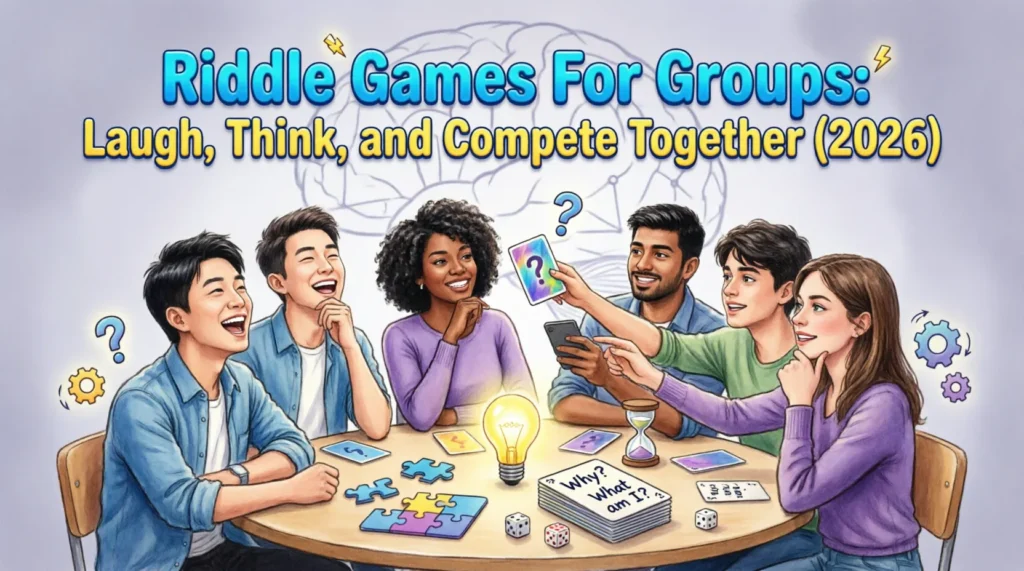
In short, riddle games for groups are one of the easiest ways to spark laughter, teamwork, and friendly competition. Whether you’re planning a party, family gathering, classroom activity, or game night, these group-friendly riddles help everyone participate and stay engaged. Scroll down and discover riddles that can turn any gathering into a memorable challenge.
Why the Riddle Games For Groups Are More Powerful Than You Think
When people gather, conversations can sometimes stall. That’s where riddle games for groups shine. They give everyone a shared challenge, encourage participation, and create those satisfying moments when someone suddenly figures out the answer.
Researchers and cognitive scientists often point to puzzles and riddles as excellent tools for activating problem-solving skills, memory, and creative thinking. Unlike many games that focus on speed or physical ability, riddles invite everyone to contribute ideas.
Studies show that collaborative puzzle-solving can improve communication and increase group engagement. Whether you’re hosting friends, leading students, or organizing a team event, riddles help people connect while exercising their minds.
Riddles are also a global tradition. Across cultures and generations, people have used clever wordplay and brainteasers to entertain, teach, and bring communities together.
What Makes a Great Riddle Games For Groups
The best group riddles strike a careful balance between challenge and accessibility. If a riddle is too easy, your group solves it instantly and moves on. If it’s too difficult, people lose interest before reaching the answer.
A strong group riddle encourages discussion. You want people throwing out ideas, debating possibilities, and building on each other’s thinking. That’s where clever misdirection becomes important. The answer should feel surprising but fair.
The famous “aha moment” is what makes riddles memorable. When your group suddenly sees the solution, there’s often a burst of laughter, groans, or applause. That emotional payoff keeps people engaged and eager for the next challenge.
For group settings, clean humor works best. You want riddles that everyone can enjoy regardless of age, background, or experience level. The most successful riddle games for groups create a welcoming atmosphere where every participant feels comfortable guessing.
Riddle Games For Groups: 20 Riddles to Try Right Now
Teamwork and Thinking Riddles
Riddle: Five people enter a room carrying one umbrella. Nobody gets wet, even though it’s raining heavily. Why?
Answer: It wasn’t raining when they entered the room.
Riddle: The more teammates share me, the larger I become. What am I?
Answer: An idea.
Riddle: I can travel through a whole group in seconds without moving my feet. What am I?
Answer: A rumor.
Riddle: Everyone in the room can hold me, but nobody can touch me. What am I?
Answer: A conversation.
Riddle: The more people add to me, the stronger I become. Yet I am not a building. What am I?
Answer: Teamwork.
Riddle: A circle of friends passes me around, but I never leave the room. What am I?
Answer: A story.
Riddle: I get shorter when everyone takes turns using me. What am I?
Answer: A pencil.
Party and Social Riddles
Riddle: I arrive at every party but never receive an invitation. What am I?
Answer: The music.
Riddle: The louder the room becomes, the harder I am to hear. What am I?
Answer: A whisper.
Riddle: Everyone wants me at game night, but nobody wants to lose me. What am I?
Answer: A turn.
Riddle: I can fill a room full of people without taking up any space. What am I?
Answer: Laughter.
Riddle: The more guests there are, the more often I get forgotten. What am I?
Answer: Someone’s name.
Riddle: I am shared by everyone at the party, yet nobody owns me. What am I?
Answer: The atmosphere.
Riddle: I can make a group cheer or groan in the same second. What am I?
Answer: A surprising answer.
Observation and Logic Riddles
Riddle: Ten people stand in a line. The first sees nine people, the second sees eight, and so on. How many people does the last person see?
Answer: Zero.
Riddle: A group takes one photo. Every person appears in the picture except the photographer. Why?
Answer: The photographer took the picture.
Riddle: The more people watch me, the less likely I am to happen. What am I?
Answer: A surprise.
Riddle: I am opened before every group game but never closed afterward. What am I?
Answer: The first question.
Riddle: A room contains twelve people and twelve chairs. Nobody is sitting down. Why?
Answer: They are all standing.
Riddle: I grow bigger every time someone guesses wrong. What am I?
Answer: The list of eliminated answers.
Riddle: Everyone can see me, but nobody can catch me. What am I?
Answer: A shadow.
How to Use the Riddle Games For Groups for Maximum Fun
Start with easier riddles to build confidence and participation.
Divide large groups into teams and award points for correct answers.
Use riddles as icebreakers before meetings, classes, or events.
Set a time limit to keep energy high and prevent overthinking.
Let participants create their own riddles after several rounds.
Finish with your hardest riddles to create a memorable finale.
You can adapt these activities for almost any setting. At family gatherings, use riddles between meals. During game nights, mix them with board games or trivia rounds. In classrooms, they make excellent warm-up exercises that encourage critical thinking.
If your group includes different ages, alternate between easy and challenging riddles. This keeps everyone involved and prevents a few strong puzzle-solvers from dominating the game. The goal is shared fun, not just finding answers.
Tips for Sharing the Riddle Games For Groups Without Spoiling the Fun
Good delivery can make a simple riddle feel unforgettable. Read each riddle slowly and clearly so everyone has time to think.
Give your group at least 20–30 seconds before offering hints. Many people arrive at the answer just after they think they’re stuck.
When someone guesses incorrectly, encourage the effort rather than immediately revealing the solution. Often, a wrong answer sparks the discussion that eventually leads the group to the correct one.
You can also adjust difficulty on the fly. If your group is struggling, provide a clue. If they’re solving everything instantly, challenge them to explain their reasoning before earning the point.
Most importantly, keep the atmosphere light. The best riddle sessions are filled with laughter, curiosity, and unexpected discoveries.
Bonus: Riddle Games For Groups That Stump Everyone
These bonus riddles are designed to make groups pause, debate, and rethink their assumptions. They’re excellent for competitive puzzle nights and advanced riddle fans.
Riddle: Everyone in a room takes one step forward at exactly the same time. Nobody changes position relative to anyone else. Why?
Answer: They all stepped forward together.
Riddle: The more people search for me, the harder I become to find. What am I?
Answer: Silence.
Riddle: A group creates me in seconds, but I can last for years. What am I?
Answer: A memory.
Riddle: I can connect complete strangers without saying a single word. What am I?
Answer: A shared smile.
Riddle: Every person in the room has me, but nobody can lend it away. What am I?
Answer: Their past.
Riddle: I am strongest when many people have different opinions about me. What am I?
Answer: A discussion.
Riddle: The larger the crowd, the easier I am to lose. What am I?
Answer: Individual attention.
FAQs About the Riddle Games For Groups
What age group are riddle games for groups best for?
Riddle games for groups work well for nearly every age range. You can adjust difficulty depending on whether you’re playing with children, teens, adults, or mixed-age gatherings. The key is choosing riddles that match your audience’s experience and interests.
How many people do you need for group riddle games?
You can enjoy group riddles with as few as three people. However, groups of six to fifteen often create the best mix of discussion, teamwork, and friendly competition.
Can riddle games for groups be used as icebreakers?
Absolutely. Riddles are excellent icebreakers because they shift attention away from awkward introductions and toward a shared challenge. They help people interact naturally while solving a problem together.
What makes group riddles different from regular riddles?
Group riddles are designed to encourage discussion rather than individual solving. The fun comes from hearing different perspectives, debating possibilities, and reaching answers as a team.
Are riddle games for groups good for classrooms and workplaces?
Yes. Educators often use riddles to encourage critical thinking, while workplace psychologists note that collaborative challenges can strengthen communication and engagement. Clean, inclusive riddles work especially well in professional and educational settings.
Final Thoughts: Keep the Fun Going with the Riddle Games For Groups
Few activities combine laughter, creativity, and problem-solving as effectively as riddle games for groups. They require almost no equipment, work in nearly any setting, and give everyone a chance to participate.
The best part is how easily you can start. Pick a handful of riddles, gather your friends, family, students, or coworkers, and let the guessing begin.
As you make riddles a regular part of your gatherings, you’ll notice something interesting. People become more confident sharing ideas, more willing to think creatively, and more comfortable working together.
Sometimes all it takes is one clever question to turn a room full of people into a room full of smiles.
Samantha Nguyen has been a literary enthusiast for over 15 years, combining her love for language and pedagogy to craft engaging riddles and puzzles. With a background in Education and Linguistics, Samantha has dedicated her career to making learning fun and accessible to children of all ages. She specializes in seasonal riddles, often weaving in cultural and historical themes to enrich classroom experiences during holidays and special events. Samantha is passionate about crafting puzzles that challenge young minds while also entertaining the whole family. Her riddles are designed to stimulate critical thinking, ensuring they remain a hit during family gatherings and road trips. She joined FunRiddleZone to reach a wider audience and share her passion for creative educational content.