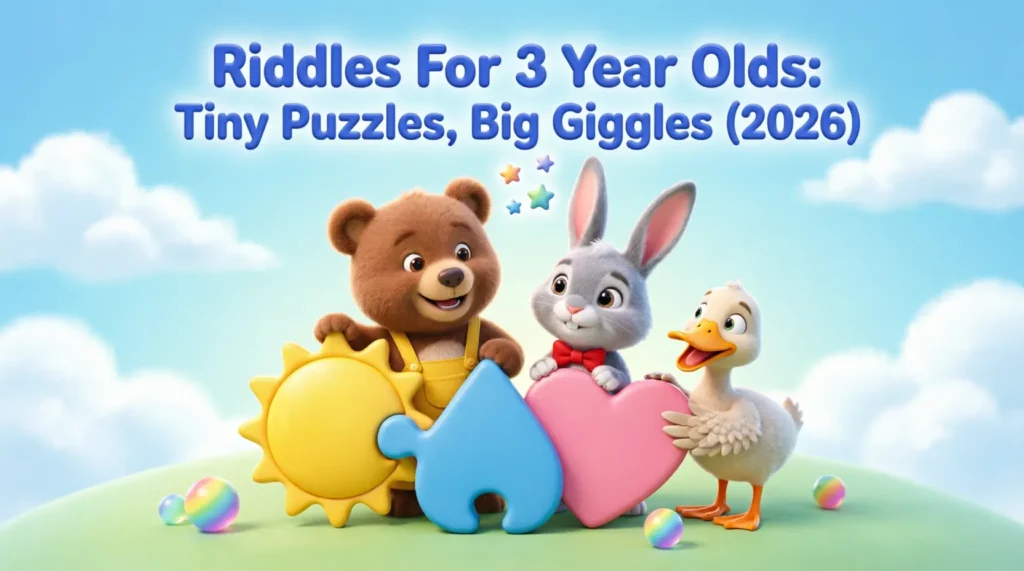
In short, riddles for 3 year olds are simple, playful brain games designed to spark curiosity, language development, and laughter. They’re perfect for parents, grandparents, teachers, and caregivers who want an easy way to entertain little ones while helping them think. Scroll down and try these fun riddles with your favorite preschooler today.
Why Riddles For 3 Year Olds Are More Powerful Than You Think
At age three, children are exploring the world through questions, observations, and imagination. That’s exactly why riddles for 3 year olds can be such a valuable activity. A simple riddle turns an ordinary moment into a fun challenge that encourages your child to think, guess, and learn.
Educators and child development researchers often highlight the importance of playful learning during the preschool years. Riddles encourage children to connect words, ideas, and objects in new ways while having fun.
Studies show that young children who regularly engage in language-based games can strengthen vocabulary, listening skills, memory, and early problem-solving abilities. Even a quick riddle during a car ride or snack break can become a meaningful learning moment.
Beyond learning, riddles create opportunities for connection. When you ask a silly question and your child proudly guesses the answer, you’re sharing a moment of discovery together. Those little victories can build confidence and keep children excited about learning.
Riddles are also part of a global storytelling tradition. Across cultures, families have used playful questions and clever puzzles to entertain children and pass time together.
What Makes a Great Riddles For 3 Year Olds
The best riddles for 3 year olds are simple, concrete, and easy to picture. Preschoolers learn best when the answer relates to something they already know, such as animals, foods, toys, colors, or everyday objects.
A great preschool riddle should be challenging enough to make a child think for a moment but not so difficult that it becomes frustrating. Young children love the feeling of figuring something out, so the answer should feel achievable.
The “aha moment” matters more than complexity. When your child suddenly realizes the answer is a banana, a duck, or a ball, they experience a small burst of excitement that keeps them engaged.
Simple wordplay also works well at this age. The clues should be short and clear, using familiar language your child hears every day. Overly tricky misdirection usually isn’t necessary because preschoolers are still developing reasoning skills.
Most importantly, riddles for young children should stay positive, clean, and age-appropriate. The goal is to encourage curiosity and laughter while helping children build confidence in their thinking abilities.
Riddles For 3 Year Olds: 20 Riddles to Try Right Now
Animal Riddles
Riddle: I say “moo” and give milk. What am I?
Answer: A cow
Riddle: I have long ears and like to hop. What am I?
Answer: A rabbit
Riddle: I quack and swim in ponds. What am I?
Answer: A duck
Riddle: I am fluffy and say “baa.” What am I?
Answer: A sheep
Riddle: I have a long neck and eat leaves from tall trees. What am I?
Answer: A giraffe
Riddle: I bark when I am excited. What am I?
Answer: A dog
Riddle: I purr and like cozy naps. What am I?
Answer: A cat
Food Riddles
Riddle: I am yellow and monkeys like me. What am I?
Answer: A banana
Riddle: I am red and grow on trees. People make pie from me. What am I?
Answer: An apple
Riddle: I am orange and crunchy. Rabbits like me. What am I?
Answer: A carrot
Riddle: I am cold, sweet, and come in cones. What am I?
Answer: Ice cream
Riddle: I am round and cheesy. You can share me at a party. What am I?
Answer: Pizza
Riddle: I pop and become fluffy when heated. What am I?
Answer: Popcorn
Everyday Things
Riddle: You kick me, throw me, and catch me. What am I?
Answer: A ball
Riddle: I help you see when it gets dark. What am I?
Answer: A lamp
Riddle: You sleep on me every night. What am I?
Answer: A bed
Riddle: I keep your feet warm when you wear shoes. What am I?
Answer: Socks
Riddle: You use me to color pictures. What am I?
Answer: A crayon
Riddle: I open and close to let people in. What am I?
Answer: A door
Riddle: I tell stories but I am not a person. What am I?
Answer: A book
🎯 More riddles for 3 year olds: Easy, Medium, and Hard Challenges
Easy Riddles for riddles for 3 year olds (Grades 6–7)
These easy challenges are perfect for students in Grades 6–7 who enjoy simple observation and playful thinking.
Riddle: I have four corners, but I never argue with anyone. What am I? Answer: A rectangle.
Riddle: I follow you on sunny days but disappear when the lights go out. What am I? Answer: Your shadow.
Riddle: I can be full of words but never speak a single one. What am I? Answer: A book.
Riddle: I have hands that never wave and a face that never smiles. What am I? Answer: A clock.
Riddle: The more classmates use me, the shorter I become. What am I? Answer: A pencil.
Riddle: I can open without a key and close without a lock. What am I? Answer: An umbrella.
Medium Riddles for riddles for 3 year olds (Grades 7–8)
These medium riddles are great for Grades 7–8 and encourage careful reasoning before jumping to an answer.
Riddle: Maya has three boxes. One is empty, one holds marbles, and one holds crayons. She moves the marbles into the empty box. Which box is empty now? Answer: The box that used to hold the marbles.
Riddle: A number doubles itself and becomes 18. What was the number? Answer: 9.
Riddle: You read me from beginning to end, but every page takes you farther away from where you started. What am I? Answer: A map.
Riddle: Two friends leave school together. One walks twice as fast, but both reach home at the same time. How? Answer: They live different distances from school.
Riddle: I grow every year but never get taller. What am I? Answer: Your age.
Riddle: You can erase me without touching me, simply by making a new one. What am I? Answer: A mistake.
Riddle: Every student can borrow me, but I always stay in the same building. What am I? Answer: A library book.
Hard Riddles for riddles for 3 year olds (Grade 8 and Up)
These harder puzzles are best for Grade 8 and up, using clever logic, abstract thinking, and careful attention to detail.
Riddle: I become larger when you remove part of me. What am I? Answer: A hole.
Riddle: I am shared by every month, but only one month begins with me. What am I? Answer: The letter “J.”
Riddle: A sentence says, “The next sentence is false.” The next sentence says, “The previous sentence is true.” What do these sentences create? Answer: A logical paradox.
Riddle: I can connect two ideas even when I stand between them. Remove me, and the meaning changes. What am I? Answer: A conjunction.
Riddle: I always arrive after today but become today when I finally come. What am I? Answer: Tomorrow.
Riddle: You can count me forever, but you’ll never reach my end. What am I? Answer: The counting numbers.
Riddle: I exist only because people agree that I do, yet I help organize nearly every day. What am I? Answer: Time on a calendar.
Using different difficulty levels helps every learner experience success while still finding new challenges. Try letting students or family members choose their own level first, then encourage them to “level up” as their confidence grows.
📚 Subject-Specific riddles for 3 year olds: Math, Science, and More
Math Riddles for riddles for 3 year olds
These math-themed riddles build problem-solving skills while keeping students engaged and smiling.
Riddle: I have three sides and three corners, and every version of me belongs to the same shape family. What am I? Answer: A triangle.
Riddle: I am the only even prime number. What am I? Answer: 2.
Riddle: I stay the same no matter how you turn me halfway around. Which number am I? Answer: 8.
Riddle: Add me to myself and you get twelve. What number am I? Answer: 6.
Riddle: I come after every calculation and tell you what you found. What am I? Answer: The answer (or result).
Science Riddles for riddles for 3 year olds
These science riddles connect everyday observations with fun facts from biology, chemistry, physics, and earth science.
Riddle: I carry water from the ground to the leaves without taking a single step. What am I? Answer: A plant stem.
Riddle: I pull everything toward Earth, but nobody can see me. What am I? Answer: Gravity.
Riddle: I change from solid to liquid when I get warm enough. What am I? Answer: Ice.
Riddle: I help you breathe, but plants make more of me every sunny day. What am I? Answer: Oxygen.
Riddle: I travel across the sky without legs, bringing rain or shade. What am I? Answer: A cloud.
Language Riddles for riddles for 3 year olds
These language riddles encourage students to think about letters, words, grammar, and vocabulary in creative ways.
Riddle: I always begin a sentence when I’m used correctly. What am I? Answer: A capital letter.
Riddle: I replace a person’s name so you don’t have to repeat it. What am I? Answer: A pronoun.
Riddle: I tell what someone does in a sentence. What am I? Answer: A verb.
Riddle: Remove the first letter from the word “plane,” and I become something simple you can draw. What am I? Answer: Lane.
Riddle: I connect two complete ideas into one longer sentence. What am I? Answer: A conjunction.
Use one subject riddle as a daily warm-up before beginning the lesson.
Turn riddles into exit tickets by asking students to explain how they reached the answer.
Divide the class into small groups and have teams solve or create subject-themed riddles together.
How to Use Riddles For 3 Year Olds for Maximum Fun
Ask riddles during car rides to keep little minds busy.
Use them as a fun warm-up before story time.
Turn them into a family dinner game.
Include them in preschool classroom activities.
Use them during birthday parties or playdates.
Create a bedtime riddle tradition with your child.
You don’t need a special setting to enjoy riddles. A few minutes while waiting in line, riding in the car, or getting ready for bed can become a playful learning opportunity.
Try using different voices, silly expressions, or dramatic pauses before revealing the answer. Young children love anticipation, and a little extra excitement can make the experience even more memorable.
If your child guesses incorrectly, celebrate the effort before giving another clue. The goal isn’t perfection—it’s engagement, curiosity, and fun.
Tips for Sharing Riddles For 3 Year Olds Without Spoiling the Fun
When you tell a riddle, give your child plenty of time to think. Three-year-olds often need a few extra seconds to process clues and form an answer.
If your child seems stuck, offer a gentle hint instead of immediately revealing the solution. You might point to an object nearby or imitate an animal sound.
Keep your tone cheerful and encouraging. When children feel safe making guesses, they’re more willing to participate and learn.
You can also adjust the difficulty on the fly. If a riddle feels too hard, simplify the clues. If it feels too easy, add one extra clue and let your child think a little longer.
Most importantly, celebrate every answer. The laughter and conversation matter more than getting the riddle exactly right.
Bonus: Riddles For 3 Year Olds That Stump Everyone
These bonus riddles are slightly trickier than the main list. They’re still preschool-friendly, but they may require a little more thinking before the answer clicks.
Riddle: I go up when rain comes down. What am I?
Answer: An umbrella
Riddle: I have wheels but I am not a bicycle. Kids ride inside me. What am I?
Answer: A stroller
Riddle: I shine during the day but sleep at night. What am I?
Answer: The sun
Riddle: I have buttons but I am not a shirt. What am I?
Answer: A remote control
Riddle: I can be big or small, and you build me with blocks. What am I?
Answer: A tower
Riddle: I have hands but cannot clap. What am I?
Answer: A clock
Riddle: I carry water but am not a cup. What am I?
Answer: A watering can
FAQs About Riddles For 3 Year Olds
What age group are riddles for 3 year olds best for?
Most of these riddles work well for children between ages 3 and 5. Younger children may need extra hints, while older preschoolers can often solve them independently.
How difficult should riddles for 3 year olds be?
The best riddles use familiar objects, animals, foods, and daily experiences. If a child becomes frustrated, the riddle is probably too difficult for their current stage of development.
Can riddles help preschool learning?
Yes. Many educators use riddles to support vocabulary development, listening skills, memory, and early critical thinking. They also encourage children to pay attention to clues and make connections.
Are riddles for 3 year olds good for classrooms?
Absolutely. Teachers often use simple riddles during circle time, transitions, morning meetings, and language activities. They can help children participate while making learning feel playful.
How often should I use riddles with my child?
A few riddles each day can be plenty. Short, consistent interactions often work better than long sessions because preschoolers tend to learn best through brief, engaging activities.
Final Thoughts: Keep the Fun Going with Riddles For 3 Year Olds
Simple riddles can create big smiles. They encourage children to think, listen, imagine, and explore the world around them in a playful way.
Whether you’re a parent planning a road trip, a grandparent looking for a fun activity, or a teacher preparing a classroom warm-up, these riddles offer an easy way to make everyday moments more engaging.
The more you use riddles, the more confident your child may become in asking questions, making guesses, and sharing ideas. Those skills can support learning long after the game is over.
Start with a few favorites today, keep the laughter going, and watch curiosity grow one riddle at a time.
Frequently Asked Questions
Why are riddles important for 3 year olds?▼
Riddles are important for 3 year olds because they spark curiosity and encourage language development. They turn ordinary moments into fun challenges, helping children think critically while having fun.
What characteristics make a riddle suitable for preschoolers?▼
A suitable riddle for preschoolers is simple, concrete, and easy to visualize. It should relate to familiar concepts like animals or everyday objects and be challenging enough to provoke thought without causing frustration.
How do riddles help strengthen a child's vocabulary?▼
Riddles help strengthen a child’s vocabulary by engaging them in language-based games that promote word connections. Regular interaction with riddles enhances listening skills and memory, making them an effective tool for early language development.
Can riddles be used during everyday activities?▼
Yes, riddles can be easily incorporated into everyday activities like car rides or snack breaks. They provide meaningful learning moments that can enhance the experience and keep children entertained.
What types of riddles are included in the article?▼
The article includes a variety of riddles, specifically animal and food riddles. Each riddle is designed to be relatable and engaging for young children, focusing on familiar themes.
How can parents and caregivers create a positive riddle experience?▼
Parents and caregivers can create a positive riddle experience by choosing age-appropriate, clean riddles that encourage curiosity and laughter. Celebrating a child’s correct guesses helps build their confidence and makes the activity enjoyable.
What is the significance of the 'aha moment' in solving riddles?▼
The ‘aha moment’ is significant because it provides a burst of excitement when a child realizes the answer to a riddle. This moment of discovery fosters engagement and reinforces a child’s willingness to learn and think critically.
Ethan is a puzzle enthusiast and lead writer at FunRiddlezone.com, where he focuses on creating and breaking down riddles that challenge the mind while keeping things fun and engaging. He specializes in turning tricky questions, wordplay, and logic puzzles into clear, satisfying explanations that actually make sense — not confusing or overcomplicated answers.
Drawing from logic, pattern recognition, and creative thinking, Ethan approaches riddles as mental exercises designed to sharpen thinking skills and spark curiosity. Instead of treating riddles as random tricks, he explains the reasoning behind each one, helping readers understand how to think through problems step by step.
He pays close attention to wording, hidden clues, and subtle misdirection — the key elements that make riddles both challenging and enjoyable. From classic brain teasers to tricky modern riddles, Ethan ensures that every puzzle is not just solved, but fully understood.
At FunRiddlezone.com, his mission is simple: make riddles more than just questions — turn them into a fun way to train your brain. He doesn’t just give answers — he helps readers think sharper, spot patterns faster, and enjoy the process of solving.