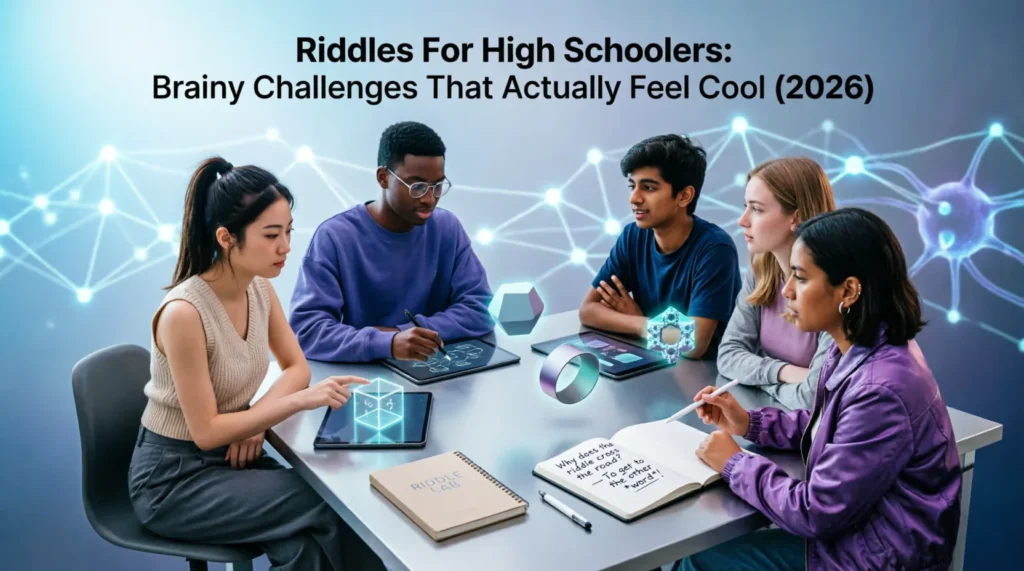
In short, riddles for high schoolers are clever, fast-paced brain teasers designed to challenge teens without feeling childish or impossible. They mix logic, humor, observation, and creativity in ways that fit classrooms, friend groups, game nights, and even study breaks. If you’re ready to test your brain and surprise your friends, these riddles are the perfect place to start.
Why Riddles For High Schoolers Are More Powerful Than You Think
High school is the perfect time for riddles. Your brain is developing faster reasoning skills, sharper memory, and stronger pattern recognition, which makes solving clever puzzles especially satisfying. Unlike simple kids’ riddles, riddles for high schoolers hit that sweet spot where the challenge feels rewarding instead of frustrating.
Educators and cognitive scientists often point out that brain teasers encourage flexible thinking and improve problem-solving skills in teenagers. When you solve a riddle, your brain has to switch perspectives quickly, which strengthens creative reasoning and attention.
Studies show that students who regularly engage with puzzles and logic games tend to improve critical thinking and verbal reasoning skills over time. That’s one reason many teachers now use riddles in classrooms as warm-up activities or group challenges.
There’s also a social side to it. A good riddle instantly changes the energy in a room. You stop scrolling, start guessing, and suddenly everyone wants to be the first person with the right answer. That mix of competition and laughter is exactly why riddles for high schoolers stay popular year after year.
What Makes a Great Riddles For High Schoolers
The best riddles for teens aren’t too obvious, but they also don’t rely on impossible trick answers. A strong high school riddle usually gives you just enough information to make your brain lean in closer. The fun comes from the moment you suddenly realize the answer was hiding in plain sight.
Wordplay matters a lot at this age. High schoolers enjoy riddles that twist meanings, hide clues in ordinary language, or force you to rethink assumptions. The answer should feel surprising but fair. If the solution makes you say, “Wait… that actually makes sense,” the riddle worked.
Another important detail is tone. Teen audiences respond better to clever humor and modern situations than childish jokes. School life, phones, sports, exams, friendships, and social media all make great themes because they feel familiar and relatable.
Good riddles also respect the audience. They challenge your thinking without becoming confusing for the sake of confusion. Teachers and youth educators often recommend riddles that encourage discussion and teamwork instead of embarrassment or overly complicated logic traps.
A memorable riddle creates an “aha moment.” That tiny burst of satisfaction is what keeps you coming back for another one.
Riddles For High Schoolers: 20 Riddles to Try Right Now
School and Classroom Riddles
Riddle: I get sharper every time you use me, but eventually I disappear completely. What am I?
Answer: A pencil
Riddle: I can fill an entire classroom but never take up any space. What am I?
Answer: Light
Riddle: The more notes you take from me, the bigger I become. What am I?
Answer: A textbook with highlighted pages
Riddle: I’m full of answers but still fail every test. What am I?
Answer: A calculator battery that died
Riddle: I travel from student to student but rarely leave the room. What am I?
Answer: A rumor
Logic and Brain Teasers
Riddle: A student walks into school on Friday, stays for three days, and leaves on Friday. How is this possible?
Answer: Friday is the name of the student’s horse
Riddle: You see me once in June, twice in November, but not at all in May. What am I?
Answer: The letter “E”
Riddle: Two friends take the same test. One finishes in 20 minutes, the other in an hour. Both get every answer correct. How?
Answer: They took different versions of the test
Riddle: I get wetter while drying others. What am I?
Answer: A towel
Riddle: The more you ignore me, the louder I become. What am I?
Answer: An alarm
Social and Modern-Life Riddles
Riddle: Everyone checks me before class, during lunch, and before bed, yet I never sleep. What am I?
Answer: A phone
Riddle: I can ruin your confidence with one number and improve your mood with another. What am I?
Answer: A test score
Riddle: I disappear when the teacher looks directly at me. What am I?
Answer: A student’s phone under the desk
Riddle: The more followers I gain, the less I actually move. What am I?
Answer: A social media account
Riddle: I connect hundreds of people but can still make someone feel alone. What am I?
Answer: Social media
Observation and Wordplay Riddles
Riddle: What has chapters but no story?
Answer: A textbook
Riddle: What gets broken almost every morning but is never touched?
Answer: A promise to wake up early
Riddle: What kind of room has no doors, windows, or ceiling?
Answer: A mushroom
Riddle: I speak in every language without saying a single word. What am I?
Answer: Music
Riddle: What can race around the world while staying in one corner?
Answer: A stamp
Competitive Challenge Riddles
Riddle: I have keys but no locks. I have space but no room. You can enter, but you can’t go inside. What am I?
Answer: A keyboard
Riddle: A teacher says, “The person who breaks me never sees me break.” What am I?
Answer: Silence
Riddle: I become shorter every time you add to me. What am I?
Answer: A candle
Riddle: What belongs to you but gets used more by your friends than by you?
Answer: Your name
Riddle: The faster you run toward me, the harder I become to catch. What am I?
Answer: The future
🎯 More riddles for high schoolers: Easy, Medium, and Hard Challenges
Easy Riddles for riddles for high schoolers (Grades 6–7)
These easy riddles for high schoolers are perfect for building confidence with observation and simple wordplay.
Riddle: I grow shorter every time I help you measure, but I never complain. What am I? Answer: A pencil.
Riddle: I visit every classroom but never take a seat. I help everyone stay on time. What am I? Answer: The clock.
Riddle: The more students use me, the lighter I become. What am I? Answer: A piece of chalk.
Riddle: I have many pages but never tell a story unless you open me. What am I? Answer: A notebook.
Riddle: I can be sharp without being dangerous, and I help solve problems every day. What am I? Answer: A sharp pencil.
Riddle: I am full at the start of class but nearly empty by the end. What am I? Answer: A whiteboard.
Medium Riddles for riddles for high schoolers (Grades 7–8)
These medium riddles for high schoolers encourage logical thinking and are great for students ready for a bit more challenge.
Riddle: Maya reads 15 pages every day. After four days, she has 12 pages left in her 72-page book. How many pages had she already read before Day 1? Answer: 0 pages. She read 60 pages in four days, leaving 12.
Riddle: Three classmates each shake hands with every other classmate exactly once. How many handshakes happen? Answer: 3 handshakes.
Riddle: A classroom has 5 rows with 6 desks in each row. Two desks are removed. How many desks remain? Answer: 28 desks.
Riddle: I always tell the truth when I am written correctly, but one missing mark can completely change my meaning. What am I? Answer: A sentence with punctuation.
Riddle: A teacher writes the numbers 1 through 20 on the board. Which digit appears the most? Answer: The digit 1.
Riddle: I become easier to carry the more you organize me. What am I? Answer: A backpack.
Riddle: You solve me by looking forward instead of backward, even though all the clues came before. What am I? Answer: A puzzle.
Hard Riddles for riddles for high schoolers (Grade 8 and Up)
These hard riddles for high schoolers reward careful thinking, creative reasoning, and looking at problems from a different angle.
Riddle: I can connect two ideas, separate two ideas, or completely change a sentence, all without making a sound. What am I? Answer: Punctuation.
Riddle: The more accurate I become, the less room I leave for guessing. What am I? Answer: Evidence.
Riddle: I can be broken without making a sound, and once broken, trust is harder to rebuild. What am I? Answer: A promise.
Riddle: Everyone in a class has me, but no one else can use mine exactly as I do. What am I? Answer: My perspective.
Riddle: I appear whenever you compare two things, even if they are completely different. What am I? Answer: A similarity.
Riddle: I always arrive after a question but before understanding. What am I? Answer: Thinking.
Riddle: The more carefully you examine me, the more details you discover, yet I never become larger. What am I? Answer: A picture.
Using difficulty levels lets students experience quick successes before tackling bigger challenges. Mixing easy, medium, and hard riddles also encourages teamwork, discussion, and confidence as learners build their problem-solving skills.
📚 Subject-Specific riddles for high schoolers: Math, Science, and More
Math Riddles for riddles for high schoolers
These math-themed riddles turn numbers, shapes, and patterns into fun brain workouts.
Riddle: I have three sides, but no matter how you turn me, I always have the same number. What am I? Answer: A triangle.
Riddle: Add me to myself and I become ten. What number am I? Answer: Five.
Riddle: I am an even number. Remove one letter from my name, and I become odd. What number am I? Answer: Seven (“s” removed becomes “even”).
Riddle: I have no corners, but I can roll across the floor. What shape am I? Answer: A circle.
Riddle: I always stay the same distance from my center, no matter where you measure. What am I? Answer: A circle.
Science Riddles for riddles for high schoolers
These science riddles connect everyday observations with exciting scientific ideas.
Riddle: I help plants make food using sunlight, water, and air. What process am I? Answer: Photosynthesis.
Riddle: I pull everything toward Earth, even if you cannot see me. What am I? Answer: Gravity.
Riddle: I change from liquid to gas when I get enough heat. What am I doing? Answer: Evaporating.
Riddle: I protect Earth from many harmful rays while floating high above us. What am I? Answer: The ozone layer.
Riddle: I travel as a wave, help you see colors, and move faster than anything else we experience every day. What am I? Answer: Light.
Language Riddles for riddles for high schoolers
These language riddles build vocabulary, grammar, and wordplay skills in an engaging way.
Riddle: I make a sentence excited without saying a single word myself. What am I? Answer: An exclamation point.
Riddle: I join two smaller words together to make one new word. What kind of word am I? Answer: A compound word.
Riddle: I can change a noun into many nouns by adding just one letter. What letter am I? Answer: The letter “s.”
Riddle: I sound the same as another word but have a different meaning and spelling. What am I called? Answer: A homophone.
Riddle: I replace someone’s name so you do not have to repeat it over and over. What am I? Answer: A pronoun.
Use one subject riddle as a quick warm-up to activate students’ thinking before beginning a lesson.
Turn riddles into exit tickets by asking students to explain why the answer is correct, not just what it is.
Divide the class into small groups and let each team solve a different set of subject riddles before sharing their reasoning.
How to Use Riddles For High Schoolers for Maximum Fun
Start class with a quick riddle challenge to wake everyone up mentally.
Use riddles during study breaks to keep your brain active without feeling overloaded.
Turn lunch breaks or road trips into mini competitions with friends.
Add riddles to youth group events, club meetings, or team-building games.
Post one riddle a day in group chats or social media stories and let people guess.
Create “riddle battles” where teams compete to solve the fastest.
The best part about riddles for high schoolers is how flexible they are. You can use them almost anywhere without needing equipment or prep time. One clever question can completely change the mood in a classroom or friend group.
If you’re a teacher, coach, or youth leader, riddles are also great for encouraging participation from quieter students. Sometimes students who don’t usually speak up suddenly become fully engaged when a puzzle appears.
You can also adjust the difficulty depending on your group. Start with lighter riddles to build confidence, then slowly introduce more challenging ones that require teamwork and discussion.
Tips for Sharing Riddles For High Schoolers Without Spoiling the Fun
Timing matters more than you think. When you ask a riddle, give people a few seconds to actually think before jumping to the answer. The pause creates suspense and makes the reveal more satisfying.
Try not to immediately shut down wrong guesses. Sometimes the funniest moments come from creative answers that weren’t even close. Keeping the energy playful helps everyone stay involved.
You should also pay attention to your audience. Some groups enjoy logic-heavy riddles, while others prefer funny wordplay or school-themed jokes. Mixing styles keeps the challenge fresh.
If a riddle completely stumps everyone, offer tiny hints instead of revealing the answer instantly. A small clue often leads to a much bigger “aha moment.”
Bonus: Riddles For High Schoolers That Stump Everyone
These bonus riddles are trickier because they rely on hidden assumptions, careful wording, or deeper logic. Even confident students usually need extra time to crack them.
Riddle: A student’s backpack becomes lighter the more books you add. How?
Answer: The books are digital downloads on a tablet
Riddle: What question can you never answer “yes” to honestly?
Answer: “Are you asleep?”
Riddle: I can be copied endlessly but still remain original. What am I?
Answer: An idea
Riddle: You use me to cheat time, but I actually make you lose it. What am I?
Answer: The snooze button
Riddle: What gets harder to see the brighter the room becomes?
Answer: A phone screen
Riddle: A classroom contains 30 students and 1 teacher. Every person has one notebook. How many notebooks are in the classroom?
Answer: Thirty-one
Riddle: The more connected people become through me, the quieter the room gets. What am I?
Answer: Wi-Fi
FAQs About Riddles For High Schoolers
What age group are riddles for high schoolers best for?
These riddles are usually perfect for teens between ages 14 and 18. They’re designed to feel smarter and more engaging than kids’ riddles while still being accessible enough to solve without advanced knowledge.
Are riddles for high schoolers good for classrooms?
Yes, many educators use riddles as classroom warm-ups, critical-thinking exercises, or group activities. They help students practice logic, reading comprehension, and creative thinking in a low-pressure way.
How hard should riddles for high schoolers be?
The best difficulty level is challenging but fair. A strong riddle should make you think for a minute or two without feeling impossible. If students completely give up, the riddle usually isn’t balanced correctly.
What makes riddles for high schoolers different from kids’ riddles?
Teen riddles often use sharper wordplay, modern themes, and more complex logic. They also tend to focus on social situations, technology, school life, and lateral thinking instead of simple punchlines.
Can riddles for high schoolers help improve thinking skills?
Many teachers and cognitive researchers believe they can. Solving riddles encourages pattern recognition, flexible thinking, memory recall, and communication skills, especially when students solve them together.
Final Thoughts: Keep the Fun Going with Riddles For High Schoolers
Riddles are one of the easiest ways to make people think, laugh, and connect at the same time. Whether you’re using them in class, with friends, or during a long bus ride, they turn ordinary moments into something more interactive.
The best riddles for high schoolers don’t talk down to teens. They challenge you just enough to keep your brain engaged while still being fun enough to share with other people immediately afterward.
If you start using riddles regularly, you’ll probably notice something interesting. Conversations become more energetic, people participate more, and even quiet groups start opening up. That’s the hidden power of a really good brain teaser.
So the next time a room feels bored, awkward, or half-asleep, throw out a clever riddle and watch what happens next.
Frequently Asked Questions
Why are riddles particularly beneficial for high schoolers?▼
Riddles are beneficial for high schoolers because they engage developing reasoning skills, memory, and pattern recognition. They provide a satisfying challenge that promotes flexible thinking and improves problem-solving skills, making them an effective educational tool.
What characteristics make a riddle suitable for high school students?▼
A suitable riddle for high school students is not too obvious and avoids impossible trick answers. It should leverage wordplay, relatable themes, and clever humor, ensuring that the answer feels surprising yet fair.
How can riddles be integrated into classroom activities?▼
Riddles can be used as warm-up activities or group challenges in classrooms, fostering engagement and teamwork among students. They can change the energy in the room, promoting competition and laughter while reinforcing critical thinking skills.
What themes resonate best with high school students in riddles?▼
Riddles that incorporate themes from school life, social media, friendships, sports, and exams resonate best with high school students. These familiar and relatable contexts make the riddles more engaging and enjoyable.
How do riddles encourage social interaction among teens?▼
Riddles encourage social interaction by creating a fun and competitive atmosphere where students can guess and discuss answers together. This collaborative environment not only enhances communication skills but also fosters a sense of community.
What should educators keep in mind when selecting riddles for their students?▼
Educators should choose riddles that challenge students’ thinking without being overly complicated or confusing. It’s important to promote discussions and teamwork, turning the experience into a learning opportunity rather than a source of embarrassment.
What is the impact of engaging with riddles on students' cognitive skills?▼
Engaging with riddles can significantly improve students’ critical thinking and verbal reasoning skills over time. Regular exposure to puzzles and brain teasers helps to strengthen their creative reasoning and attention.
Samantha Nguyen has been a literary enthusiast for over 15 years, combining her love for language and pedagogy to craft engaging riddles and puzzles. With a background in Education and Linguistics, Samantha has dedicated her career to making learning fun and accessible to children of all ages. She specializes in seasonal riddles, often weaving in cultural and historical themes to enrich classroom experiences during holidays and special events. Samantha is passionate about crafting puzzles that challenge young minds while also entertaining the whole family. Her riddles are designed to stimulate critical thinking, ensuring they remain a hit during family gatherings and road trips. She joined FunRiddleZone to reach a wider audience and share her passion for creative educational content.