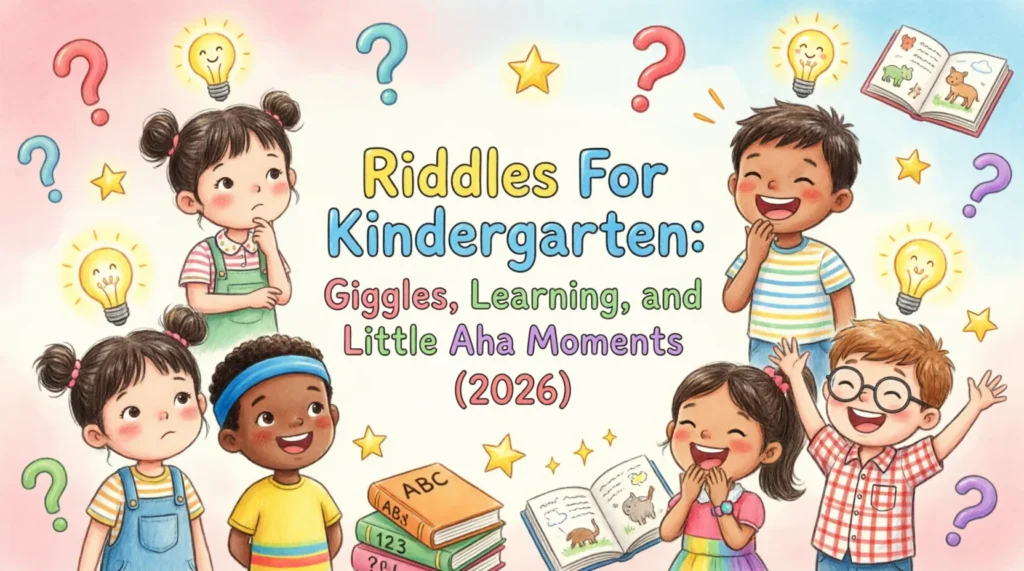
In short, riddles for kindergarten are simple, playful brain teasers designed for young children who are learning language, observation, and problem-solving skills. They are perfect for classrooms, family time, car rides, and early learning activities. Scroll down to discover fun kindergarten-friendly riddles that will spark smiles and curious thinking right away.
Why Riddles For Kindergarten Are More Powerful Than You Think
Kindergarteners are naturally curious. They ask questions all day, notice tiny details, and love discovering how things work. That makes riddles a perfect match for their growing minds.
When you use riddles for kindergarten, you are doing more than entertaining children. You are helping them practice listening, vocabulary, memory, and creative thinking in a way that feels like play rather than work.
Educators and child development researchers often point to puzzles and riddles as valuable tools for strengthening early language skills. The process of hearing clues, making guesses, and finding answers encourages children to think carefully and communicate their ideas.
Studies show that young children who regularly engage in word games and problem-solving activities often build stronger verbal reasoning skills over time. Even a few minutes of riddle fun can turn an ordinary day into a meaningful learning experience.
Riddles are also a global tradition enjoyed across cultures. Children everywhere love the excitement of guessing, laughing, and sharing clever answers with friends and family.
What Makes a Great Riddles For Kindergarten
A great kindergarten riddle is simple enough to understand but surprising enough to make children think. The goal is not to confuse young learners. Instead, it is to guide them toward a satisfying little discovery.
The best riddles for kindergarten use familiar topics such as animals, colors, food, weather, toys, and classroom objects. Young children learn best when they can connect clues to things they already know from everyday life.
Another important ingredient is the “aha moment.” A kindergarten riddle should make children smile when they hear the answer. The clues should seem tricky at first but make perfect sense once the answer is revealed.
Clean and age-appropriate humor matters too. Kindergarten children respond well to playful ideas, silly situations, and imaginative thinking. They do not need complicated wordplay or advanced logic puzzles to have fun.
When you choose riddles designed specifically for young learners, you create opportunities for confidence-building. Every correct answer gives children a small success that encourages them to keep learning and exploring.
Riddles For Kindergarten: 20 Riddles to Try Right Now
Riddles About Animals
Riddle: I say “moo” and live on a farm. I give milk and like green grass. What am I?
Answer: A cow
Riddle: I hop instead of walk and have long ears. What am I?
Answer: A rabbit
Riddle: I am yellow, fluffy, and say “peep peep.” What am I?
Answer: A chick
Riddle: I have a long neck and like tall trees. What am I?
Answer: A giraffe
Riddle: I waddle when I walk and love swimming. What am I?
Answer: A duck
Riddle: I spin a web but do not use a computer. What am I?
Answer: A spider
Riddle: I have black and white stripes and look like a horse. What am I?
Answer: A zebra
Riddles About School and Learning
Riddle: I help you draw, but I get shorter as you use me. What am I?
Answer: A pencil
Riddle: I have many pages but I am not a tree. You read me every day. What am I?
Answer: A book
Riddle: Teachers write on me and students look at me. What am I?
Answer: A whiteboard
Riddle: I carry your crayons, papers, and lunch to school. What am I?
Answer: A backpack
Riddle: I tell you when school starts and when recess begins. What am I?
Answer: A clock
Riddle: I erase pencil marks when mistakes happen. What am I?
Answer: An eraser
Riddle: You sit on me while learning in class. What am I?
Answer: A chair
Riddles About Everyday Things
Riddle: I shine in the sky during the day and help keep you warm. What am I?
Answer: The sun
Riddle: I fall from clouds and make puddles. What am I?
Answer: Rain
Riddle: I am cold, sweet, and come in many flavors. What am I?
Answer: Ice cream
Riddle: I have wheels but I am not a bicycle. I take people places. What am I?
Answer: A car
Riddle: You wear me on your feet when you go outside. What am I?
Answer: Shoes
Riddle: I light up a room when it gets dark. What am I?
Answer: A lamp
🎯 More riddles for kindergarten: Easy, Medium, and Hard Challenges
Easy Riddles for riddles for kindergarten (Grades 6–7)
These easy challenges are perfect for building confidence with simple observation and clever wordplay.
Riddle: I can be opened, but I am not a door. I can tell stories without speaking. What am I? Answer: A book.
Riddle: I travel across every classroom without taking a single step. What am I? Answer: Sound.
Riddle: I become shorter every time someone uses me, but I still help people learn. What am I? Answer: A pencil.
Riddle: I have corners but never complain when I’m folded. What am I? Answer: A piece of paper.
Riddle: You can erase me without touching me, simply by remembering the right answer. What am I? Answer: A mistake.
Riddle: I always point in one direction, but I never leave the page. What am I? Answer: An arrow.
Medium Riddles for riddles for kindergarten (Grades 7–8)
These medium riddles are best for students ready to connect clues and think through more than one step.
Riddle: Three friends each read one different book. Ava finished before Ben. Ben finished before Leo. Who finished last? Answer: Leo.
Riddle: Every desk in a row has one notebook. If two more desks are added and every desk still has exactly one notebook, what must happen? Answer: Two more notebooks are needed.
Riddle: You have five apples and give away two. How many apples did you have to give away? Answer: Two.
Riddle: A classroom clock is correct at noon but gains one minute every hour. After three hours, how many minutes fast is it? Answer: Three minutes.
Riddle: A picture has four sides. Cut it once straight across the middle. How many pieces do you have? Answer: Two pieces.
Riddle: Maya wrote every even number from 2 through 10. How many numbers did she write? Answer: Five.
Riddle: You walk into the library with one bookmark and leave with three. Without borrowing any extras, how is that possible? Answer: You found two bookmarks inside the books you already had.
Hard Riddles for riddles for kindergarten (Grade 8 and Up)
These harder riddles reward careful thinking, clever reasoning, and looking beyond the obvious.
Riddle: I become more valuable after I am broken, but only if I was a promise. What am I? Answer: Trust that can be rebuilt.
Riddle: Two students see the same answer, but only one is correct. The answer didn’t change—what did? Answer: They were answering different questions.
Riddle: I grow larger every time you remove something from me. What am I? Answer: A hole.
Riddle: The more carefully you examine me, the less you notice everything else around you. What am I? Answer: Your focus.
Riddle: I can fill an entire room even though I have no weight. What am I? Answer: Light.
Riddle: Yesterday follows me, tomorrow waits for me, but I exist only once. What am I? Answer: Today.
Riddle: I disappear the moment everyone agrees they have found me. What am I? Answer: A mystery.
Using different difficulty levels helps every learner experience success while still feeling challenged. Try letting students or family members choose their own level first, then encourage them to “level up” after solving a few correctly.
📚 Subject-Specific riddles for kindergarten: Math, Science, and More
Math Riddles for riddles for kindergarten
These math-themed riddles strengthen number sense, patterns, and logical thinking while keeping learning fun.
Riddle: I have four equal sides and four right angles. Who am I? Answer: A square.
Riddle: Double me and then add four. The answer is fourteen. What number am I? Answer: Five.
Riddle: I come after 49 and before 51. What number am I? Answer: 50.
Riddle: I have three sides and three corners, no matter how big or small I become. What am I? Answer: A triangle.
Riddle: Count by fives from 5. I am the fourth number you say. What number am I? Answer: 20.
Science Riddles for riddles for kindergarten
These science riddles encourage curiosity about the natural world with simple, familiar concepts.
Riddle: Plants use me to make their food, and I come from the sky during the day. What am I? Answer: Sunlight.
Riddle: I can be solid, liquid, or gas, but I am still the same substance. What am I? Answer: Water.
Riddle: I pull everything toward Earth without making a sound. What am I? Answer: Gravity.
Riddle: I help you breathe, but you cannot usually see me. What am I? Answer: Air.
Riddle: Bees visit me for nectar, and I help many plants make seeds. What am I? Answer: A flower.
Language Riddles for riddles for kindergarten
These language riddles build vocabulary, spelling, and word awareness through playful thinking.
Riddle: Remove my first letter and I still sound exactly the same. I am a place where students learn. What word am I? Answer: School.
Riddle: I always begin a sentence when I stand at the front. What am I? Answer: A capital letter.
Riddle: I separate ideas instead of joining them together. What punctuation mark am I? Answer: A period.
Riddle: I describe a noun and make writing more colorful. What part of speech am I? Answer: An adjective.
Riddle: Rearrange the letters in “LISTEN” and you can become very quiet. What new word do you get? Answer: Silent.
Use one subject riddle as a quick warm-up before introducing a new lesson.
Turn riddles into exit tickets to review important concepts at the end of class.
Divide students into small groups and let them solve subject riddles together before discussing the reasoning behind each answer.
How to Use Riddles For Kindergarten for Maximum Fun (or Impact)
Start the morning with a riddle during circle time.
Use a riddle as a transition between activities.
Turn car rides into guessing games.
Add riddles to birthday parties or playdates.
Use them at the dinner table to encourage conversation.
Let children create their own riddles after solving a few.
When you use riddles regularly, children begin listening more carefully and thinking more creatively. You may notice that they become eager to ask questions and explain their ideas.
For teachers, riddles can be excellent warm-up activities before lessons. For parents, they offer a quick way to connect with children without needing special materials or preparation. A simple riddle can transform a few spare minutes into a fun learning moment.
Tips for Sharing Riddles For Kindergarten Without Spoiling the Fun
Give children enough time to think before revealing the answer. Young learners often need a little extra time to process clues and make connections.
If a child guesses incorrectly, celebrate the effort. You can respond with, “That’s a great guess!” before offering another clue.
Watch your audience and adjust the difficulty as needed. If your kindergarteners solve every riddle instantly, add slightly more challenging clues. If they seem stuck, simplify the hints.
Most importantly, keep the mood playful. The goal is curiosity and laughter, not perfection. When children feel safe guessing, they become more willing to participate and learn.
Bonus: Riddles For Kindergarten That Stump Everyone
These bonus riddles are still kindergarten-friendly, but they require a little more thinking. They are perfect when your young puzzlers are ready for an extra challenge.
Riddle: I have a face but no eyes, nose, or mouth. What am I?
Answer: A clock
Riddle: The more you dry with me, the wetter I get. What am I?
Answer: A towel
Riddle: I go up when rain comes down. What am I?
Answer: An umbrella
Riddle: I have keys but cannot open a door. What am I?
Answer: A piano
Riddle: I can be cracked, made, told, and played. What am I?
Answer: A joke
Riddle: I follow you around on sunny days but disappear at night. What am I?
Answer: Your shadow
Riddle: I have hands but cannot clap. What am I?
Answer: A clock
FAQs About Riddles For Kindergarten
What age group are riddles for kindergarten best for?
Most kindergarten riddles work best for children between ages 4 and 6. The clues are designed to match the vocabulary, experiences, and thinking skills common at this stage of development.
How hard should kindergarten riddles be?
Kindergarten riddles should be easy enough to solve with some thought but not so obvious that there is no challenge. A good rule is that children should be able to figure out many answers after hearing one or two clues.
Can riddles for kindergarten be used in the classroom?
Yes. Teachers often use riddles during circle time, literacy lessons, morning meetings, and transition periods. They help students practice listening, critical thinking, and communication skills in an engaging way.
What makes kindergarten riddles different from regular riddles?
Kindergarten riddles focus on familiar objects, animals, and experiences. The language is simpler, the clues are shorter, and the answers are easier for young learners to understand.
Are riddles for kindergarten good for language development?
Absolutely. Many educators use riddles because they encourage children to learn new words, describe objects, understand clues, and express their ideas. These activities support early communication and literacy growth in a fun setting.
Final Thoughts: Keep the Fun Going with Riddles For Kindergarten
Riddles for kindergarten combine learning and laughter in a way that few activities can. They encourage children to listen closely, think creatively, and enjoy the excitement of discovering answers.
Whether you are a parent, teacher, caregiver, or older sibling, you can use these riddles almost anywhere. A few minutes of guessing and giggling can brighten a classroom, a family dinner, or a long car ride.
As children become more familiar with riddles, they often start creating their own. That is when you really see imagination, vocabulary, and confidence begin to grow.
The best part is that every riddle opens the door to another question, another laugh, and another wonderful moment of learning together.
Frequently Asked Questions
What are the benefits of using riddles for kindergarteners?▼
Riddles for kindergarteners help develop language, observation, and problem-solving skills in a playful manner. They encourage listening, vocabulary growth, memory retention, and creative thinking while ensuring that learning feels like fun rather than work.
How can riddles support early learning activities?▼
Riddles can be integrated into various settings such as classrooms, family time, and car rides to enhance learning experiences. They spark curiosity and laughter, making them ideal for engaging young minds in meaningful ways.
What makes a riddle suitable for kindergarteners?▼
A suitable riddle for kindergarteners is simple, familiar, and surprising enough to inspire thoughtful guesses. It should connect to everyday life themes like animals and colors, ensuring that children can relate to the clues and enjoy the ‘aha moment’ when they find the answer.
Why are riddles considered valuable tools for language development?▼
Educators and researchers highlight that riddles and puzzles strengthen verbal reasoning skills in young children. Engaging with riddles helps children practice communication and critical thinking by encouraging them to listen carefully and articulate their ideas.
What kinds of topics do great kindergarten riddles cover?▼
Great kindergarten riddles typically cover familiar topics such as animals, food, colors, toys, and classroom objects. These themes resonate with children’s everyday experiences, making it easier for them to connect the clues to their knowledge.
How can parents and educators create a fun riddle experience?▼
Parents and educators can create a fun riddle experience by choosing age-appropriate riddles that incorporate playful humor and imaginative thinking. Encouraging children to guess and share their answers fosters a positive environment where learning is celebrated.
What are some examples of kindergarten-friendly riddles?▼
Examples of kindergarten-friendly riddles include: ‘I say
Samantha Nguyen has been a literary enthusiast for over 15 years, combining her love for language and pedagogy to craft engaging riddles and puzzles. With a background in Education and Linguistics, Samantha has dedicated her career to making learning fun and accessible to children of all ages. She specializes in seasonal riddles, often weaving in cultural and historical themes to enrich classroom experiences during holidays and special events. Samantha is passionate about crafting puzzles that challenge young minds while also entertaining the whole family. Her riddles are designed to stimulate critical thinking, ensuring they remain a hit during family gatherings and road trips. She joined FunRiddleZone to reach a wider audience and share her passion for creative educational content.