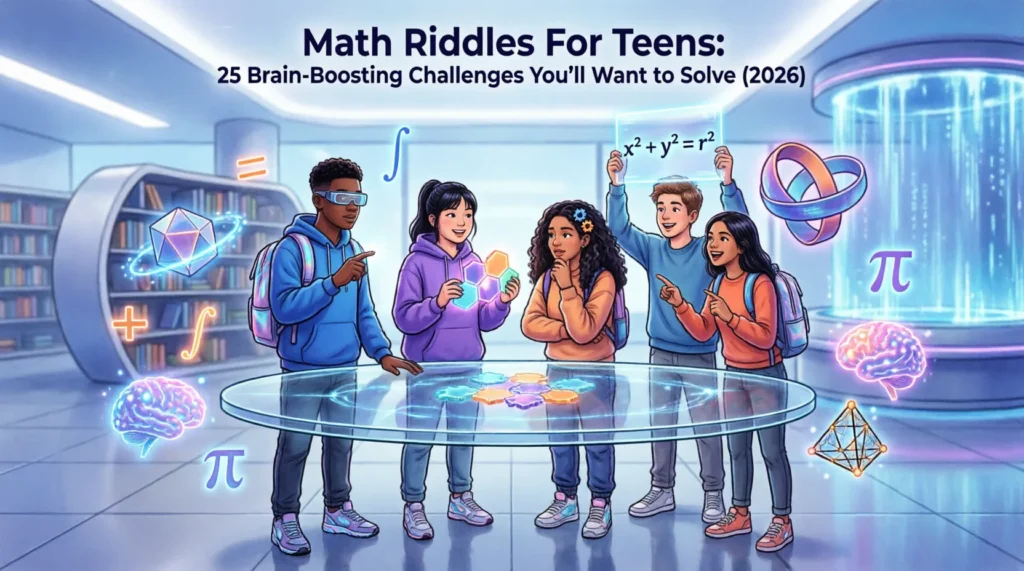
In short, math riddles for teens combine numbers, logic, patterns, and creative thinking into fun challenges that are both entertaining and educational. They’re perfect for students, teachers, parents, and anyone who enjoys stretching their brain while having a good time. Scroll down and see how many you can solve before checking the answers!
Looking for more? Check out our full Riddles For Teens hub for even more categories, difficulty levels, and a complete FAQ.
Why Math Riddles for Teens Are More Powerful Than You Think
Math isn’t just about formulas and homework. When math appears in the form of a clever riddle, it becomes a game that challenges your mind in exciting ways.
Math riddles for teens encourage critical thinking, pattern recognition, and problem-solving skills. Instead of memorizing answers, you learn how to analyze clues, test ideas, and think from different angles.
Educators and cognitive scientists often highlight puzzles as valuable tools for strengthening reasoning skills. The process of solving a riddle helps your brain create connections between logic, creativity, and memory.
Studies show that students who regularly engage with logic-based puzzles often develop stronger analytical thinking skills and greater confidence when tackling challenging problems.
Another reason these riddles work so well is that they make learning feel less like work. Whether you’re competing with friends, warming up before class, or looking for a fun brain break, math riddles can turn ordinary moments into rewarding mental challenges.
Riddles are also part of a global tradition of playful learning. Across cultures, people have used puzzles and brain teasers to teach reasoning, sharpen observation, and bring groups together through friendly competition.
What Makes a Great Math Riddle for Teens
A great math riddle sits in the sweet spot between easy and impossible. If the answer appears instantly, there’s no challenge. If it’s too difficult, most people lose interest before reaching the solution.
The best math riddles for teens often include a small twist. You may think the problem is about arithmetic when it’s actually testing your observation skills. Sometimes the trick lies in wording, while other times it hides in a pattern you didn’t notice at first.
The most satisfying riddles create an “aha moment.” That’s the instant when everything suddenly clicks and the answer becomes obvious. Those moments are memorable because your brain enjoys discovering hidden connections.
Strong riddles also stay age-appropriate while remaining clever. Teen audiences appreciate challenges that respect their intelligence without requiring advanced college-level mathematics. A mix of logic, number patterns, estimation, and creative thinking usually works best.
Most importantly, great riddles reward curiosity. They encourage you to keep exploring possibilities rather than giving up after the first wrong guess.
Math Riddles for Teens: 25 Riddles to Try Right Now
Number Challenges
Riddle: I am a two-digit number. My digits add up to 9. If you reverse my digits, the new number is 27 greater than me. What number am I?
Answer: 36
Riddle: If two numbers multiply to 36 and add to 13, what are they?
Answer: 4 and 9
Riddle: What number becomes half of itself when you remove the first digit?
Answer: 10
Riddle: A number is divisible by 2, 3, and 6. It is greater than 20 but less than 30. What number could it be?
Answer: 24
Riddle: I am an odd number. Remove one letter from my name and I become even. What number am I?
Answer: Seven
Riddle: Which has more value: three quarters or six eighths?
Answer: They are equal.
Riddle: A clock shows 3:15. What is the angle between the hour and minute hands?
Answer: 7.5 degrees
Riddle: What is the smallest positive number that is evenly divisible by both 4 and 6?
Answer: 12
Pattern and Logic Riddles
Riddle: What comes next in this sequence: 2, 6, 12, 20, 30, ?
Answer: 42
Riddle: I increase but never subtract. Add me again and again and I grow quickly. What am I?
Answer: Multiplication
Riddle: A farmer has 17 sheep. All but 9 run away. How many are left?
Answer: 9
Riddle: If five machines make five gadgets in five minutes, how long would 100 machines take to make 100 gadgets?
Answer: Five minutes
Riddle: Two fathers and two sons go fishing and catch three fish. Each person gets one fish. How is that possible?
Answer: They are a grandfather, father, and son.
Riddle: Which number should replace the question mark? 1, 4, 9, 16, 25, ?
Answer: 36
Riddle: You see me once in a minute, twice in a moment, but never in a thousand years. What am I?
Answer: The letter M
Riddle: What mathematical symbol can make 5 greater than 55?
Answer: Move the line from one 5 to create 5 > 5.
School and Everyday Math Riddles
Riddle: A classroom has 24 students. Half are wearing sneakers. How many students are wearing sneakers?
Answer: 12
Riddle: You buy three notebooks for $2 each and one pen for $4. How much do you spend?
Answer: $10
Riddle: A bus has 12 passengers. Five get off and three get on. How many passengers are on the bus now?
Answer: 10
Riddle: If a pizza is cut into 8 slices and you eat 3, what fraction remains?
Answer: 5/8
Riddle: A student reads 15 pages each day. How many pages will they read in 7 days?
Answer: 105
Riddle: I am the result when 9 is multiplied by itself. What am I?
Answer: 81
Riddle: Four friends split 20 cookies equally. How many cookies does each friend get?
Answer: 5
Riddle: A rectangle has a length of 8 and a width of 5. What is its area?
Answer: 40
Riddle: If today is Tuesday, what day will it be 14 days from now?
Answer: Tuesday
🎯 More math riddles for teens: Easy, Medium, and Hard Challenges
Easy Riddles for math riddles for teens (Grades 6–7)
These easy challenges are perfect for students in Grades 6–7 who are building confidence with simple observation, number sense, and fun math thinking.
Riddle: I am an even number. If you divide me by 2, you get 6. What number am I? Answer: 12
Riddle: Which is heavier: 1 kilogram of feathers or 1 kilogram of books? Answer: Neither—they both weigh 1 kilogram.
Riddle: I have three sides and three corners. What shape am I? Answer: A triangle
Riddle: Add me to myself and you get 18. What number am I? Answer: 9
Riddle: I am the only number that has the same number of letters as my value. What number am I? Answer: Four
Riddle: Which clock shows the correct time only twice each day without ever moving? Answer: A stopped clock
Medium Riddles for math riddles for teens (Grades 7–8)
These medium-level riddles are great for Grades 7–8 and encourage students to think through patterns, logic, and multiple steps.
Riddle: A number doubled is 16 more than half of itself. What number is it? Answer: 32
Riddle: A rectangle has a perimeter of 20 units. One side is 6 units long. How long is the other side? Answer: 4 units
Riddle: I am between 40 and 50. My digits add up to 9, and I am divisible by 3. What number could I be? Answer: 45
Riddle: Mia has 24 stickers. She gives one-fourth to a friend and then buys 5 more. How many stickers does she have now? Answer: 23
Riddle: I am a two-digit number. My tens digit is twice my ones digit, and my digits add up to 9. What number am I? Answer: 63
Riddle: Three friends split 27 marbles equally. How many marbles does each friend get? Answer: 9
Hard Riddles for math riddles for teens (Grade 8 and Up)
These harder challenges are best for Grade 8 and up, using abstract thinking, careful reasoning, and clever mathematical ideas.
Riddle: I am a number that stays exactly the same when multiplied by 1, divided by 1, or added to 0. What am I demonstrating? Answer: The identity property
Riddle: I am a two-digit number. Reverse my digits and I become 27 less than before. The digits differ by 3. What number am I? Answer: 63
Riddle: Two consecutive odd numbers multiply to 143. What are they? Answer: 11 and 13
Riddle: A square and a triangle together have 7 sides. How many sides does each shape have? Answer: The square has 4 sides, and the triangle has 3.
Riddle: If every side of a square doubles, how many times larger is its area? Answer: Four times larger
Riddle: A number leaves a remainder of 1 when divided by 2, 3, and 4. What is the smallest positive number that works? Answer: 13
Riddle: I am greater than 50 but less than 70. I am divisible by both 3 and 5, but not by 2. What number am I? Answer: 60
Using difficulty levels helps every learner find a challenge that feels achievable while still encouraging growth. Teachers and parents can start with easier riddles to build confidence, then gradually introduce tougher puzzles as problem-solving skills improve.
📚 Subject-Specific math riddles for teens: Math, Science, and More
Math Riddles for math riddles for teens
These math-themed riddles help students practice patterns, numbers, and reasoning while having fun.
Riddle: I am a number. Multiply me by 5 and subtract 10 to get 40. What am I? Answer: 10
Riddle: Which shape has four equal sides and four right angles? Answer: A square
Riddle: What comes next: 1, 4, 9, 16, 25, __? Answer: 36
Riddle: I have 12 edges, 8 corners, and 6 faces. What solid shape am I? Answer: A cube
Riddle: If two angles each measure 45 degrees, what do they make together? Answer: A right angle (90 degrees)
Science Riddles for math riddles for teens
These science riddles connect everyday observations to biology, chemistry, physics, and earth science concepts.
Riddle: I help plants make food using sunlight, water, and carbon dioxide. What process am I? Answer: Photosynthesis
Riddle: I pull everything toward Earth’s surface, but you cannot see me. What am I? Answer: Gravity
Riddle: I can be solid, liquid, or gas, yet I am still the same substance. What am I? Answer: Water
Riddle: I protect Earth from many harmful rays coming from the Sun. What part of the atmosphere am I? Answer: The ozone layer
Riddle: I am the force that keeps the Moon traveling around Earth instead of flying away. What am I? Answer: Gravity
Language Riddles for math riddles for teens
These language riddles encourage students to think about letters, vocabulary, grammar, and creative wordplay.
Riddle: Remove the first letter from the word “smile,” and I become something you wear. What am I? Answer: Mile? Wait—none. Instead: Remove the first letter from “glove” and you get “love.” What remains? Love
Riddle: Which punctuation mark asks a question without speaking? Answer: A question mark
Riddle: What word becomes shorter when you add two letters to it? Answer: Short (adding “er” makes “shorter”)
Riddle: I begin every sentence but never appear in the alphabet. What am I? Answer: A capital letter
Riddle: What English word has three consecutive double letters? Answer: Bookkeeper
Use one or two riddles as a warm-up to get students thinking before introducing a new lesson.
Turn riddles into exit tickets by asking students to explain how they found each answer.
Divide the class into small groups and let teams solve subject-themed riddles together to encourage discussion and collaborative problem-solving.
How to Use Math Riddles for Maximum Fun
Start class with a daily riddle challenge.
Use them during road trips to keep everyone engaged.
Turn them into friendly competitions with friends.
Add them to study groups as warm-up exercises.
Use them at family dinners to spark conversation.
Challenge yourself to solve one before checking the answer.
When you use math riddles for teens regularly, you’ll notice that solving them becomes faster and more intuitive. Your brain begins looking for patterns automatically, which can help in both academics and everyday problem-solving.
You can also increase the challenge by setting time limits or encouraging players to explain how they reached their answers. Sometimes the reasoning process is even more interesting than the solution itself.
Tips for Sharing Math Riddles Without Spoiling the Fun
Give people enough time to think before revealing the answer. A few extra seconds can make the difference between frustration and a satisfying breakthrough.
Watch how your audience responds. If your friends solve every riddle instantly, increase the difficulty. If they seem stuck, offer a small hint instead of giving away the solution.
Encourage creative guesses. Even incorrect answers can lead to interesting discussions and help people think in new ways.
Mix easy and difficult riddles together. That balance keeps everyone engaged and gives each person a chance to experience a successful solve.
Most importantly, celebrate clever thinking rather than speed. The goal is to enjoy the challenge, not just finish first.
Bonus: Math Riddles for Teens That Stump Everyone
These bonus riddles are designed to be a little trickier. They require careful reading, creative reasoning, and a willingness to question your first assumption.
Riddle: A bat and a ball cost $1.10 together. The bat costs $1 more than the ball. How much does the ball cost?
Answer: 5 cents
Riddle: If you multiply me by any other number, the answer will always remain me. What number am I?
Answer: Zero
Riddle: A lily pad doubles in size every day. It covers a pond in 20 days. On what day was it half the pond?
Answer: Day 19
Riddle: What three positive numbers give the same result when multiplied and added together?
Answer: 1, 2, and 3
Riddle: I am a number. Double me and add 10. The result is 30. What am I?
Answer: 10
Riddle: A book and a notebook cost $15 total. The book costs $9 more than the notebook. How much is the notebook?
Answer: $3
Riddle: What is the next number? 1, 11, 21, 1211, 111221, ?
Answer: 312211
Riddle: A rope ladder hangs over the side of a boat. The rungs are one foot apart. The tide rises three feet. How many additional rungs become submerged?
Answer: None. The boat rises with the tide.
FAQs About Math Riddles for Teens
What age group are math riddles for teens best for?
Most math riddles for teens work well for ages 13 to 19. The ideal difficulty level challenges logical thinking without requiring advanced mathematics, making them suitable for middle school and high school students.
How hard should math riddles for teens be?
The best riddles feel challenging but solvable. If a riddle requires only a few minutes of thinking and leads to a satisfying realization, it’s usually at the right difficulty level for teen audiences.
Can teachers use math riddles in the classroom?
Absolutely. Many educators use riddles as warm-up activities, discussion starters, or enrichment exercises. They help students engage with mathematical thinking in a low-pressure and enjoyable way.
What makes math riddles different from regular riddles?
Math riddles often combine numbers, patterns, logic, and reasoning. While traditional riddles may rely heavily on wordplay, math-based challenges encourage analytical thinking and problem-solving.
Do math riddles actually improve problem-solving skills?
Many educators and cognitive scientists believe they can. Regular puzzle-solving encourages persistence, logical reasoning, pattern recognition, and flexible thinking—all valuable skills both inside and outside the classroom.
Final Thoughts: Keep the Fun Going with Math Riddles for Teens
Math riddles for teens offer much more than a quick challenge. They combine entertainment with learning, helping you sharpen your reasoning skills while having fun.
Whether you’re a student looking for a brain workout, a teacher planning engaging activities, or a parent searching for screen-free entertainment, these riddles provide plenty of opportunities to think creatively.
The more often you practice solving puzzles, the more confident you may become when facing difficult questions in school and everyday life. Small moments of curiosity can grow into powerful habits of problem-solving.
Grab a friend, pick your favorite riddle, and see where one clever question can take you.
Frequently Asked Questions
What are the benefits of solving math riddles for teens?▼
Math riddles for teens enhance critical thinking, pattern recognition, and problem-solving skills. They transform learning into a fun game, making it easier for students to strengthen their analytical abilities and build confidence in tackling challenging problems.
How can math riddles help in a classroom setting?▼
Educators can use math riddles as engaging tools to promote reasoning and collaboration among students. By incorporating these puzzles into lessons, teachers can create a dynamic learning environment that encourages students to think creatively and work together.
What makes a math riddle effective for teens?▼
An effective math riddle strikes a balance between being challenging yet solvable. It often includes clever twists or requires observation skills, ensuring that the experience leads to satisfying ‘aha moments’ rather than frustration.
Are math riddles suitable for all ages of teens?▼
Yes, math riddles can be tailored to be age-appropriate while still being clever enough to engage a teen audience. The riddles in the article respect their intelligence without requiring advanced mathematical knowledge, making them accessible for various skill levels.
Can math riddles be used for group activities?▼
Absolutely! Math riddles can foster friendly competition and teamwork, making them ideal for group activities. They encourage collaboration as participants discuss possible solutions and share insights, enhancing the learning experience.
What types of skills do math riddles help develop?▼
Math riddles help develop a range of skills including logical reasoning, creativity, and memory. Regular engagement with these puzzles can lead to stronger analytical thinking skills and improved problem-solving abilities.
How do math riddles differ from traditional math problems?▼
Math riddles differ from traditional math problems by incorporating elements of creativity and critical thinking rather than just rote memorization. They often present challenges in a playful format that encourages exploration of different approaches to find the solution.
Samantha Nguyen has been a literary enthusiast for over 15 years, combining her love for language and pedagogy to craft engaging riddles and puzzles. With a background in Education and Linguistics, Samantha has dedicated her career to making learning fun and accessible to children of all ages. She specializes in seasonal riddles, often weaving in cultural and historical themes to enrich classroom experiences during holidays and special events. Samantha is passionate about crafting puzzles that challenge young minds while also entertaining the whole family. Her riddles are designed to stimulate critical thinking, ensuring they remain a hit during family gatherings and road trips. She joined FunRiddleZone to reach a wider audience and share her passion for creative educational content.